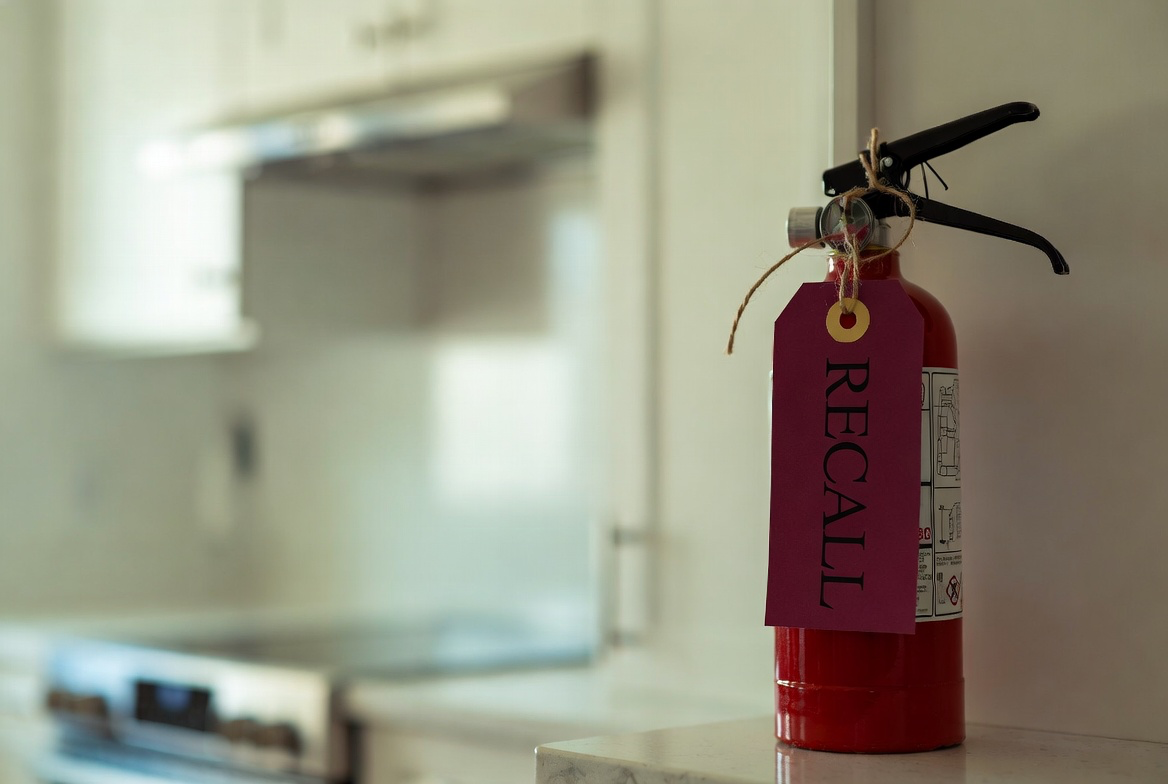
5 Hidden Product Recalls Most Homeowners Never Hear About
The CPSC's own research puts recall participation at around 6%. That means 94 out of 100 owners of a recalled product never act. Below are five of the biggest recalls still sitting in American homes, every stat sourced to the official notice, and a 60-second method for checking your own house.

table of contents
- The quiet problem with product recalls
- Why recall notification fails (the actual numbers)
- 1. Kidde plastic-handle fire extinguishers
- 2. Gree dehumidifiers (13 brand names)
- 3. IKEA Malm and other tip-over dressers
- 4. Samsung top-load washing machines
- 5. Kidde dual-sensor smoke alarms
- How to check every product in your house in 60 seconds
- Where to register and subscribe so the next recall finds you
- Secondhand, inherited, and rental property recalls
- FAQ
The quiet problem with product recalls
Every Thursday morning, the Consumer Product Safety Commission posts a fresh batch of recalls. Some affect a few thousand units. Some affect tens of millions. Almost none of them make the evening news for more than one cycle. For how to search the CPSC database and recalls.gov from your phone, start with our CPSC recalls app guide.
The reason most homeowners miss them is structural, not personal. Manufacturers can only contact you if you mailed in the warranty card or registered the product online, and registration rates for most consumer products sit in the single digits. Buy a dishwasher second-hand, inherit a fire extinguisher from a previous homeowner, or pick up a dresser at an estate sale and the maker has no way to find you. The recall goes out. You never hear about it. If a recalled product already caused damage, documentation matters for insurance too. See how to file a home insurance claim for what to photograph and when to call your adjuster.
Below are five recalls that have quietly stayed in millions of American homes. Every unit count, hazard description, and CPSC notice number is sourced to the official recall page. The remedies are still active. Refunds, repairs, and replacements remain available. The hard part is knowing the recall exists.
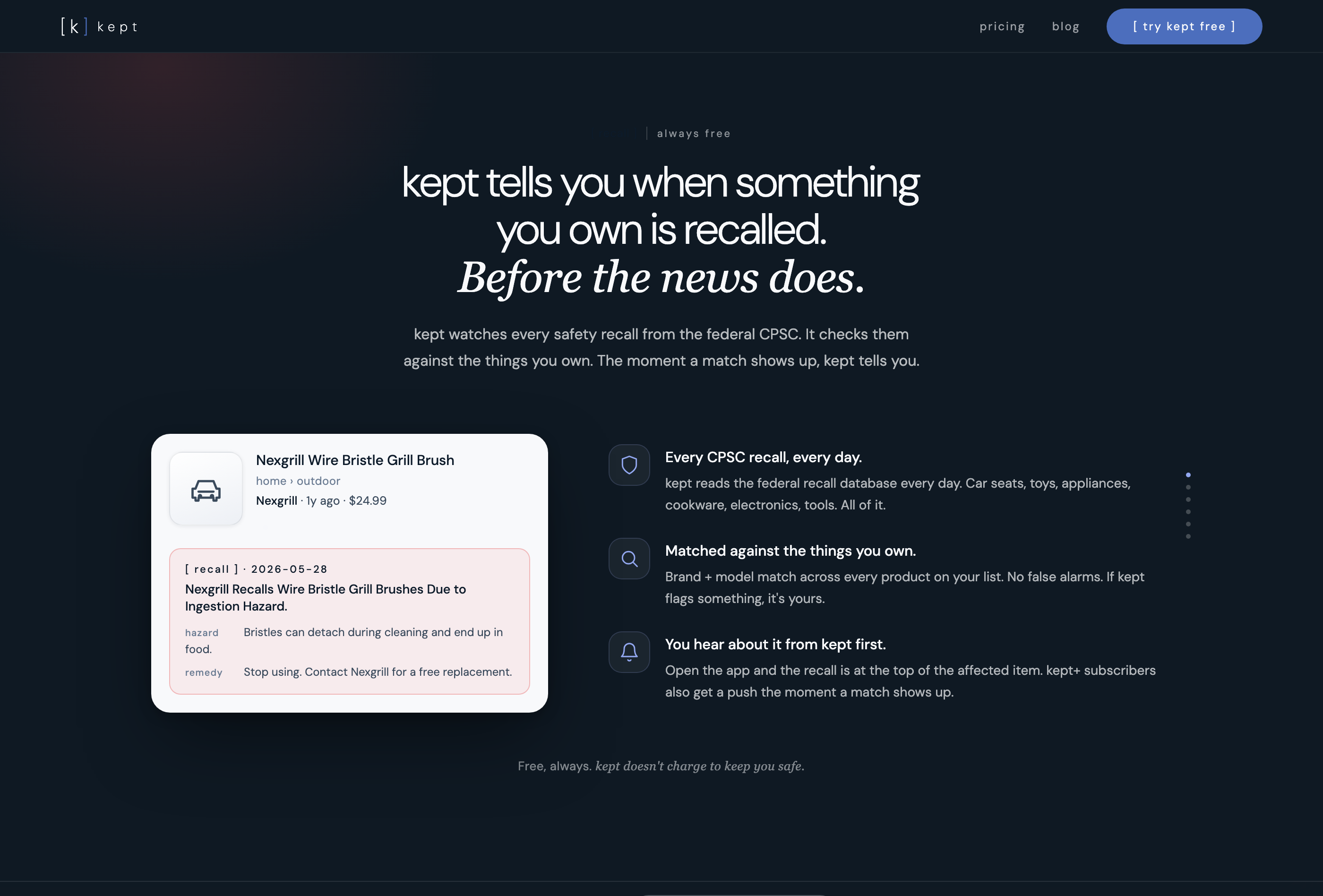
what a recall alert looks like inside kept. the item is flagged automatically the moment the CPSC posts a matching notice.
Why recall notification fails (the actual numbers)
The 6% in the headline comes from the CPSC itself. The rest of the numbers come from consumer surveys and industry data, and they are worse than most people realize.
- Around 6% participation across all recalls. Recall effectiveness, defined as the percentage of affected consumers who actually return, repair, or stop using the product, sits at roughly 6% for general consumer products. The CPSC reported that figure at its 2017 recall effectiveness workshop, based on recalls closed between fiscal 2013 and 2016, and the Senate Commerce Committee cited it again in 2021. For products under $20 it was closer to 4%. No newer official average has been published.
- Most people never register, and few know they bought a recalled product. In a Consumer Reports national poll, only about one in five U.S. adults knew they had bought a recalled product (other than a car) in the previous three years, and more than half said they never or rarely fill out product registration cards.
- Older products do worse. Cars are the best-tracked benchmark we have. The Alliance for Automotive Innovation puts recall repair completion at about 83% for newer vehicles, falling to roughly 44% for cars five to ten years old and lower still past ten years. Refrigerators, dehumidifiers, and dressers are not registered with the same rigor as cars, so the dropoff for household goods is steeper.
- Second-hand owners are invisible. When a recalled product changes hands, the manufacturer's notification path breaks completely. There is no central registry of who owns what dresser, dehumidifier, or smoke alarm in the United States.
That is the gap the rest of this post is about. Five recalls below, two practical sections at the end on how to plug it.
1. Kidde plastic-handle fire extinguishers
In November 2017, Kidde recalled roughly 37.8 million plastic-handle fire extinguishers sold in the United States, plus 2.7 million sold in Canada, after about 391 reports of extinguishers that failed to discharge or whose nozzles detached, including a 2014 death in a car fire where responders couldn't get one to work. The recall covers 134 plastic-handle models made between January 1973 and August 2017, plus push-button Pindicator models. The official notice is CPSC Recall 18-022.
recall 18-022 at a glance
- Product
- Kidde plastic-handle fire extinguishers, 134 models
- Units (US)
- ~37.8 million
- Made
- January 1973 – August 2017
- Hazard
- Handle can clog or nozzle can detach when pin is pulled
- Incidents
- ~391 failure reports, 1 death, ~16 injuries, ~91 reports of property damage
- Remedy
- Free replacement extinguisher
- Notice
- cpsc.gov/Recalls/2018/Kidde
That date range matters. If your house was built any time in the last fifty years, an extinguisher in the garage or kitchen pantry is a candidate. Pull it down and look at the handle. If it is black or red plastic and not metal, check the model number on the label against the Kidde recall page. The replacement is free and the manufacturer does not require proof of purchase.
Why it slipped past most homeowners: fire extinguishers are bought once, hung on a wall, and forgotten. They do not get registered. The 2017 recall got one news cycle. The same extinguisher is still hanging in plenty of houses nearly nine years later, on the wall, useless.
kept is reader-supported. When you buy through links on this page we may earn a small commission, at no extra cost to you. It never changes what we recommend.
2. Gree dehumidifiers (13 brand names)
If there is a single category that proves the recall system does not reach homeowners, it is dehumidifiers. Gree Electric Appliances recalled about 2.2 million dehumidifiers under 12 brand names in September 2013, added about 350,000 GE-brand units in 2014, reannounced in 2014 and 2016, and in August 2023 recalled another 1.56 million. By the 2016 reannouncement there were about 450 fires and more than $19 million in property damage, and the CPSC says four deaths in house fires may be tied to recalled units, according to the agency's 2023 stop-use warning.
gree dehumidifier recall family
- Brand names
- Danby, De'Longhi, Fedders, Fellini, Frigidaire, GE, Gree, Kenmore, Norpole, Premiere, Seabreeze, SoleusAir, SuperClima
- Units (US)
- ~4 million across the 2013–2014 and 2023 recalls
- Sold at
- Home Depot, Lowe's, Walmart, Costco, Sam's Club, Sears
- Hazard
- Overheats, smokes, catches fire
- Incidents
- ~450 fires and $19M+ property damage by 2016; 4 deaths the CPSC says may be linked
- Remedy
- Full refund
- Notices
- 2017 reannouncement, 2023 warning
The model is on a label on the back of the unit. Find it, search the brand and model at cpsc.gov/recalls, and if the unit is on the list, unplug it now. The remedy is a full refund: contact Gree at greedehumidifierrecall.com or (866) 853-2802. In 2021 Gree and its Hong Kong subsidiary agreed to pay $91 million for failing to tell U.S. regulators about the hazard, which tells you how long these units were known to be a problem.
kept checks your saved items against active recall databases so the hidden ones find you instead.
[ try kept free ]3. IKEA Malm and other tip-over dressers
In June 2016, IKEA recalled 29 million MALM and other chests and dressers in the United States (about 8 million MALM units and 21 million other models) after children were crushed when the units tipped over. In November 2017 the recall was reannounced after an eighth child death, with the U.S. unit count revised to about 17.3 million. By then IKEA had received 186 tip-over reports involving MALM units, including 91 injuries to children. The original notice is CPSC Recall 16-204.
recall 16-204 at a glance
- Product
- IKEA Malm and similar chests and dressers
- Units (US)
- ~29 million at recall; revised to ~17.3 million in 2017
- Sold
- 2002 – 2016
- Hazard
- Tips over if not anchored to wall
- Incidents
- 8 child deaths; 186 MALM tip-over reports with 91 child injuries (as of 2017)
- Remedy
- Full refund or free anchor kit and in-home installation
- Notice
- cpsc.gov/Recalls/2016/IKEA-Malm
The Malm is not the only one. The CPSC's Anchor It campaign covers tip-over recalls from Walmart Mainstays, South Shore, Ameriwood, Hodedah, and most other budget furniture brands. The STURDY Act, signed in December 2022, made a tougher stability standard for clothing storage units mandatory from September 2023, but units sold before then are still in homes by the tens of millions.
If you own a tall dresser bought in the last twenty years and it is not bolted to the wall, treat it as a recall candidate. Anchor kits are free from IKEA for Malm units, inexpensive at any hardware store for everything else, and take about ten minutes to install. While the dresser is pulled out from the wall, this is also a good moment to check the appliance lifespans guide for when to replace the rest of your house.
4. Samsung top-load washing machines
On November 4, 2016, Samsung recalled 2.8 million top-load washing machines after 733 reports of excessive vibration or the top of the machine detaching from the chassis during the high-speed spin cycle. Nine injuries were reported, including a broken jaw and an injured shoulder. The recall covered 34 models manufactured between March 2011 and November 2016. The notice is CPSC Recall 17-028.
recall 17-028 at a glance
- Product
- Samsung top-load washing machines, 34 models
- Units (US)
- ~2.8 million
- Manufactured
- March 2011 – November 2016
- Hazard
- Top can detach during high-speed spin
- Incidents
- 733 reports of vibration or top detachment, 9 injuries
- Remedy
- Free in-home repair, rebate toward a new washer, or full refund (if purchased within 30 days of recall)
- Notice
- cpsc.gov/Recalls/2016/Samsung
The remedy is still available years later. If your house came with a Samsung top-loader and you are not sure when it was bought, the model and serial are on a sticker inside the lid or on the back. Check it before you run another bedsheets cycle. Samsung's top-load washer recall page checks model numbers, or call the number in the notice, 866-264-5636. Until the fix is done, the CPSC says to wash bedding and bulky or water-resistant items only on the delicate or waterproof cycle, which spins slower.
While the top-loader gets the headlines, washers have a long history of leaks and water damage when hoses fail. Recall or not, knowing the model number makes every future repair, claim, and parts order faster.
5. Kidde dual-sensor smoke alarms
In March 2018, Kidde recalled about 452,000 dual-sensor smoke alarms (models PI2010 and PI9010) sold in the United States, plus 40,000 in Canada, because a yellow protective cap, meant to be removed during manufacturing, was sometimes left covering one of the two smoke sensors. The alarm appears to work. The test button beeps, the LED blinks. It does not actually sense smoke. The official notice is CPSC Recall 18-128.
recall 18-128 at a glance
- Product
- Kidde dual-sensor smoke alarms, models PI2010 and PI9010
- Units (US)
- ~452,000
- Sold
- September 2016 – January 2018 at Home Depot, Menards, Walmart, Amazon
- Date codes
- 2016 Sep 10 through 2017 Oct 13
- Hazard
- Yellow cap covers smoke sensor, alarm cannot detect fire
- Remedy
- Free replacement alarm
- Notice
- cpsc.gov/Recalls/2018/Kidde-Smoke
That is the worst kind of recall, because the product looks fine until the moment it has to save someone. Most homeowners never check. Pull each alarm down once and read the model number and date code on the back. If it's a PI2010 or PI9010 dated 2016 Sep. 10 through 2017 Oct. 13, look through the opening on the side for a yellow cap. Don't open the case or try to pull the cap out. If you see one, contact Kidde for a free replacement, and keep the old alarm up until the new one is installed.
While the alarm is down, check the date stamp. Smoke alarms are designed to last 10 years, and CO alarms typically 5 to 10 depending on the model (the replace-by date is printed on the back). The CPSC carbon monoxide safety center recommends replacing both at end of life regardless of recall status.
How to check every product in your house in 60 seconds
The reason most people never check recalls is that it feels like a project. It is not. Once your model numbers live in one place, the actual check is fast.
The setup, once
- Walk the house with your phone. Kitchen, laundry, basement, garage, bedrooms. Anything that plugs in or holds laundry.
- Find the data plate. Refrigerators: side wall of the fresh-food compartment. Dishwasher: edge of the door. Washer and dryer: back panel or door frame. Furnace: front panel. Full guide on where to find the model number on any appliance if you get stuck.
- Scan the barcode. Open kept, tap the scanner, and point it at the barcode on the data plate. The model and product name fill in automatically.
- Take a photo of the full sticker. Serial numbers, manufacture dates, and revision codes all matter for recall lookups. The photo lives with the item.
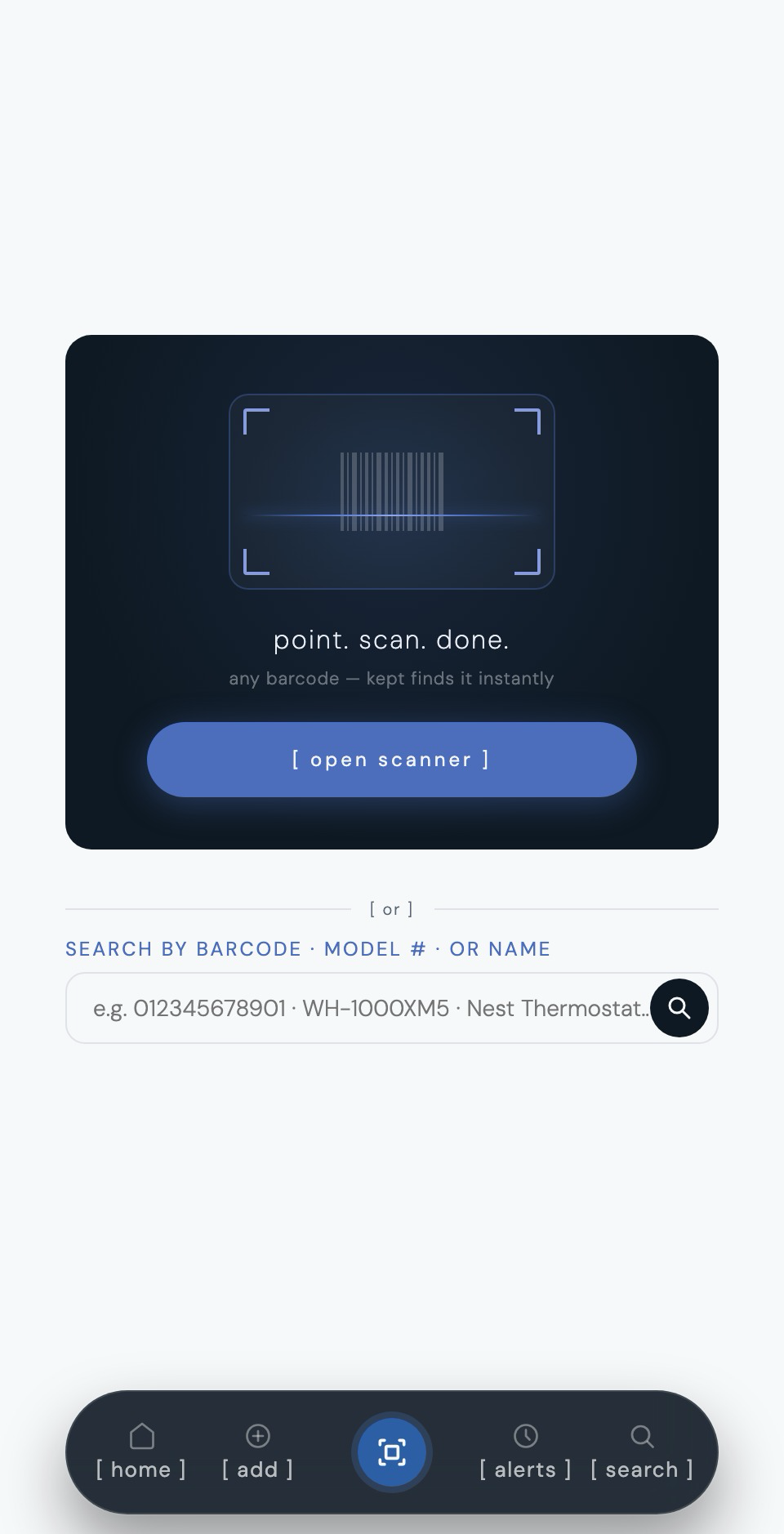
the kept scanner reads the barcode on most appliance data plates and auto-fills the product, model, and specs.
The check, every Thursday
- Open cpsc.gov/recalls or sign up for the weekly email at the same address.
- Scan the new recall list. It takes under a minute.
- If a category matches something you own, open kept, search the brand, and confirm the model.
That is the entire workflow. The hard part is the first hour of cataloging. Once that is done, the recall check becomes a one-minute habit instead of a Saturday afternoon archaeology project. The same model numbers help with warranty claims, replacement parts, and the kind of home binder a real estate agent will ask for when you sell.
Recall-check shortlist for an average house
- ☐ Fire extinguishers (handle material, model, date)
- ☐ Smoke and CO alarms (model on back, date stamp)
- ☐ Dehumidifier (brand and model on back panel)
- ☐ Washing machine and dryer (model and serial)
- ☐ Dishwasher (model and serial on door edge)
- ☐ Refrigerator (model and serial inside fresh-food side wall)
- ☐ Range, cooktop, and microwave
- ☐ Water heater (model on tank label)
- ☐ Furnace and AC condenser
- ☐ Tall dressers and bookcases (anchor status counts as a recall check)
- ☐ Power tools, lithium batteries, and e-bike chargers
- ☐ Kids' products: cribs, strollers, sleepers, high chairs, sound machines
Run this list once and you will almost certainly find a unit on an active recall. Most homes have at least one.
Where to register and subscribe so the next recall finds you
The single most effective change you can make is closing the loop on registration. Manufacturers cannot mail a recall notice to people they cannot identify. Five free signups, in order of how much risk they cover.
1. CPSC and recalls.gov email alerts
The fastest single signup. Subscribe at cpsc.gov for weekly recall emails covering everything the CPSC regulates: appliances, furniture, electronics, toys, sporting goods, kids' products. recalls.gov is the federal multi-agency portal that aggregates CPSC, NHTSA, FDA, and USDA notices into one feed.
2. SaferProducts.gov
The CPSC's SaferProducts.gov is where consumers file complaints about products before a recall is announced. Search incidents on a model you own to spot trouble early. If something goes wrong with a product in your home, this is also where you report it; pattern recognition across many filings is how recalls get triggered.
3. NHTSA recalls (for the garage)
Vehicle, tire, car seat, and motorcycle recalls live at nhtsa.gov/recalls. Enter the VIN to see open recalls on any car you own, even ones you bought used. NHTSA also offers free email alerts by make and model.
4. FDA and USDA (for the kitchen)
Drug, medical device, and food recalls live at fda.gov/safety/recalls. Meat, poultry, and egg recalls are at fsis.usda.gov/recalls. Both offer email signup. Recalls.gov rolls these in too.
5. Manufacturer registration cards (for the warranty)
Register every appliance with its manufacturer using the card in the box or the online portal. Registration also unlocks warranty service, which on appliances over $500 is meaningfully valuable. Save the registration confirmation in kept under the item so the registration is searchable later.
The four-tab bookmark bar every homeowner should have
- ☐ cpsc.gov/recalls for appliances, furniture, kids' products
- ☐ nhtsa.gov/recalls for vehicles, car seats, tires
- ☐ fda.gov/safety/recalls for drugs, medical devices, cosmetics
- ☐ fsis.usda.gov/recalls for meat, poultry, eggs
Secondhand, inherited, and rental property recalls
Buy a house and you inherit every appliance and fixture the previous owner left behind, along with every active recall attached to them. Buy a dresser at an estate sale and the original manufacturer has no idea you exist. Rent out a unit and the same gap opens up between you and the tenant.
If you bought a house in the last five years
Walk every appliance, fixture, and fire-safety device on day one. The five categories in this post (extinguishers, dehumidifiers, dressers, top-load washers, smoke alarms) are the ones most commonly inherited and most commonly missed. The information sweep doubles as your new-house info checklist.
If you bought used on Facebook Marketplace, Craigslist, or estate sales
Check the model number against the CPSC recall list before you buy whenever possible, and definitely before you bring kids near it. The most-resold recalled items, going by CPSC enforcement actions, are tip-over dressers, drop-side cribs (banned in 2011 and still resold), inclined infant sleepers (banned under the Safe Sleep for Babies Act), and the same Kidde plastic-handle extinguishers from this post.
If you're a landlord
Liability for a recalled product in a rental unit can fall on the property owner. Keep a documented record of model numbers for every supplied appliance, run a recall sweep before each tenant change, and document the date you checked. kept lets you keep separate inventories per property and export the recall-check history if a claim ever surfaces.
The single most under-checked recall category in inherited homes: drop-side cribs. They were banned for sale in 2011 but tens of thousands remain in attics, garages, and Facebook Marketplace listings. If a crib has a side rail that drops to make it easier to lift a baby out, the CPSC says do not use it under any circumstances.
Frequently asked questions
How do I find out if a product in my home has been recalled?
Search the product name, brand, and model number at recalls.gov or cpsc.gov/recalls. Both are free, and new CPSC recalls post every Thursday. Vehicles are searchable by VIN at nhtsa.gov/recalls. Food and drug recalls live at fda.gov. If you do not know your model number, check the data plate on the appliance. Save model numbers in kept so a recall check is a 5-second search instead of a flashlight expedition behind the dryer.
Why don't manufacturers contact me directly about recalls?
Most manufacturers only have your contact information if you mailed in a warranty card or registered the product online. According to CPSC and academic research, recall completion rates for consumer products average around 6% across all categories. Registration rates sit in the single digits for most categories. If you bought a recalled item second-hand, the manufacturer has no way to reach you at all. The burden of finding out falls on the owner.
What should I do if I own a recalled product?
Stop using the product, then follow the remedy listed in the official CPSC recall notice. The remedy is usually a free repair, replacement, or refund. You do not need a receipt for most recalls. Contact the manufacturer at the phone number or website listed in the notice, not a third-party site that may charge fees. Keep a record of the claim in case the manufacturer asks for proof later.
Are old recalls still valid?
Yes. Recall remedies do not expire in most cases. The 2016 IKEA Malm dresser refund and anchor kit, the 2017 Kidde plastic-handle extinguisher replacement, and the 2016 Samsung top-load washer rebate are all still active years later. Manufacturers are required to honor the CPSC-approved remedy regardless of when you discover the recall, and most do not require the original receipt.
How can I keep up with new recalls without checking every week?
Subscribe to free email alerts at cpsc.gov and recalls.gov, register every new appliance with its manufacturer using the included registration card or online portal, and use a home inventory app like kept to keep model and serial numbers in one place. When a new recall drops, you can search your inventory in seconds instead of crawling behind appliances.