
How to File a Home Insurance Claim: Steps and Proof
Most claims pay out less than they should. Not because of fine print. Because the homeowner couldn't prove what they owned. Here's exactly what to do from the moment damage happens to the moment you get paid.

table of contents
The first 24 hours
The first thing to do after damage is stop more damage from happening. A burst pipe means turning off the water. A broken window means covering it. Most policies include a provision requiring you to prevent further loss. If you don't, the insurer can reduce your payout for anything that got worse after the initial event.
Do not start major repairs or throw anything away before the adjuster sees the damage. Temporary fixes are fine and expected. Gut-renovating the bathroom before the claim is filed is not.
Check your policy for the filing deadline. Most insurers want claims reported promptly. Some have language as tight as 30 days from the date of loss, even if the full damage isn't known yet. States set outer limits too, and they're tightening. Florida, for example, cut the deadline to report a new or reopened claim from two years to one in its 2022 reform law, and supplemental claims from three years to 18 months. File early and update the claim as you learn more. Don't wait until you have everything figured out.
If police involvement is relevant (theft, vandalism, vehicle damage), file a police report before contacting your insurer. The report number is documentation they'll ask for.
Document the damage
Do this before cleanup, before contractors, and before the adjuster arrives if possible. Photos and video taken immediately after a loss are more credible than ones taken days later.
What to photograph
- Wide shots of every affected room, from the doorway, showing full context
- Close-ups of specific damage: the waterline on the wall, the broken lock, the scorched ceiling
- Serial number stickers on damaged electronics and appliances. Photograph these even if the item still turns on.
- Anything you're about to move or throw away. Photograph it in place first.
Video is underrated here. Walk every affected room narrating what you see, open closets and storage, describe what's damaged and why. Courts and adjusters accept walkthrough video as evidence of ownership. It takes 10 minutes and costs nothing.
If you built a home inventory before the loss, this step is mostly done. You have model numbers, serial numbers, purchase prices, and photos already on file. If you didn't, you're rebuilding the list from memory under the worst possible circumstances.
kept is reader-supported. When you buy through links on this page we may earn a small commission, at no extra cost to you. It never changes what we recommend.
Filing the claim
Contact your insurer by phone or through their online portal. You'll need your policy number, the date of loss, a description of what happened, and a general sense of the damage. You don't need a full itemized list at this stage. That comes later.
The insurer will assign a claim number and a claims adjuster. Write both down. Every conversation you have from this point forward should reference the claim number, and you should keep a log of every interaction: date, time, who you spoke to, and what was said. Email beats phone for this. It creates a record automatically.
What to tell them
Describe the damage factually. Don't speculate about cause before the adjuster inspects. "Water came through the ceiling on Tuesday evening" is the right level of detail. "I think the roof failed because of poor installation" is not. That's a conclusion that may or may not be accurate and could complicate your claim.
Don't minimize the damage and don't exaggerate it. State what you know, note what you're still assessing, and say you'll follow up in writing.
Emergency living expenses
If your home is uninhabitable, most policies cover additional living expenses (ALE) while repairs are underway. This covers hotel stays, meals above your normal food budget, and similar costs. Keep every receipt. ALE reimbursement requires documentation just like property damage does.
Working with the adjuster
The adjuster works for the insurance company, not for you. That's not adversarial. They're there to assess damage and determine what the policy covers. But their job is to verify the claim, not to maximize your payout.
Be present during the inspection. Walk them through every area of damage. Don't assume they'll find it all. If damage is hidden (inside a wall, under flooring, in an attic), point it out and explain how you know it's there.
You're allowed to ask the adjuster questions during the inspection. Ask what they're noting, what they're not including and why, and what documentation would help support items they're uncertain about.
After the inspection, you'll receive a written estimate. Review it line by line. If items are missing or repair costs seem low, get independent contractor estimates. A second opinion from a licensed contractor is standard practice and adjusters expect it.
If there's a significant gap between the adjuster's estimate and what contractors are actually quoting, you can negotiate. Document everything in writing. "Per our phone call on May 22" is not documentation. "As I mentioned in my email of May 22" is.
What determines your payout
Two things control how much you get: your coverage terms and your documentation.
Replacement cost vs. actual cash value
Replacement cost coverage pays what it costs to buy a new equivalent item today. Actual cash value (ACV) deducts depreciation. A five-year-old TV worth $800 new might pay out $300 under ACV. Check your policy. Most modern homeowners policies include replacement cost for personal property, but not all do, and depreciation schedules vary by item category.
Coverage limits and sublimits
Your policy has an overall personal property limit, but it also has sublimits for specific categories. Jewelry theft is a common one: the Insurance Information Institute says standard policies generally cap it around $1,500 for the whole category, not per piece. An engagement ring alone can blow past that without a rider. Electronics may have their own sublimit. High-value items like instruments, artwork, or collectibles may require a scheduled personal property endorsement to be fully covered.
If you're not sure what your sublimits are, read the declarations page of your policy now, before a loss.
Documentation is what converts coverage to cash
Your policy might cover a $2,800 laptop. But if you can't tell the adjuster the make, model, and purchase price, they'll estimate, and estimates run conservative. The same laptop with a serial number, a purchase date, and a receipt pays the full amount.
This is where a detailed home inventory pays off directly. Here's what that looks like in kept for a single item:
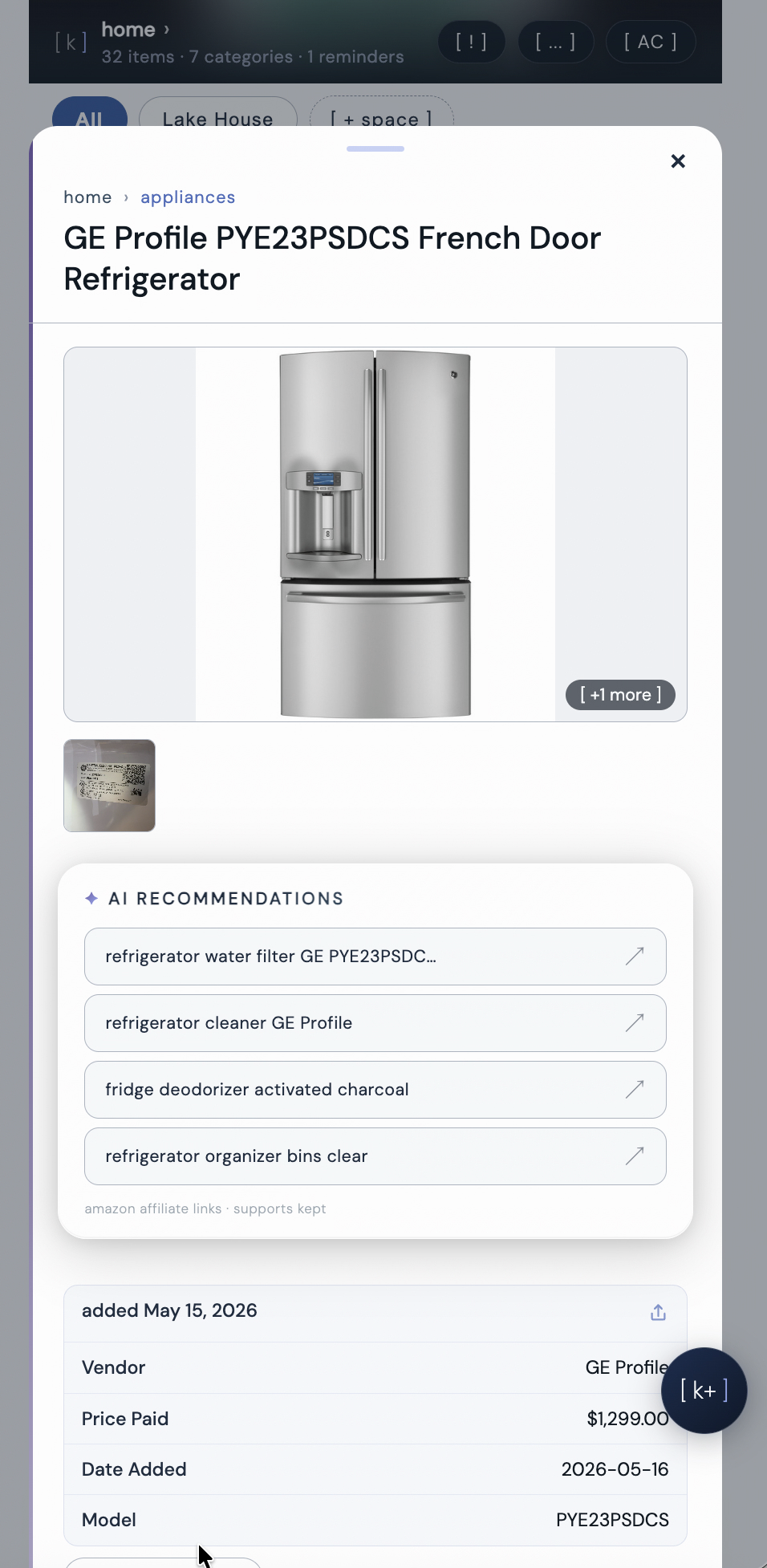
model number, serial, purchase price, purchase date: the four fields an adjuster needs to verify and value a claim item.
For appliances, the model number is on a data plate inside the door or on the back panel. Check the full guide on where to find appliance model numbers if you're building your inventory now.
Keeping your inventory current matters too. An item you bought three years ago and never recorded is an item you'll struggle to claim. The habit is simple: when you set up anything significant, add it to kept before you throw away the box.
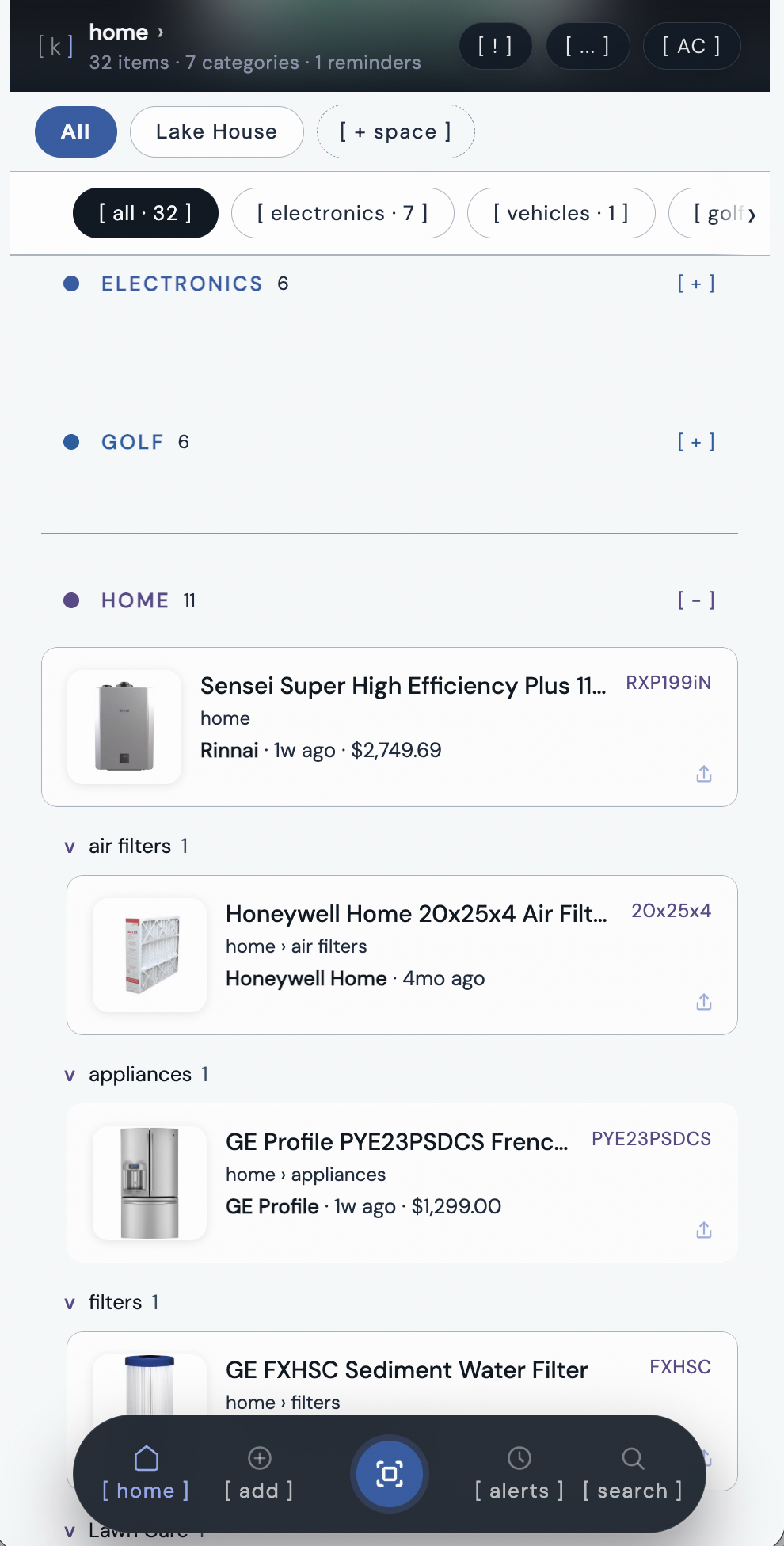
your full inventory, organized. every item a potential claim line, documented before you need it.
If your claim is denied
A denial is not final. Your insurer must provide a written explanation citing the specific policy language that supports the denial. Get that in writing before doing anything else.
Read the denial letter against your actual policy. Adjusters make mistakes. Coverage exclusions are sometimes applied incorrectly. If the denial references a policy exclusion, read that exclusion in full, not just the adjuster's summary of it.
Your options after a denial
- Internal appeal: Submit a written appeal to the insurer with supporting documentation: additional photos, contractor estimates, a detailed inventory of claimed items. Most insurers have a formal appeals process with a deadline, typically 30 to 60 days from the denial date.
- Public adjuster: A public adjuster works for you, not the insurer. They assess the damage independently and negotiate on your behalf. Fees usually run 10 to 20% of the settlement, and some states cap them. Florida limits fees to 10% for claims in the first year after a declared emergency and 20% otherwise. Worth considering for large claims where the gap between the insurer's offer and actual damages is significant.
- State insurance department: Every state has a department of insurance that regulates insurers and handles complaints. Filing a complaint doesn't cost anything and sometimes prompts a re-review without further action on your part.
- Attorney: For large claims or bad-faith handling, an insurance attorney may be warranted. Many work on contingency for property damage cases.
The contractor contacts you have on file matter here too. An independent estimate from a licensed contractor you trust carries more weight than one from a contractor the insurer recommends.
kept stores purchase prices, dates, serial numbers, and photos so your claim is documented before you need it.
[ try kept free ]Frequently asked questions
What documentation do I need for a home insurance claim?
You need proof of ownership and proof of value for every item you're claiming. That means photos of the damage, photos of individual items, serial numbers and model numbers for electronics and appliances, purchase receipts or credit card statements, and a written inventory listing each item with its approximate purchase price and date. The more documentation you have before the adjuster visits, the stronger your claim.
How long does a home insurance claim take?
Simple claims (a broken window, a single appliance) can close in 2 to 4 weeks. Complex claims involving structural damage or large personal property losses can take 2 to 6 months. Your state may require the insurer to acknowledge your claim within 10 to 30 days and accept or deny it within 40 days, but those are minimums. The single biggest factor you control is how fast and complete your documentation is. Slow documentation means a slow claim.
What should you not say to a home insurance adjuster?
Don't say "I think" or "I'm not sure" when describing damage or items. Adjusters document what you tell them, and uncertainty weakens your claim. Don't speculate about what caused the damage before the inspection. Don't accept a settlement on the spot if it feels low. You're allowed to ask questions, request a written explanation, and get independent repair estimates before accepting anything. You're also allowed to say you'll follow up in writing.
Can I keep leftover money from a home insurance claim?
Sometimes, for personal property. If you have actual cash value coverage, the check is yours to spend. With replacement cost coverage, most insurers pay the depreciated value first and hold back the rest until you show a receipt for the replacement, so there's usually nothing extra to keep unless you replace for less. For structural claims (roof, walls, foundation), the money is expected to go toward repairs, and your mortgage lender may be named on the check. Read your policy's loss settlement section before you spend anything.
What happens if my home insurance claim is denied?
You can appeal. The insurer must provide a written explanation for the denial. Review your policy to see whether the denial is legitimate based on your coverage terms and exclusions. If you believe the denial is wrong, submit a written appeal with supporting documentation: photos, receipts, contractor estimates, and your inventory. If the appeal fails, you can hire a public adjuster who works on your behalf (typically for 10-15% of the settlement), or file a complaint with your state's department of insurance.