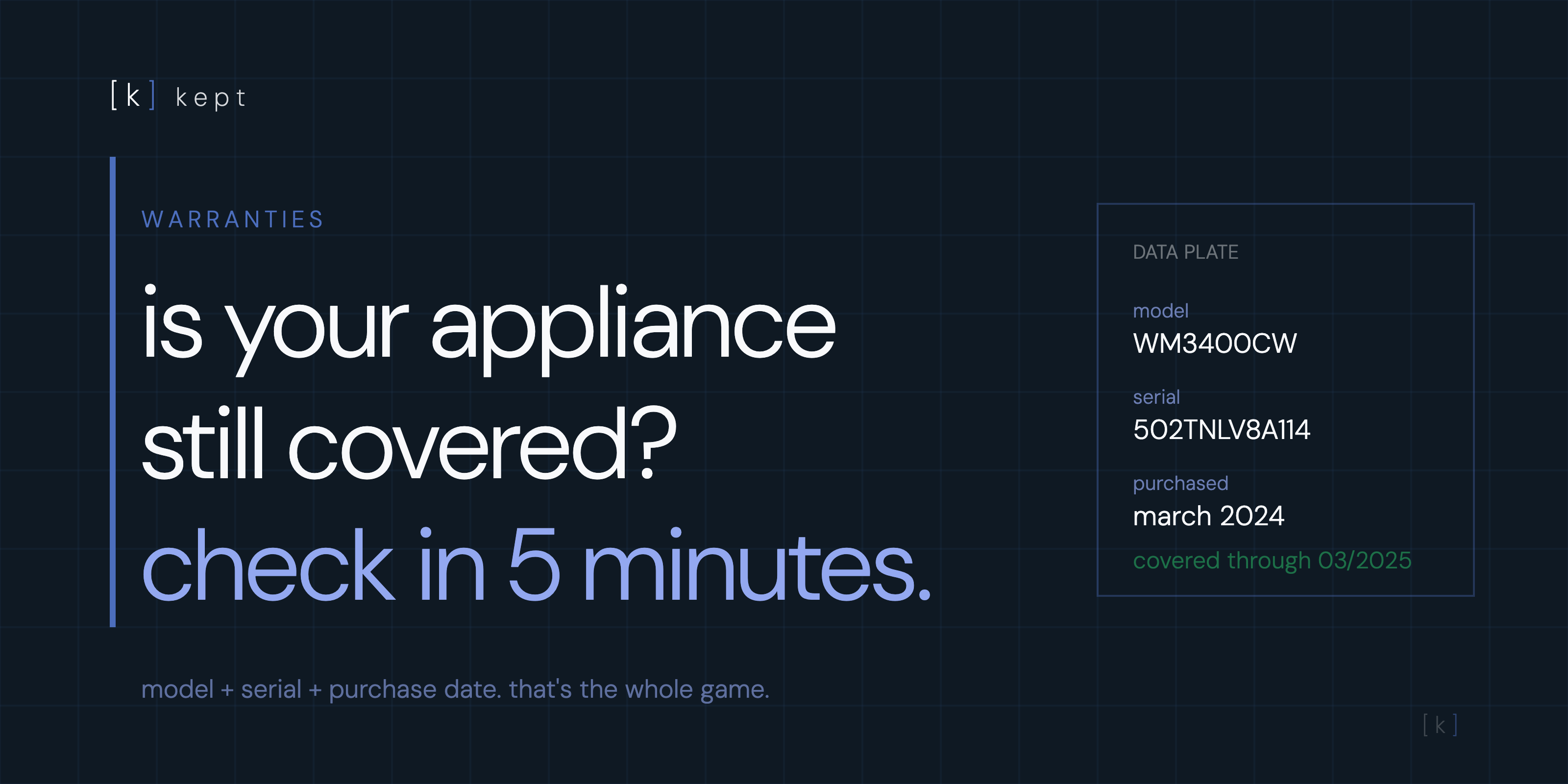
Appliance Warranty Check: Free Lookup by Serial Number (2026)
The washer died mid-cycle. The repair quote is $380. Before you pay a dollar of it, spend five minutes answering one question: is this still covered? Here's exactly how, even if the receipt vanished years ago.
Warranty check by serial number
Pick your brand and paste the serial off the data plate. For GE and Whirlpool-family appliances the serial encodes the month and year it was built, so you get an age even with no receipt.
table of contents
The 5-minute warranty check
Run these in order. Most people get their answer by step three.
- Get the model and serial number off the appliance. Not the manual, not memory. The data plate on the unit itself.
- Pin down the purchase date. Email receipt, credit card statement, or retailer order history. Approximate is fine for now.
- Check the manufacturer's warranty page. Search "[brand] warranty check" and enter the serial number. No tool? Call support with the serial.
- Ask about component coverage. Even if the general warranty expired, the broken part might carry its own longer coverage. Compressors, motors, and drums often do.
- Call your credit card issuer. If you paid by card, you may have a free extra year of coverage on top of everything above.
The order matters. Repair techs and call centers all start with the same question, "what's the model and serial?", so everything downstream is blocked until you have those two numbers.
Step one is always the serial number
The serial number does two jobs. It identifies your exact unit, and it encodes when that unit was built. Manufacturers use the manufacture date as the fallback warranty clock when there's no proof of purchase, which is why you can often get a coverage answer with nothing but this one number.
The data plate hides in a different spot on every appliance: inside the fridge on the side wall, inside the dishwasher door edge, behind the washer's door frame. Our guide to finding appliance model numbers walks through every appliance type, spot by spot.
Got the serial in hand? Our free warranty check tool decodes a GE serial number straight to its manufacture date, and works out where a purchase date leaves you on both the one-year and the five-year sealed-system clocks.
While you're crouched back there with your phone flashlight: photograph the plate. That photo is the difference between doing this hunt once and doing it every time something breaks.

Where each brand hides the answer
Every major brand can check coverage. They differ on how much they put online:
| Brand | How to check |
|---|---|
| Samsung | Online warranty page under Support. Enter the serial number, or sign in if you registered the product |
| LG | Support site has a warranty information lookup by serial number |
| GE | Support search by model number shows coverage terms; call with the serial for unit-specific status |
| Whirlpool / Maytag / KitchenAid | Same parent company. Coverage terms in the manual; call or chat with the serial number for status |
| Bosch | Online registration account shows coverage; otherwise call with the serial |
| Frigidaire / Electrolux | Call or chat with model and serial; agents can see the manufacture window |
GE warranty check by serial number
GE is the most self-serve brand of the group, so it gets its own walkthrough. Decode the serial to its build date with our free warranty check tool, or enter the model and serial number in the service and support section at geappliances.com, where GE pulls coverage from the serial's manufacture date — no proof of purchase needed. Can't find the data plate? Our guide to where the model and serial number hide covers every appliance type. Prefer the phone: 1-800-432-2737 (1-800-GE-CARES), with the model and serial ready.
One pattern across all of them: if you registered the appliance when you bought it, the answer is sitting in your account right now. If you didn't, the serial number gets you there a few minutes slower. Either way the call takes under ten minutes, which is a good hourly rate against a $380 repair. Direct links and phone numbers for every major brand are in our appliance warranty lookup by serial number directory.
No receipt? You still have three outs
The receipt is the cleanest proof, and it's almost always gone. In order of effort:
- Your email. Search the brand name, the store name, and "order confirmation." Home Depot, Lowe's, and Best Buy all keep order history in your online account, often going back years.
- Your credit card statement. The transaction date establishes the purchase date, which manufacturers accept as proof in most cases.
- The serial number's manufacture date. The fallback that almost always works. Appliances usually sell within months of manufacture, so brands will honor coverage windows based on the build date alone.
If the appliance fails all three checks and the repair quote is high, run the numbers against its age before paying. Our appliance lifespan guide covers when a repair beats a replacement.
kept is reader-supported. When you buy through links on this page we may earn a small commission, at no extra cost to you. It never changes what we recommend.
The credit card year nobody claims
If you paid with a credit card, there's a decent chance you own an extra year of warranty and don't know it. Visa Signature, most Mastercard tiers, and nearly all American Express cards extend the manufacturer warranty, typically by one year, on purchases made with the card.
The benefit is automatic but the claim is not. You call the number on the back of the card, say "extended warranty claim," and provide the card statement showing the purchase plus the repair estimate. Issuers pay out either the repair cost or the purchase price, whichever is less.
Two details that trip people up: the original manufacturer warranty usually needs to have been one year or longer, and the card benefit caps out (often $10,000 per claim). For a dead $900 washer in month 18, this phone call is the whole ballgame.
Make this the last time you scramble
Everything above is damage control. The 30-second version of this entire article, done in advance, looks like this: when an appliance enters your house, photograph the data plate and the receipt, and store both where you can search them.
That's what our appliance warranty lookup guide builds out in full: what to save, when, and where. In kept, it's one entry per appliance with the model, serial, purchase date, and a reminder before the warranty expires, so free coverage never lapses unused again.
The stat that should sting: most people pay out of pocket for at least one repair that was covered. Not because the warranty was hard to use, but because nobody could answer "when did we buy this?" in the moment that mattered.
kept stores your purchase date, warranty terms, and serial number so the answer is always one search away.
[ try kept free ]Frequently asked questions
How do I find out if my appliance is still under warranty?
Find the model and serial number on the appliance's data plate, then check the manufacturer's website. Most major brands (Samsung, LG, GE, Whirlpool) have a warranty lookup tool where you enter the serial number. If there's no online tool, call the brand's support line with the serial number and they can tell you the coverage status in one call.
Can I check an appliance warranty with just the serial number?
Usually, yes. The serial number encodes the manufacture date, and manufacturers use it to estimate the warranty window when there's no proof of purchase. Coverage technically starts at the purchase date, so a receipt or credit card statement can extend the window in your favor, but the serial number alone is enough to get an answer.
How do I claim an appliance warranty without a receipt?
Call the manufacturer with the model and serial number. Many honor claims based on the manufacture date encoded in the serial. Also check your email for the order confirmation, your credit card statement for the purchase date, and the retailer's order history. Big-box stores can often look up old purchases by phone number or loyalty account.
Do credit cards extend appliance warranties?
Many do. Visa Signature, many Mastercard tiers, and most American Express cards add up to one extra year on top of the manufacturer warranty when you paid with the card. Call the number on the back of your card before paying for any repair: the benefit is real money and almost nobody uses it.
How long is the average appliance warranty?
One year of full parts-and-labor coverage is standard for major appliances. Specific components often carry longer parts-only coverage: refrigerator compressors and washer motors commonly run 5 to 10 years. Labor coverage nearly always ends after year one, so a covered part can still come with a real service bill.
Does appliance warranty start on purchase date or delivery date?
Almost always the purchase date on the receipt, not the delivery date — even if the appliance sat in a warehouse for weeks before it arrived. The exception is large custom or special-order appliances, where some manufacturers start the clock at delivery instead. Check the warranty card or manufacturer's terms if the two dates are far apart.
What voids a standard appliance warranty?
The most common triggers: using the appliance commercially instead of in a home, unauthorized repairs or opening the unit yourself, damage from a power surge or improper installation, and removing or defacing the serial number tag. Normal wear and tear on cosmetic parts (handles, knobs, finish) is also usually excluded even while the rest of the unit is covered.