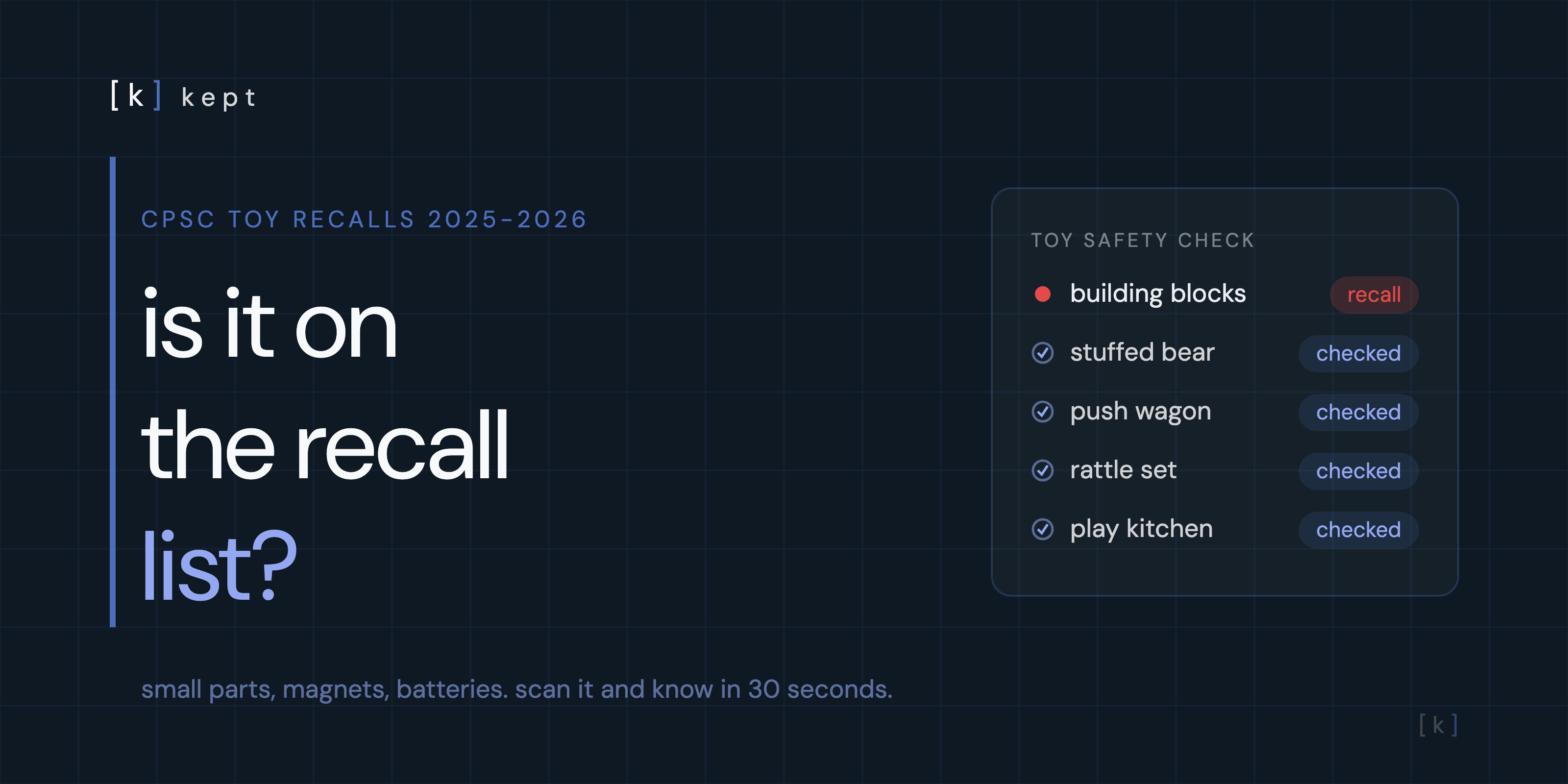
CPSC Baby Product & Infant Toy Recalls 2026: 30-Second Check
Toys get recalled more often than almost any other product category. Here's how to check the one sitting on your floor right now, what to do if it's on the list, and how to stop doing this check by hand every time a new one comes into the house.

table of contents
Current CPSC baby and toy recalls (2026)
Every entry below is an active recall taken from the CPSC's own database. Units are the number sold in the US. Open any product to read the official notice, which lists model numbers, sale dates, and how to claim your refund or repair.
| Announced | Product | Hazard | Units |
|---|---|---|---|
| Jul 23, 2026 | Sili Factory Pull String Teething Toys | Choking — teething toys violate the mandatory standard for toys | 5,918 |
| Jul 16, 2026 | Boon PIVOT Collapsible Toddler Tower Kitchen Step Stools | Tip-over — toddler towers can tip over while in use | 116,908 |
| Jul 2, 2026 | Gigglescape™ Under the Sea Popping Toy | Choking — clear plastic dome can detach from the blue plastic base | 49,000 |
| Jun 25, 2026 | MedPride Baby Oil | Poisoning — baby oil contains low-viscosity hydrocarbons | 8,420 |
| Jun 18, 2026 | GOPO TOYS Pull String Teething Toys | Choking — teething toys violate the mandatory standard for toys | 70,410 |
| Jun 18, 2026 | Joolz Aer2 Car Seat Adapters for Joolz Aer 2 Stroller | Fall — car seat adapters can fail to properly attach to the stroller, which may allow the car seat to fall | 3,840 |
| Jun 18, 2026 | CooCooBaby Baby Loungers | Suffocation — baby loungers violate the mandatory standard for Infant Sleep Products | 2,355 |
| Jun 18, 2026 | BABESIDE Doll and Stroller Toys | Choking — toys violate the small parts ban | 2,200 |
| Jun 11, 2026 | LiKee Pull String Teething Toys | Choking — teething toys violate the mandatory standard for toys | 24,400 |
| Jun 4, 2026 | Boon NURSH 8 oz Reusable Baby Bottles | Choking — hard plastic outer shell can bubble or partially peel off, resulting in loose pieces of film-like plastic that pose a… | 40,000 |
| May 21, 2026 | Toy Headbands, Electronic Pet Cage-Dinosaur Tribes, My Pet Bird… | Battery ingestion — children's toys violate the mandatory standard for toys | 84,700 |
| May 14, 2026 | Tiyol Pull String Teething Toys | Choking — teething toys violate the mandatory standard for toys | 102,430 |
| May 14, 2026 | Misco Sports Badminton Toy Sets Red/Blue MT2383 | Battery ingestion — misco Sports Badminton Toy Sets violate the mandatory safety standard for children's toys | 15,120 |
| Apr 30, 2026 | Stephan Baby Boo Bunnie and Friends Children's Toys | Choking — toys' plastic cube can break into small parts or sharp edges | 227,500 |
Source: CPSC recall database. Shows the 14 largest by units sold of 42 baby, infant, and toy recalls announced January–July 2026. Smaller recalls are listed on CPSC.gov.
Why toys top the recall list
Ask a parent what they worry about with a new toy and most say choking. That instinct is correct, but it's not the whole list. Toys get pulled from CPSC.gov for a handful of specific, repeat reasons, and knowing them makes the next unboxing faster to eyeball.
- Small parts that detach. Eyes on stuffed animals, wheels on push toys, magnetic pieces on building sets. The threshold is whether a part fits through a small-parts test cylinder about the width of a toilet paper tube, roughly the size of a child's airway.
- High-powered magnets. If two magnets get swallowed separately, they can attract through intestinal walls and cause perforations that require surgery. This is one of the CPSC's most aggressive enforcement categories, and sets marketed for older kids or adults still get recalled when they end up in a house with a toddler.
- Button batteries. A coin-sized battery lodged in a child's throat or esophagus can cause a chemical burn within two hours. Any toy with a battery compartment that opens without a screwdriver is worth a second look.
- Lead and phthalates. Cheap painted toys and soft vinyl items, often from third-party marketplace sellers, occasionally test over the federal limit for lead or banned plasticizers.
- Strangulation risk. Cords on pull toys, straps on activity gyms, and drawstrings longer than the safety standard allows.
For the bigger picture across every baby and kids product category, not just toys, our guide to the 2026 recall list above covers strollers, cribs, and car seats too. Consumer Reports counted 145 baby and kids products recalled in 2025, and toys with small parts or magnets were among the most common repeat categories.
How to check if a toy is recalled
Every consumer product recall in the United States runs through cpsc.gov/Recalls, filterable by category, brand, or date. For a toy in front of you, the process is the same one we cover in more depth in how to check if a product has been recalled, with a few toy-specific wrinkles.
What to look for on the toy itself
- Brand and product name, usually printed on a fabric tag, molded into the plastic base, or on the original box if you kept it
- Model or item number, often a string of letters and numbers near the manufacturer's logo
- Date code or batch number, which matters because most toy recalls only affect units made within a specific window, not the entire product line forever
Search the brand and product name at cpsc.gov/Recalls first. If nothing matches, that's a reasonably good sign, though it's worth checking again after any birthday or holiday when several new items enter the house at once. The official CPSC Recall App covers the same database if you'd rather search from your phone.
The part that actually breaks down for most families isn't the search, it's remembering to do it. A toddler can own 40 or 50 individual toys within a year between gifts, hand-me-downs, and impulse buys. Nobody re-checks all 50 every Thursday when the CPSC posts its weekly list. This is exactly the gap a home inventory app closes: scan a toy's barcode once with kept's barcode scanner and it captures the brand and model, then checks that item against new recalls in the background from then on. You get a red [ recall ] flag on the specific toy instead of scrolling a list every week.
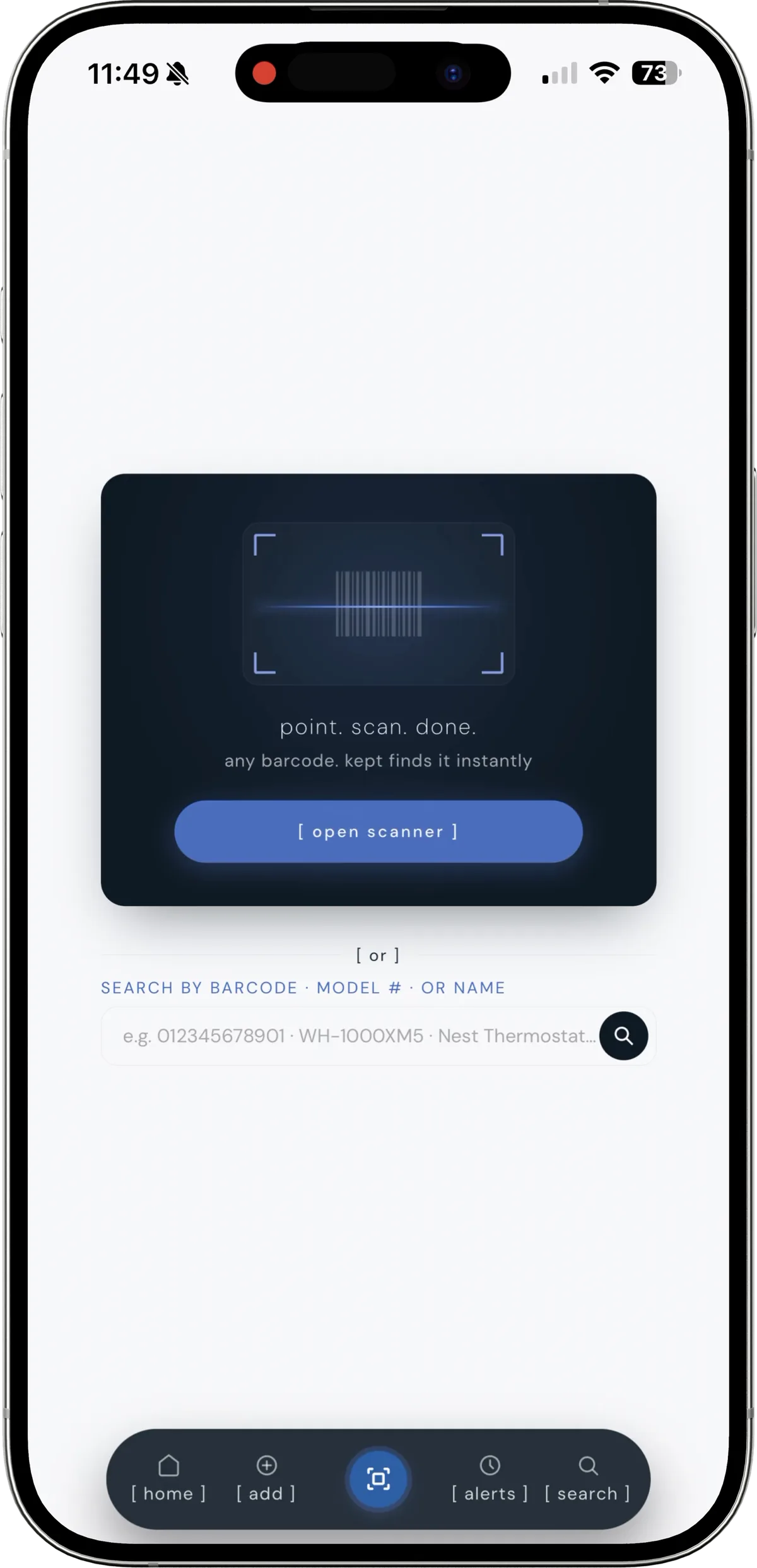
point the scanner at the toy's barcode once. kept takes it from there.
What to do if the toy is recalled
Take it away from your child immediately, even if it's never caused a problem. A recall exists because of a hazard the manufacturer or the CPSC identified, not because your specific unit already failed. Waiting for evidence of a problem is the wrong instinct here.
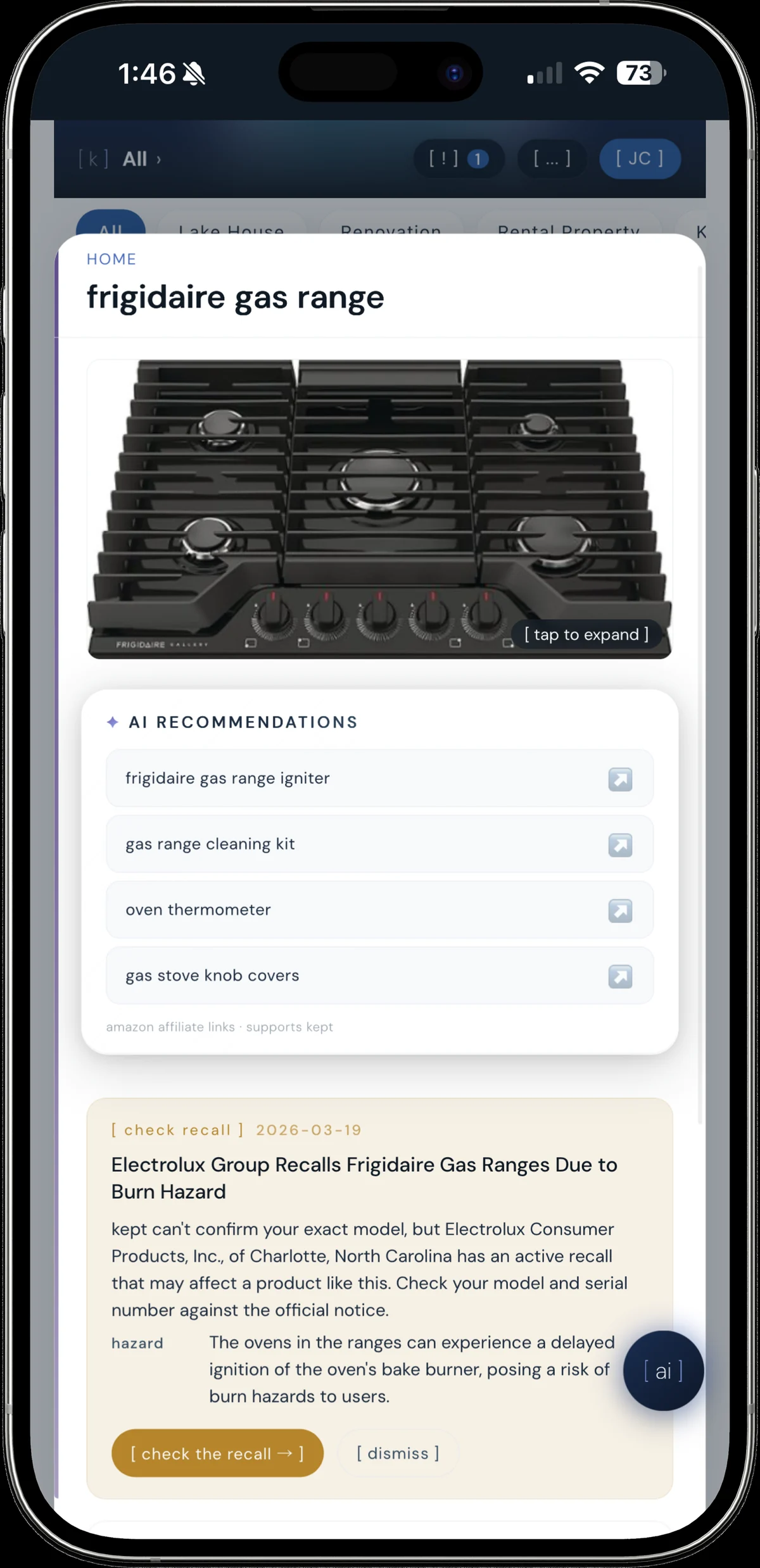
this is what a flagged item looks like in kept: the hazard, the notice, and one tap to check it.
The remedy process
- ☐ Read the recall notice for the specific remedy: refund, replacement, or a free repair kit
- ☐ Locate the model or date code the notice asks for, not just the brand
- ☐ File the claim through the link in the notice, which is usually the manufacturer's own site
- ☐ You typically don't need a receipt. Recalls are tied to the product itself, not proof of purchase
- ☐ Dispose of or return the toy as instructed. Don't donate or resell a recalled item, even after the remedy ships
Refunds and replacements for toy recalls usually process within four to six weeks. There's no deadline to file: if you find out a toy was recalled two years after you bought it, the claim is still valid.
kept scans a toy once and watches it for recalls from then on, no weekly list-checking required.
[ try kept free ]Checking hand-me-down and secondhand toys
Secondhand toys carry a specific risk that new ones don't: the original recall notice may have gone to a different family entirely, or to nobody, if the item was a gift or came from a garage sale. A toy can sit in a bin for three years, get recalled in year two, and still get handed down in year three with nobody the wiser.
Before it goes into rotation
- Search the brand and model at cpsc.gov/Recalls, the same way you would for something new
- Check for missing or loose small parts, and any battery compartment that doesn't require a tool to open
- Look for wear that's created a new hazard the original design didn't have: a cracked rattle, a frayed cord, a seam that's opened up around stuffing or a squeaker
- If you can't identify the brand at all, no tag, no molded logo, no model number, treat that as a reason for extra caution with a child under three, since you have no way to check it against anything
This is also where saving items pays off for the giving side, not just the receiving side. If you're passing toys along yourself, our guide on keeping track of receipts and product details covers the same habit applied to bigger purchases: capture the brand and model once, while you still have it, so whoever gets the item next has something to search.
How to report an unsafe toy
You don't have to wait for an official recall to flag a toy that scares you. Report it directly at SaferProducts.gov, the CPSC's public incident database. You don't need to be the one who got hurt, and the toy doesn't need to have already caused an injury. A part that came loose, a battery compartment that popped open on its own, a seam that split after two uses: all of it is worth reporting.
Consumer reports are one of the main ways the CPSC decides which products to investigate. A pattern of reports on the same item, even before an official recall, can move a product toward one faster.
Staying ahead of the next recall
The CPSC posts new recalls every Thursday morning, usually five to ten across every product category, and you can subscribe to email alerts at cpsc.gov for free. The tradeoff is volume: most weeks, nothing in that list touches your house, and skimming a full recall digest every week is a habit that fades fast. Our guide to CPSC recall alerts covers every option for getting notified, official and otherwise.
The alternative is narrowing the feed to just what you own. Save each toy in kept when it enters the house, barcode scan or a quick photo, and it gets checked against new recalls automatically from that point on. You only hear about it when something you actually have gets flagged, not every recall issued that week.
Frequently asked questions
How do I check if a baby toy has been recalled?
Search the brand and product name at cpsc.gov/Recalls, or use the free CPSC Recall App. You'll get the most reliable match with the model number or a date code, which is usually molded into the plastic or printed on a tag sewn into fabric toys. If you've saved the toy's brand and model in kept, it checks automatically and flags the item if a recall matches, so you don't have to remember to look.
What toys are currently recalled by the CPSC?
The list changes weekly, so there's no fixed answer, but the CPSC posts every current toy recall at cpsc.gov/Recalls, filterable by category. The most common repeat offenders are small-parts choking hazards, high-powered magnet sets, toys with excessive lead or phthalates, and battery compartments that don't lock securely. Check the list directly rather than relying on a search result that may be out of date.
Where can I report a dangerous infant toy?
Report it at SaferProducts.gov, the CPSC's public incident database. You don't need to wait for an official recall to file a report, and you don't need to be the one injured. Include the brand, model or date code, where you bought it, and what happened. Consumer reports are part of how the CPSC decides which products to investigate next.
How do I get immediate notifications for baby product recalls?
Sign up for CPSC email alerts at cpsc.gov, which land the same day a recall posts, usually Thursday mornings. Those alerts cover every recall, not just what your kid owns, so most weeks you're skimming past things that don't apply. For alerts tied to your own child's toys specifically, save them in kept: it matches your saved items against new recalls automatically and only flags the ones that are actually yours.
What should I do if my child has a recalled toy?
Take it away from your child immediately, even if nothing has gone wrong with it yet. Recalls are issued because a product has a specific hazard, not because of a problem you'll necessarily see. Follow the remedy in the recall notice: most offer a full refund, a free replacement, or a repair kit. You typically don't need the receipt, since the recall is tied to the model or date code, not proof of purchase.
How do you verify if a second-hand infant toy is safe to use?
Before it goes into rotation, search the brand and model at cpsc.gov/Recalls, since secondhand and hand-me-down toys are exactly the ones most likely to have missed a recall notice the first owner never saw. Check for loose or missing small parts, exposed battery compartments, and any wear that's created a new sharp edge or choking hazard the original design didn't have. If you can't identify the brand or find a model number, that's itself a reason to be cautious about giving it to a child under three.