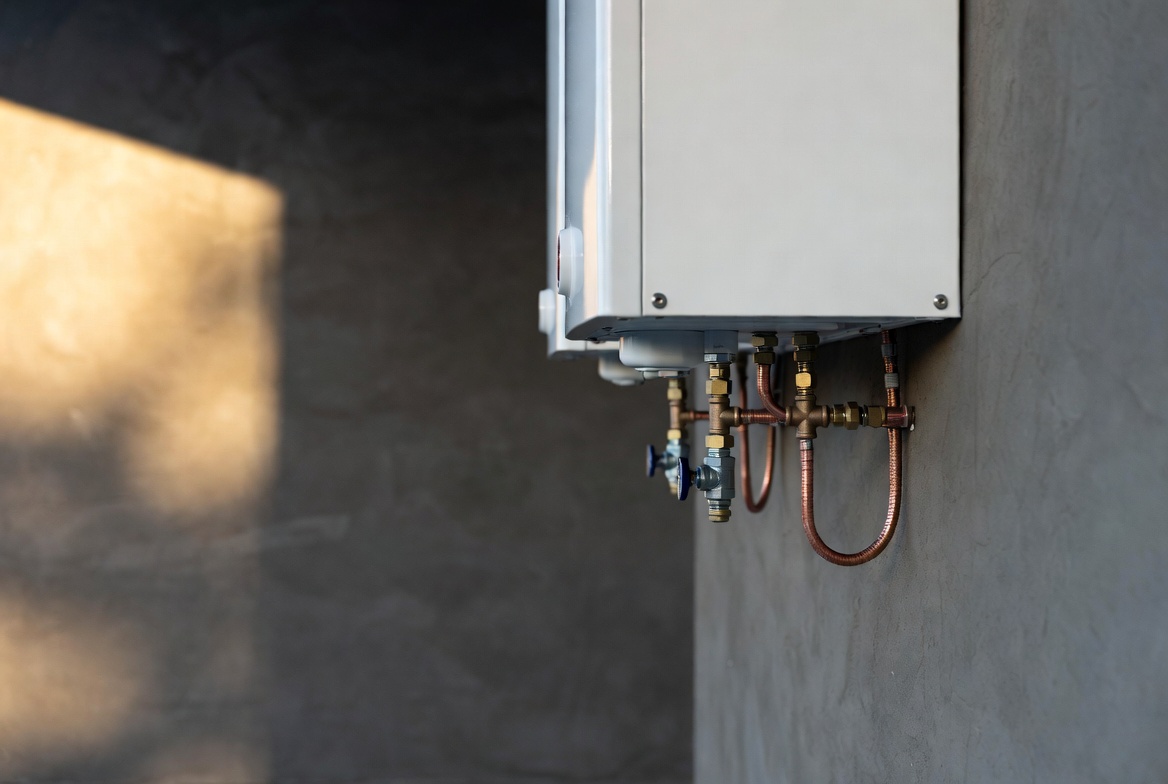
Water Heater Maintenance: Yearly Tasks and When to Replace
Most homeowners never touch their water heater until it fails. A little maintenance each year keeps it running longer, costs you almost nothing, and tells you exactly when to start budgeting for a replacement before it floods your utility room.

table of contents
Why most homeowners skip it
Your water heater sits in a corner of the basement or utility room and does its job without asking for anything. That's exactly why it gets ignored. Until the morning you turn on the shower and nothing happens, or worse, until the tank rusts through and you're looking at a flooded floor and an emergency plumber bill.
A tank water heater costs $800 to $2,000 installed. A tankless unit runs $1,500 to $3,500. Neither is a casual expense. Annual maintenance costs almost nothing — a few dollars in supplies, an hour of your time — and it can add years to the life of the unit.
The maintenance tasks are also straightforward. You don't need a plumber for most of them. You just need to know what to do and when to do it. This is part of any solid home maintenance checklist — it just rarely makes the list because nobody explains what's actually involved.
Annual maintenance: tank water heaters
Tank water heaters — the kind with a large cylindrical storage tank — need four things each year. Three of them you can do yourself in under an hour.
Flush the tank
Sediment (calcium, magnesium, and other minerals from your water supply) settles at the bottom of the tank over time. It insulates the water from the heating element, forces the unit to work harder, and eventually eats through the tank lining. A full flush takes about 30 minutes.
- Turn the thermostat to the pilot setting (gas) or off (electric)
- Shut off the cold water supply valve at the top of the tank
- Connect a garden hose to the drain valve near the base of the tank and run it outside or to a floor drain
- Open a hot water faucet somewhere in the house to prevent a vacuum from forming
- Open the drain valve and let the tank empty completely
- Briefly turn the cold water supply back on to stir up and flush out any remaining sediment, then drain again
- Close the drain valve, refill the tank, restore power or gas
In hard water areas (most of the midwest, southwest, and southeast US), do this every six months instead of annually.
Check the anode rod
The anode rod is a magnesium or aluminum rod that runs down the center of your tank. It sacrifices itself through electrolytic corrosion so the tank walls don't rust. When the rod is gone, the tank starts to corrode. Most rods last 3 to 5 years.
To check it, locate the rod (usually under a plastic cap on top of the tank, sometimes under the hot water outlet fitting), unscrew it with a 1-1/16" socket, and pull it out. If it's less than half an inch thick or heavily pitted, replace it. A new anode rod costs $20 to $50 and takes 15 minutes to swap.
Test the TPR valve
The temperature-pressure relief valve is a safety device that opens if the tank gets dangerously hot or overpressurized. It's the small valve on the side of the tank with a lever and a pipe running down toward the floor.
Lift the lever briefly — water should flow out of the discharge pipe. If nothing flows, or if the valve drips continuously after you release it, replace it. A faulty TPR valve is a safety issue, not just a maintenance one.
Check the temperature setting
The dial should be set to 120°F. Higher settings waste energy and increase the risk of scalding. Lower settings can allow bacterial growth in the tank. If you have a dishwasher without a booster heater, 120°F is still the right setting — modern dishwashers heat their own water.
kept is reader-supported. When you buy through links on this page we may earn a small commission, at no extra cost to you. It never changes what we recommend.
Annual maintenance: tankless water heaters
Tankless water heaters (also called on-demand or instantaneous heaters) heat water as it flows through — no storage tank. They last significantly longer than tank units, but they have one critical maintenance need: descaling.
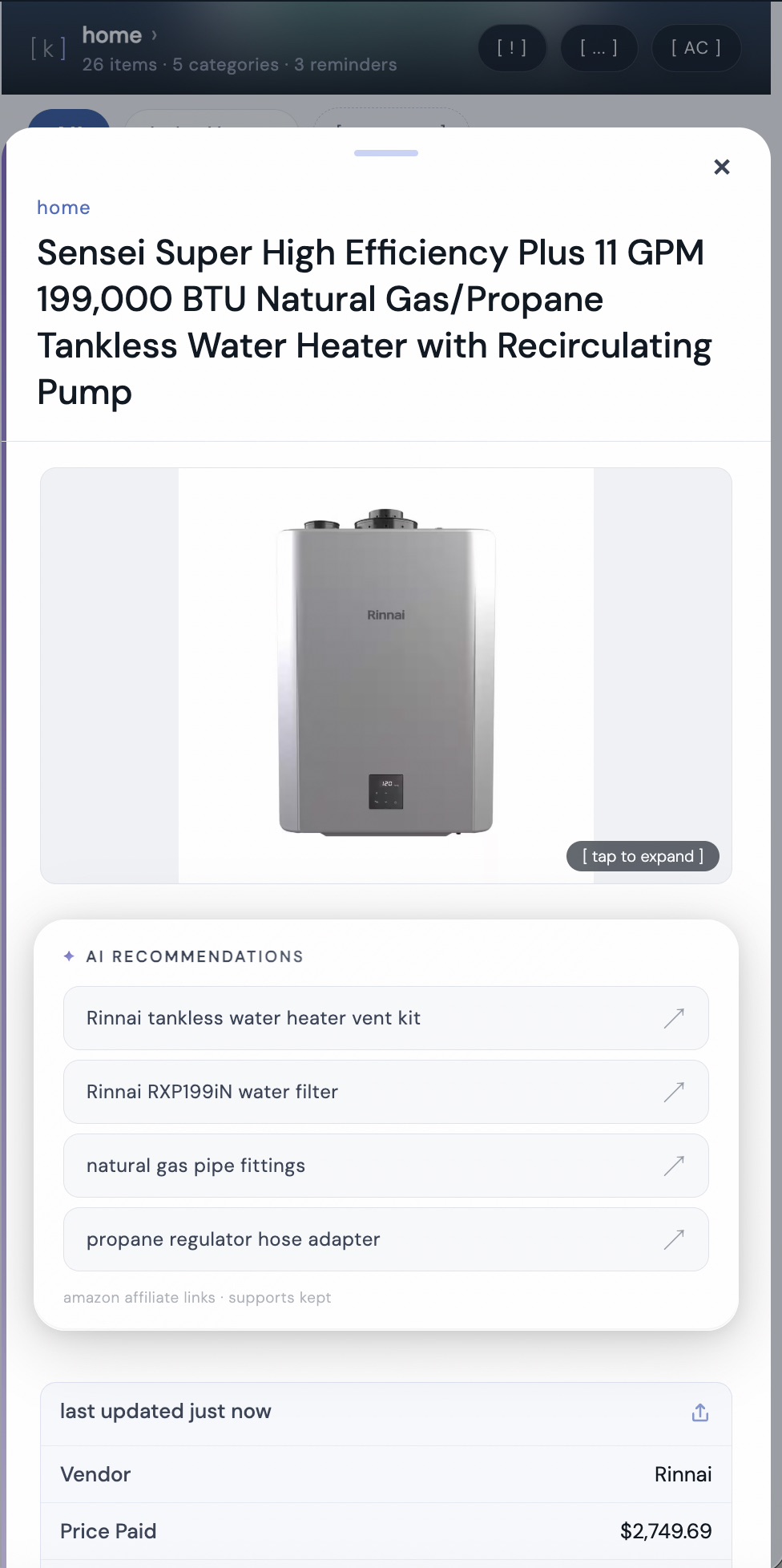
saved once with the model number, kept also surfaces the maintenance parts worth keeping on hand.
Descale the heat exchanger
The heat exchanger is the core of a tankless unit — it's where water gets heated. Mineral scale from hard water builds up inside it over time, reducing flow rate, cutting efficiency, and eventually causing the unit to fail or throw error codes. Annual descaling removes that buildup before it becomes a problem.
Most tankless units have service valves (isolation valves with ports for a pump) built into the cold inlet and hot outlet lines. The process:
- Shut off gas or power to the unit and close the water supply valve
- Connect a small submersible pump and hoses to the service valve ports
- Circulate a food-grade descaling solution (or undiluted white vinegar) through the unit for 45 to 60 minutes
- Flush with clean water for 5 minutes to rinse
- Close the service valves, restore water supply and power
In soft water areas you can go every 18 months. In hard water areas (water hardness above 11 gpg), do it every six months. If your unit is throwing an error code about flow rate or scale, descaling is almost always the fix.
Clean the inline filter
Most tankless units have a small screen filter on the cold water inlet that catches debris. Pull it out, rinse it under a tap, and reinstall. Takes two minutes. Do it every few months — more often if your water is cloudy or your pipes are older.
Check the air intake filter
Some models (including certain Rinnai units) have an air intake filter that keeps dust out of the combustion chamber. Check your owner's manual for its location. If it's visibly dusty, rinse it off and let it dry before reinstalling.
Annual professional service
Every year or two, have a licensed technician inspect the gas connections, venting, and heat exchanger. This is especially important in the first few years with a new unit. A good technician will also check the error code history and flag any patterns that suggest a developing issue.
How to find out how old your water heater is
The manufacture date is encoded in the serial number on the unit's data label. The label is on the side or top of a tank unit, or on the front of a tankless unit. The format varies by brand — the same principle that applies to any appliance serial number, which you can read more about in our guide on where to find appliance model numbers.
Here's how the major brands encode the year:
- Rheem / Ruud: The first four digits of the serial number are the year and week of manufacture. A serial starting with 2218 was made in the 22nd week of 2018.
- Bradford White: The second character is a letter representing the year. A=2004, B=2005, C=2006, D=2007, E=2008, F=2009, G=2010, H=2011, J=2012, K=2013, L=2014, M=2015, N=2016, P=2017, R=2018, S=2019, T=2020, U=2021, V=2022, W=2023, X=2024. (Note: I and O are skipped to avoid confusion with 1 and 0.)
- A.O. Smith / State / American: The first two characters encode the year. Look up your specific serial format on the brand's website using your model number.
- Rinnai: Most Rinnai units print the manufacture date directly on the label in a YYYY/MM format. If not, the serial number structure for your specific model is in the installation manual.
If you're not sure of your brand's format, a quick search for "[brand name] water heater serial number date decoder" will get you the answer in under a minute.
How long does a water heater last?
Tank water heaters: 8 to 12 years with regular maintenance. Without it, more like 6 to 8. The number one thing that shortens tank life is skipping the annual flush — sediment buildup accelerates corrosion from the inside.
Tankless water heaters: 15 to 20 years or more, provided they get descaled annually. The heat exchanger on a well-maintained tankless unit can last 20+ years. One that never gets descaled in a hard water area might fail in 8 to 10.
Water quality is the biggest variable either way. If you're on well water or in a high-hardness area, cut the expected lifespan by 20 to 30% unless you're running a softener or descaling on a tighter schedule.
Signs it needs to be replaced
Age alone isn't always a reason to replace a water heater. But age plus any of the following means it's time to start getting quotes rather than waiting for a failure.
Tank water heaters
- Rust-colored hot water — especially if it only appears on the hot side, not the cold. This means the tank is corroding internally.
- Rumbling or popping sounds during heating — that's sediment getting hot and crackling. Heavy enough sediment means the unit is working significantly harder than it should.
- Visible rust or wet spots around the base — small leaks at the fittings can sometimes be repaired, but rust on the tank body means the tank itself is failing.
- Consistently lukewarm water — if the unit can no longer heat a full tank before running out, the heating element (electric) or burner (gas) is degrading.
- Age over 10 years with any new problem — at this point, repairs rarely make financial sense. Start budgeting for replacement.
Tankless water heaters
- Recurring error codes — occasional codes can be cleared; codes that keep coming back after descaling and cleaning point to a failing component.
- Reduced flow rate that doesn't improve after descaling — significant heat exchanger damage that can't be cleared.
- Unit that's 15+ years old with any new issue — at that point, replacement parts may be discontinued and a new unit is likely more cost-effective.
The general rule: if the repair estimate is more than half the cost of a new unit installed, replace it. Find a plumber you trust through your contractor contact list before you're in emergency mode — getting three quotes when you're not desperate leads to much better outcomes than calling whoever answers on a Saturday morning.
How to track it all in kept
The hardest part of water heater maintenance isn't doing it — it's remembering to do it, and remembering when you last did it. A year goes by fast. When you can't remember if you flushed it last spring or the spring before, you either do it twice or skip it entirely.
Adding your water heater to kept takes about two minutes. Search for the model number (for a Rinnai RXP199iN, for example, kept pulls in the specs automatically), add the install date, and save your serial number in the notes. kept's AI reads the model and flags the recommended maintenance schedule and replacement window.
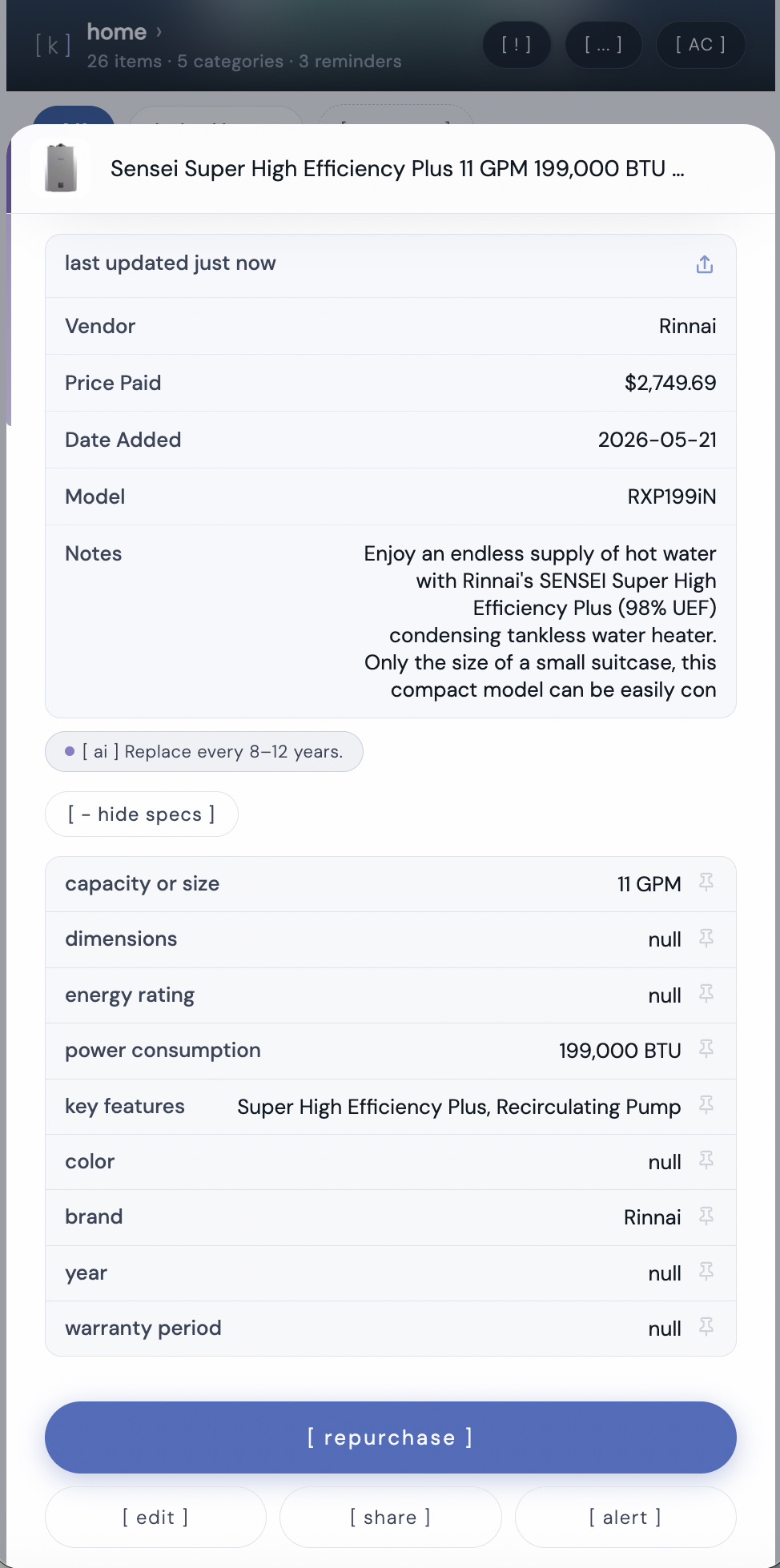
From there, set an annual alert for your flush or descaling date. Next year when the reminder fires, the service history is right there — last flush date, model, serial number, and any notes from your last technician visit. You'll also have the data you need for an appliance warranty claim if something fails within the coverage period.
The goal is to never be in the position of standing in front of a 12-year-old tank, not knowing the last time it was serviced, trying to decide whether to repair or replace. That's an avoidable situation. A home maintenance log that's actually kept current makes it a non-decision.
kept stores model number, install date, and every flush so you know exactly where your unit stands.
[ try kept free ]Frequently asked questions
How often should I flush my water heater?
Tank water heaters should be flushed once a year to remove sediment that builds up at the bottom of the tank. In areas with hard water, flush every six months. Tankless water heaters should be descaled (flushed with a deliming solution) annually, or every six months in hard water areas. Skipping flushes lets sediment and scale accumulate, which reduces efficiency and shortens the unit's life.
How long does a water heater last?
A tank water heater typically lasts 8 to 12 years with regular maintenance. Without it, expect 6 to 8. A tankless water heater can last 15 to 20 years or more if it's descaled annually and serviced by a technician every year or two. Water quality matters a lot — hard water shortens the lifespan of both types significantly.
How do I find out how old my water heater is?
The manufacture date is encoded in the serial number on the unit's data label. The format varies by brand. Rheem and Ruud use the first four digits as year and week (e.g., 2218 means the 22nd week of 2018). Bradford White uses a letter as the second character to indicate the year (A=2004, B=2005, up through the alphabet). A.O. Smith encodes the year in the first two characters. For Rinnai tankless units, the manufacture date is often printed directly on the label. If you save the serial number in kept, you can look this up any time.
What maintenance does a tankless water heater need?
Tankless water heaters need an annual descaling flush to remove mineral buildup from the heat exchanger — the part that heats the water. You circulate a food-grade descaling solution (or white vinegar) through the unit using a small pump and service valves for 45 to 60 minutes. You should also clean the inline water filter screen every few months, check the air intake filter if your model has one, and have a licensed tech inspect the gas connections and heat exchanger every year or two.
What are the signs my water heater needs to be replaced?
For tank water heaters: rust-colored hot water, a rumbling or popping sound during heating (that's sediment), visible rust or corrosion on the tank or fittings, water pooling around the base, or any unit older than 10 years that starts having problems. For tankless units: recurring error codes, noticeably reduced hot water flow or output, or scale buildup that can't be cleared with descaling. In both cases, if the repair cost is more than half the replacement cost, replace it.