Home Inventory for Renters: What to Document
You don't own the walls. You still own everything inside them. Here's how to build a renter's inventory that protects you when something goes wrong: theft, fire, flood, or a landlord who forgets what was already broken.

table of contents
Why renters need an inventory (more than you think)
Homeowners hear about home inventories constantly: from insurers, from financial planners, from every "new homeowner checklist" on the internet. Renters almost never do. The assumption is that renters own less, so the stakes are lower.
That assumption is wrong. Renters policies are commonly written for $20,000 to $30,000 of personal property, and once you add it up, plenty of one-bedroom apartments hold that much. A laptop, a TV, a couch, a bed, kitchen appliances, clothes, bikes, musical instruments. It adds up fast. And unlike homeowners, renters face three separate scenarios where an inventory pays for itself:
- Renters insurance claims. After a theft, fire, or burst pipe, your insurer pays based on what you can prove you owned. No documentation, no payout. Memory is not documentation.
- Security deposit disputes. Your landlord says the scratched floor is your fault. Your move-in photos say it was already there. The photos win.
- Knowing how much insurance to buy. Most renters guess at coverage amounts and guess low. An inventory gives you the real number.
How inventory connects to renters insurance
Renters insurance is cheap: 2026 national averages run about $13 to $23 a month depending on the coverage assumed (NerdWallet puts it at about $13 a month for $30,000 of personal property and $100,000 of liability), with Louisiana and parts of the Southeast costing the most. It covers personal property, liability, and additional living expenses if your apartment becomes uninhabitable. The personal property portion (the part that replaces your stuff) is where your inventory matters.
Two things to know:
Replacement cost vs. actual cash value
Actual cash value (ACV) policies pay what your item is worth today, after depreciation. Your three-year-old laptop that cost $1,200 might pay out $400 to $500. Replacement cost policies pay what it costs to buy a new equivalent. The difference on a single claim can be thousands of dollars.
Your inventory helps either way: the insurer still needs proof you owned the item, when you bought it, and what you paid. But if you have a choice, replacement cost coverage is worth the small premium increase.
Coverage limits and scheduled items
Standard renters policies cap personal property coverage at $20,000 to $50,000 total, with sub-limits on categories like jewelry ($1,500), electronics ($2,500), and bicycles ($1,000). If your inventory reveals you own $4,000 in jewelry or $6,000 in camera equipment, you need a scheduled rider, and your inventory is what proves that to the insurer.
Without an inventory, most renters pick a coverage number that feels right and hope it's enough. That is a bet you do not want to lose.
What to document in your apartment
You do not need to catalog every coffee mug. Focus on items that cost money to replace or that have serial numbers an insurer will ask for.
Priority items for renters
- Electronics: laptop, tablet, phone, TV, gaming console, speakers, headphones. Record serial numbers. They are on the bottom, back, or in Settings.
- Furniture over $200: couch, bed frame, mattress, dining table, desk. Photo plus approximate purchase price.
- Kitchen appliances: stand mixer, blender, coffee machine, Instant Pot. Anything you would not want to re-buy.
- Bikes and sporting gear: serial number is stamped under the bottom bracket on bikes. Skis, golf clubs, and gym equipment add up.
- Musical instruments: guitars, keyboards, amps. Serial numbers are on the headstock or back panel.
- Jewelry and watches: photo, appraised value if you have it, and purchase receipt. These hit sub-limits fast.
- Clothing collections: you do not need every shirt, but a closet-wide photo plus an estimate covers the category.
- Tools: drill sets, toolboxes, camping gear. Easy to forget, expensive to replace all at once.
kept is reader-supported. When you buy through links on this page we may earn a small commission, at no extra cost to you. It never changes what we recommend.
What you can skip
Consumables (food, toiletries), low-value decor under $50, and anything you would not bother claiming. If replacing it costs less than your deductible, it does not need an entry.
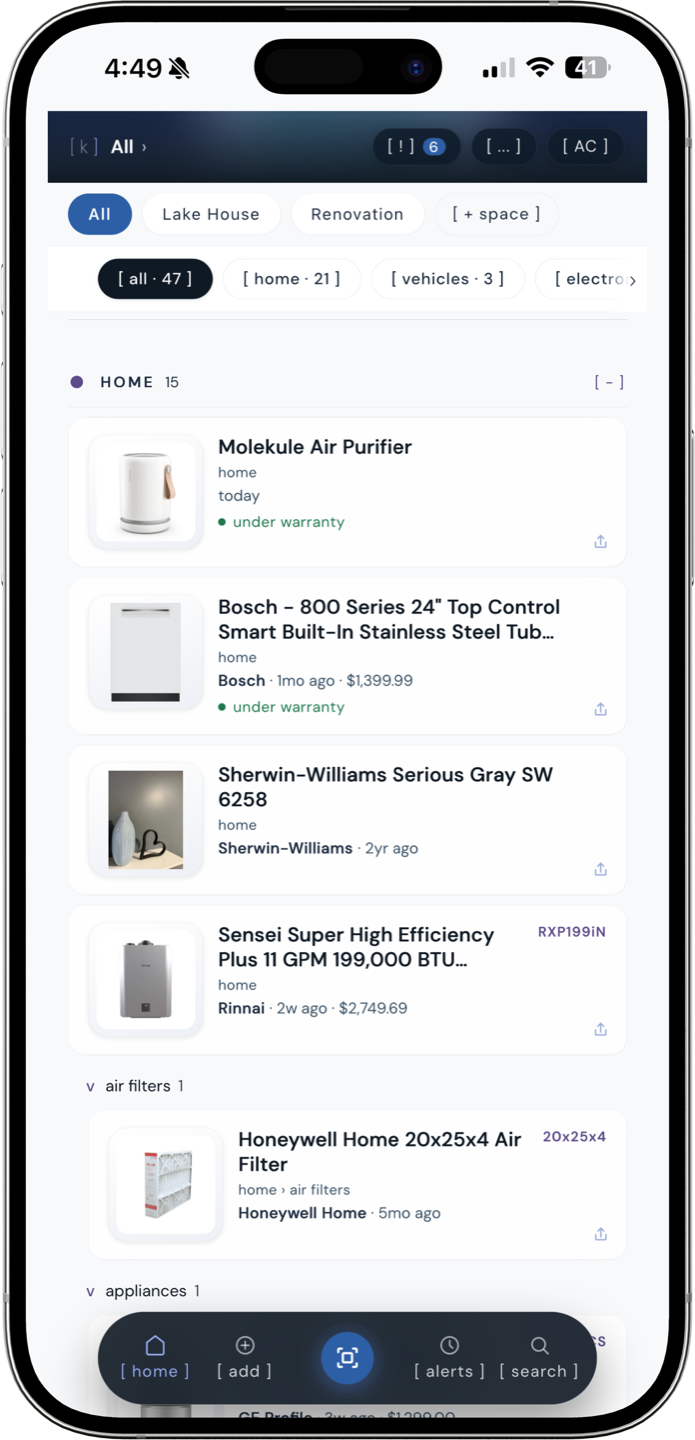
a renter's inventory in kept: electronics, appliances, and furniture organized by category with prices and warranty dates.
The move-in inventory: protecting your deposit
This is the renter-specific move that homeowners never need to think about. On move-in day, before you unpack, walk through the apartment and document every existing flaw:
- Scratched or stained floors
- Wall damage: scuffs, holes, cracked paint
- Stained or torn carpet
- Chipped countertops or cabinets
- Appliance condition: dents, rust, broken handles
- Window and door condition: cracked glass, broken locks, damaged screens
- Bathroom fixtures: stained tubs, dripping faucets, missing caulk
Take photos with your phone. The metadata includes the date and time automatically. If your landlord provides a move-in condition form, fill it out thoroughly. If they do not, your timestamped photos are your form.
Store these alongside your personal inventory. When your lease ends and the landlord tries to deduct for a scratch that was there before you moved in, you have proof. In most states, landlords must return your security deposit within 14 to 30 days and provide an itemized deduction list. Your photos make disputing unfair charges straightforward.
One app for both jobs
kept stores your personal property inventory and your move-in condition photos in the same place. Tag the apartment items by room and add notes like "existing damage, move-in." When you move out, everything is in one export.
try kept free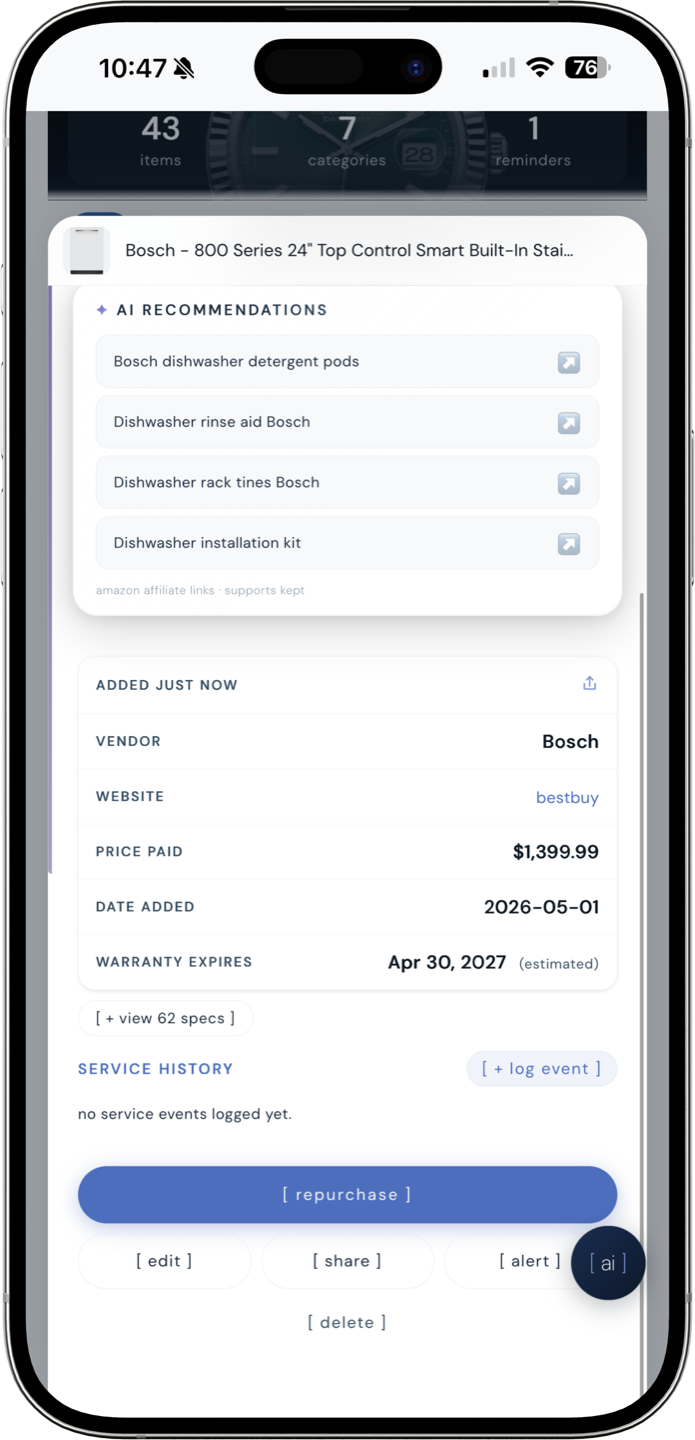
item detail view: vendor, price paid, warranty expiration, and 62 specs saved from a single barcode scan.
Roommates: who owns what
Shared apartments create a specific problem: when two or three people split a living room, nobody remembers who bought the bookshelf. This matters when someone moves out, when something breaks, and especially when filing an insurance claim (your policy covers your belongings, not your roommate's).
Three rules that prevent arguments:
- Each person inventories their own stuff. Your inventory, your items. If you bought the couch, it is on your list. If your roommate bought the TV, it is on theirs.
- Shared purchases get a note. Split a coffee table 50/50? Both of you add it with a note: "split with [name], $150 each." This matters for insurance. You can only claim your share.
- Photos resolve disputes. Before anyone moves out, each person photographs their items in place. "That was my lamp" is hard to argue when the other person has a photo of it in their old apartment.
kept's family sharing feature lets roommates share a space so everyone sees the full apartment inventory, while each item is tagged to its owner.
How to build your inventory in 30 minutes
Apartments are smaller than houses. That is your advantage. Most renters can cover their entire apartment in a single session.
- Living room (10 minutes): TV, speakers, gaming console, couch, coffee table, bookshelf contents worth noting. Scan barcodes on electronics. kept pulls model details automatically.
- Bedroom (8 minutes): bed frame, mattress, laptop, tablet, jewelry, closet overview photo.
- Kitchen (5 minutes): stand mixer, blender, nice cookware, knife set. Skip utensils and plates unless they are high-end.
- Entryway and storage (5 minutes): bike, tools, camping gear, seasonal items in closets.
- Bathroom (2 minutes): electric toothbrush, hair tools, anything over $50. Quick.
For a deeper walkthrough of the room-by-room method, see home inventory for insurance. The process is the same whether you rent or own. The difference is what you do with the data afterward.
When you move: take the inventory with you
Renters move more often than homeowners. The median renter stays 2 to 3 years. Your inventory should move with you, not live in a shoebox of receipts that gets lost in the shuffle.
A browser-based app like kept is built for this. Your inventory is tied to your account, not your device. Open it on any phone, any browser, any new apartment. When you move:
- Before packing: update your inventory with anything new since you last added items. Good time to delete things you got rid of.
- During the move: photograph high-value items before they go in the truck. If movers damage your TV, the photo plus your inventory entry is your claim.
- After move-in: do the move-in condition walk of the new place. Update room assignments on existing items. Add new purchases as you unbox them.
For a complete moving checklist, see moving inventory checklist.
Frequently asked questions
How do I make a renters insurance inventory list?
Go room by room, starting with the most expensive items. For each one, record the name, a photo, purchase date, price paid, and serial or model number if it has one. Focus on items over $50 and anything with a serial number: electronics, furniture, kitchen appliances, bikes, instruments, jewelry, and tools. Export the finished list as a CSV or PDF and share it with your insurer. The whole process takes about 30 minutes.
How much personal property coverage do I need for an apartment?
Add up the replacement cost of everything you own. That is your coverage target. Most renters guess low because they forget closets, kitchen drawers, and storage. A home inventory gives you the real number instead of a guess. A typical policy with $30,000 in personal property coverage costs roughly $13 to $23 a month in 2026. If your total exceeds that, raise the limit or you will be under-insured.
Do I need receipts to file a renters insurance claim?
Receipts help, but they are not the only proof adjusters accept. Photos of the item, screenshots of online order confirmations, credit card statements, and serial numbers all count. An inventory app like kept stores photos, model numbers, and purchase dates together so you have multiple forms of proof for each item without digging through email or file drawers.
What is the difference between Actual Cash Value (ACV) and Replacement Cost Value (RCV) for renters?
ACV pays what the item was worth at the time of loss, factoring in depreciation. A three-year-old laptop worth $1,200 new might pay out $400 to $500. RCV pays what it costs to buy the same item new today, so that laptop claim pays $1,200. RCV policies cost a few dollars more per month but close the gap on big-ticket electronics and furniture. Check your policy declarations page to see which you have.
Should I list landlord-provided appliances on my home inventory?
Yes, but mark them as landlord-owned. Documenting the fridge, stove, dishwasher, and HVAC at move-in protects you from being charged for pre-existing damage at move-out. Take a photo showing the condition and note the model number. If a landlord appliance is recalled, your inventory helps you notify the property manager with the exact model and recall details.