
Home Inventory for Insurance: A Room-by-Room Guide
About 1 in 18 insured homes has a claim each year, and fire and lightning claims averaged $88,170 from 2019 to 2023. Non-catastrophe fire claims alone averaged $173,111 in 2024, nearly double 2020. The homeowners who get paid in full have one thing in common: they could prove what they owned. This is how to build that proof before you need it.

table of contents
- A $94,000 lesson in why inventories matter
- What adjusters actually want to see
- What to include, room by room
- ACV vs. replacement cost: how documentation affects payout
- The high-value categories that need extra coverage
- The fastest way to start
- Where to store it and when to update
- Common mistakes that cost people money
- FAQ
A $94,000 lesson in why inventories matter
The following is a composite case study, drawn from common patterns we hear from kept users and from public adjuster write-ups. Names and specifics are illustrative, but the dynamic is real and repeats often.
Mark and Sarah live in a four-bedroom house outside Denver. Two-car garage, finished basement, a husband who collects power tools and a wife who collects vintage cookware. In late winter, a lithium battery on a charger in the garage failed. The fire spread to the kitchen before the department contained it. No one was hurt. The structure was repairable. The contents were not.
Their policy had $250,000 in personal property coverage on a replacement-cost basis. They expected the claim to be straightforward. It was not.
The adjuster asked for a contents list. Not a vague one. Item-by-item, with descriptions, model numbers, purchase dates, and prices. Sarah pulled out a phone and started typing what she could remember. Some things were obvious: the refrigerator, the espresso machine, the KitchenAid. Other things were not. What model was the air fryer? Which year did they buy the sectional? How many of those All-Clad pans were 10-inch and how many were 12-inch?
Two weeks in, Mark was reconstructing his tool inventory by scrolling through Amazon order history and Home Depot email receipts. He estimated the rest. Sarah did the same with the kitchen. They submitted a list of about 380 items totaling $112,000.
The adjuster paid $94,000 of it. The gap came from three places: items they could not prove they owned (no photo, no receipt, no model number) were paid at a depreciated generic value or denied. Items with proof were paid at full replacement cost. A pair of vintage Wüsthof knives that Sarah remembered as costing $400 was valued at $90 because nothing connected the memory to a purchase. A Milwaukee impact driver with a model number and a registration record was paid at $279, the current retail.
The lesson is not that the insurer was unfair. The lesson is that every item you can't prove is an item you argue about, and items you forget never get claimed at all. The stakes keep climbing: according to Insurance Information Institute data, the average non-catastrophe fire claim rose from $99,613 in 2020 to $173,111 in 2024. The work to protect yourself is about three hours.
What adjusters actually want to see
"Proof of ownership" is the phrase the industry uses. An adjuster needs two things for every item in the claim: that you owned it, and what it was worth. The forms of evidence that satisfy both, ranked roughly by strength:
- Receipts and invoices. The strongest single piece of evidence. Date, price, and item all in one document.
- Credit card and bank statements. If the original receipt is gone, a card statement showing the purchase at the retailer is enough for most claims.
- Photos and video of the item in your home. Proves the item existed and was in your possession. A close-up of a serial plate plus a wider shot showing the item in its room is hard to dispute.
- Owner's manuals, original boxes, and product registrations. A registered product, especially for tools and electronics, ties you to the serial number on the manufacturer's side.
- Appraisals. Required for jewelry, art, antiques, and collectibles above your policy sublimit. Without one, the insurer values those items at the sublimit, not what they are worth.
- Witness statements. Weakest, but accepted. A neighbor or family member confirming items they saw in your home supports the claim when nothing else exists.
A single piece of evidence is usually enough for a small item. For anything above a few hundred dollars, stack two or three. A photo plus a receipt plus a serial number is essentially uncontestable. Our step-by-step guide on how to file a home insurance claim walks through what to send the adjuster and in what order.
One tap, ready for the adjuster
kept exports an insurance packet PDF with item descriptions, model numbers, purchase prices, and a total replacement value. Send it to your insurer or save it off-device. Scan a barcode to add items in seconds.
try keptWhat to include, room by room
You don't need to catalog every fork. Focus on items over $50 and anything with a serial number.
Living room
- Television: make, model, serial number. Usually the single highest-value item in a living room. Full guide on where to find model numbers on electronics and appliances.
- Audio equipment: soundbars, receivers, subwoofers, streaming devices
- Furniture with real value: sectionals, recliners, entertainment centers
- Gaming consoles and accessories
- Artwork, rugs, decorative items over $100
Kitchen
- Major appliances: refrigerator, dishwasher, range, microwave. Model numbers are on data plates inside the door or on the back panel.
- Small appliances: espresso machine, stand mixer, air fryer, blender. A KitchenAid stand mixer is $400+. A Breville espresso machine can be $600. These matter.
- High-value cookware: All-Clad, Le Creuset, and similar sets are worth documenting by piece.
Bedrooms
- Electronics: laptops, tablets, phones, smart watches. Serial numbers are in Settings on phones and tablets; on the bottom of laptops.
- Jewelry: description and approximate value for everyday pieces, full appraisal for anything over $500. Standard policies cap jewelry coverage at $1,500–$2,500 without a rider.
- Mattress: brand and size. A quality mattress is $800–$2,000.
Home office
- Computers and monitors: serial numbers matter most here. A single desktop setup can be $2,000–$5,000.
- Peripherals: external drives, docking stations, webcams, headsets
- Printers and scanners
Garage and storage
- Power tools: brand, model, approximate purchase price. A set of Dewalt or Milwaukee tools runs several thousand dollars.
- Lawn equipment: mower, leaf blower, chainsaw, pressure washer
- Bikes and sports gear: road bikes especially ($1,000+)
- Items in storage bins: holiday decorations, camping gear, seasonal items. These are among the most consistently underclaimed after a loss.
kept is reader-supported. When you buy through links on this page we may earn a small commission, at no extra cost to you. It never changes what we recommend.
ACV vs. replacement cost: how documentation affects payout
Two phrases drive almost every contents claim: actual cash value (ACV) and replacement cost value (RCV). Your policy uses one or the other for personal property, and the difference is enormous.
Actual cash value pays what the item is worth today, after depreciation. A 5-year-old laptop that cost $2,000 new and has an assumed 5-year life is worth roughly $0 to your insurer on an ACV basis. Even at 2 years old, it would be valued near $1,200.
Replacement cost value pays what it costs to buy an equivalent new item today. The same 5-year-old laptop pays out at the price of a comparable new model, not its depreciated value. RCV coverage costs about 8% more in annual premium, on average, and is almost always worth it for personal property.
Here is the part most people miss: on most RCV policies, the insurer first pays the ACV amount, then pays the rest only after you replace the item and submit proof. No proof of replacement, no RCV payout. The inventory matters at both ends. You document what you owned to start the claim, then document what you replaced to collect the full amount.
Check your declarations page now. Look for "personal property" or "Coverage C" and the words "replacement cost" or "actual cash value." If it says ACV, call your agent and ask what RCV would cost. The premium difference is usually small. The payout difference after a major loss is not.
The high-value categories that need extra coverage
Standard homeowners policies have sublimits. A sublimit is a cap on how much the insurer pays for a specific category, regardless of your overall coverage. The most common surprises:
- Jewelry: typically $1,000–$2,500 total. A single $4,000 ring exceeds the cap on its own. Schedule it with a rider for about $1.50–$2 per $100 of value per year.
- Cash: usually capped around $200. Keep large amounts in a bank or a properly scheduled safe.
- Firearms: often capped at $2,500 for theft.
- Silverware and flatware: typically $2,500 for theft.
- Business property in the home: often $2,500. Home offices with high-value equipment need a rider.
- Collectibles, art, and antiques: covered at fair market value, which often falls far below replacement, and only with an appraisal on file.
The fix is a scheduled personal property endorsement, sometimes called a rider or floater. You list specific items with appraised values. Each scheduled item bypasses the sublimit, often carries a $0 deductible, and is usually covered against broader perils including accidental loss and mysterious disappearance.
For the inventory itself: photograph appraisals, receipts, and certificates of authenticity for anything you schedule. Store the documents in the same cloud folder as your inventory.
The fastest way to start
Three methods work. Pick one based on how much time you have and how much detail you want.
Option 1: A 15-minute video walkthrough
Walk through every room narrating what you see. Open closets. Open cabinets. Open drawers. Pan slowly across shelves so the camera catches titles, brands, and labels. Step into the garage. Open every tool chest. Upload the file to Google Drive, iCloud, or Dropbox the same day. Email a copy to yourself as a backup.
This is the minimum viable inventory. It is not detailed, but it is dramatically better than nothing and adjusters accept it as a starting point.
Option 2: A spreadsheet
Columns: Item, Description, Purchase Date, Purchase Price, Model/Serial, Photo link, Receipt link. One row per item. Slower than video but searchable and sortable. Hand it directly to an adjuster or upload to your insurer's claims portal.
Option 3: A home inventory app
Apps built for this purpose, including kept, let you photograph items, scan barcodes to auto-fill the make and model, and organize by room. The output is a structured record that includes photos and stays synced to the cloud, accessible after a loss even if your phone was damaged. For a full comparison, see our guide to the best home inventory app.
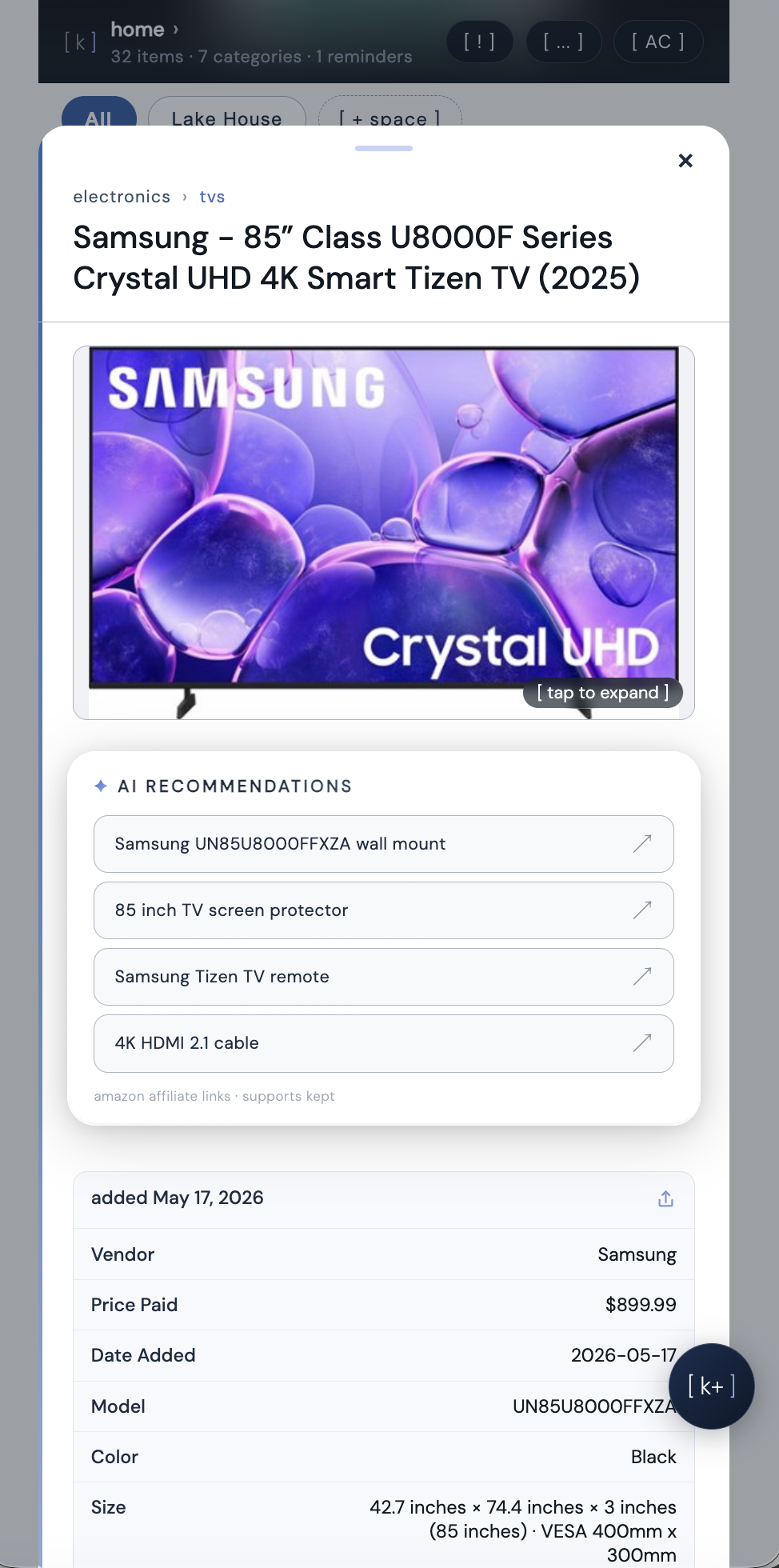
model number, serial, purchase date: everything an adjuster will ask for, captured in one screen.
The 80/20 priority order
Do not try to document the whole house in one session. Start with the five rooms that hold the highest claim value:
- Home office (laptops, monitors, peripherals: easily $5,000+ in one room)
- Living room (TV, audio, gaming, furniture)
- Kitchen (appliances and small appliances)
- Garage and basement storage (tools, lawn equipment, sports gear, holiday bins)
- Primary bedroom (jewelry, mattress, watches, electronics)
For each room: photograph the space from the doorway first to establish the wide view. Then photograph individual high-value items. Capture serial number stickers on the back or bottom of electronics. Scan barcodes on appliances and tools. Same approach as appliance warranty tracking, and the same information solves both problems.
Three hours over a weekend covers a typical household. By the time you finish, you have a cloud-synced record of the items that account for 80%+ of your contents value.
Where to store it and when to update
Storage rule one: not only in your house. The inventory is most useful after a fire, flood, or break-in, which is exactly when documents stored at home are gone or inaccessible. If you live in hurricane or wildfire country, our hurricane home inventory guide covers the fast pre-storm version and where to store it so the disaster can't take both.
Use at least two layers:
- Cloud sync. Google Drive, iCloud, Dropbox, or a home inventory app like kept that backs up automatically. This is the primary copy.
- An off-device backup. Email yourself a PDF or CSV every few months. Or hand a USB drive to a family member outside the house.
- A fireproof safe for irreplaceable physical documents: appraisals, marriage certificates, passports, original receipts for high-value items. A safe protects against fire but not theft or total structural loss, so it is one layer of three, not the only layer.
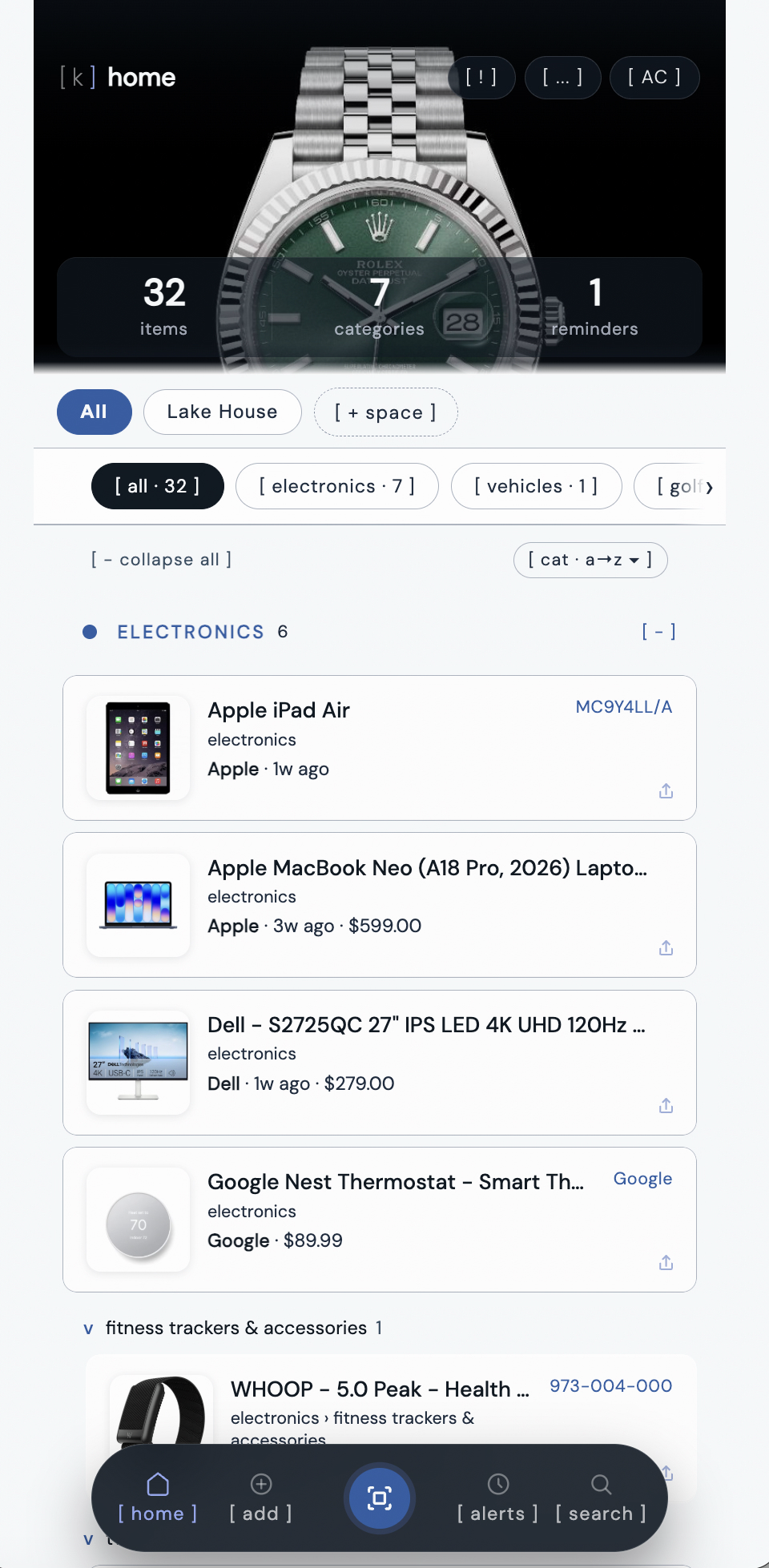
your whole house, organized. accessible from any device after a loss.
How often to update: review the full inventory once a year, ideally the month before your homeowners policy renews. In between, add new items as you buy them. A rule that works: anything over $100, log it before you throw out the receipt. Anything over $1,000, log it the same day, with a photo and the serial number.
Your inventory is part of a larger set of homeowner records that belong in one place. The post on things to remember about your house covers paint codes, contractor contacts, filter sizes, and the other information that lives nowhere until you need it.
Common mistakes that cost people money
Six patterns we see again and again:
- Storing the inventory only on the phone it was built on. The phone is in the house. The house is on fire. The inventory is gone with the phone. Always sync to the cloud.
- Skipping the garage, attic, and basement. Storage areas hold thousands of dollars in tools, holiday decorations, sports gear, and seasonal items. They are also the most consistently underclaimed after a loss.
- No serial numbers. A photo of "a Sony TV" gets you a generic ACV payout. A photo plus the model number on the back gets you a specific replacement cost.
- Not scheduling jewelry or art. The default sublimit will not cover anything significant. A rider is cheap. The gap without one is not.
- Forgetting to update after big purchases. A new $3,500 sectional logged in the inventory is paid out. The same sectional bought after the last update and never logged is a memory.
- Not telling a spouse or partner where the inventory lives. In a real loss, one person is often handling logistics while the other is dealing with displacement and family. Both need access.
Frequently asked questions
What should be included in a home inventory?
A home inventory should include every item worth more than $50 plus anything with a serial number. For each item, record a description, the purchase date, the purchase price, and the model or serial number. Add a photo of the item and a copy of the receipt for high-value purchases. The categories that matter most for insurance payouts are electronics, major and small appliances, furniture, jewelry, tools, and anything stored in the garage, attic, or basement.
How often should I update my home inventory?
Review your home inventory at least once a year and add new items as you buy them. The easiest rule is to log anything that costs more than $100 before you throw out the receipt. A good time to do an annual review is the month before your homeowners policy renews. An out-of-date inventory is almost as bad as no inventory: if you bought a new TV last year and never logged it, the adjuster has nothing to value it against.
What proof do you need for a home insurance claim?
Adjusters look for proof of ownership and proof of value. Receipts and credit card statements are the strongest form of proof. Photos and video walkthroughs prove the item was in the home. Serial numbers, model numbers, and product registrations confirm the exact item. Appraisals are required for jewelry, art, and collectibles above your policy sublimit. The more documentation you have for a single item, the harder the claim is to dispute or depreciate.
Do insurance companies require a home inventory?
No homeowners policy requires an inventory before a loss. But when you file a claim, you have to prove what you owned and what it was worth. Without an inventory you are reconstructing that list from memory in the middle of a crisis. Adjusters can only pay for items you document, so the inventory is effectively required at claim time. Building it before a loss is the only practical option.
What is the best way to do a home inventory?
The best way is a phone-based inventory that stores photos, model numbers, and purchase prices in the cloud. A video walkthrough is the fastest starting point: walk every room, narrate, open closets and drawers, then back it up off-device. From there, log high-value items individually with serial numbers and receipts. A dedicated app like kept handles photo storage, barcode scans for model number lookup, and room-by-room organization without spreadsheet maintenance.