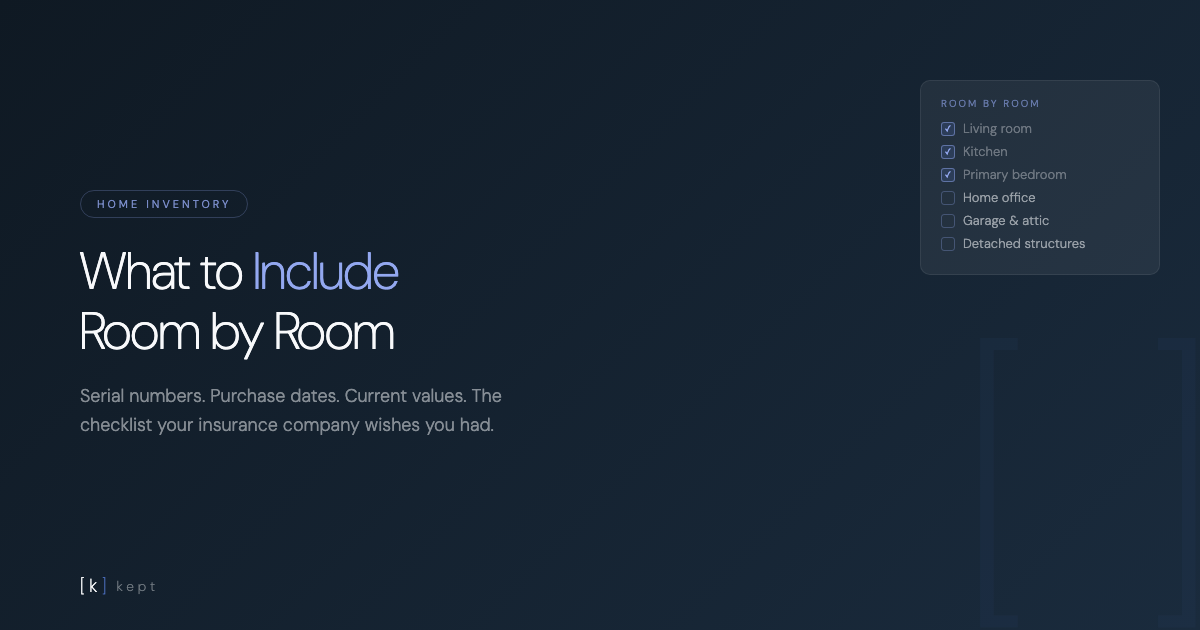
Home Inventory Checklist: What to Include Room by Room
Most people don't build a home inventory until after something goes wrong. A pipe bursts, a fire starts, or a thief walks off with $8,000 in electronics. Then the insurance adjuster asks for serial numbers, purchase dates, and photos. You have none of it.
table of contents
Why you need a home inventory
Your homeowners or renters insurance policy includes personal property coverage. That's the part that pays to replace your belongings after a covered loss. But getting paid requires proof: what you owned, when you bought it, and what it was worth.
Without a home inventory list, you're reconstructing that proof from memory during one of the worst weeks of your life. Insurance adjusters process claims faster when you hand them a documented list with photos, serial numbers, and receipts. Undocumented claims get smaller payouts. Yet only 47% of homeowners have a home inventory at all, according to a 2023 Triple-I and Munich Re survey, so most claims start from memory, and memory forgets whole closets.
A home inventory also helps beyond insurance. It shows you what you own for estate planning. It gives you proof of ownership if something is stolen and recovered. And if you ever need to file a home insurance claim, having a finished inventory means you spend time recovering, not scrambling.
stop guessing what you own when it matters most
kept builds your home inventory as you go. Scan a barcode, snap a photo, and it fills in the model number, specs, and value. Free on any phone.
[ try kept free ]What to document for every item
A home inventory is only useful if you capture the right details. Recording "TV" doesn't help an insurance adjuster. Recording "Samsung QN65Q80D, 65-inch QLED, serial #04M33CPK500231, purchased 2025-03-14 for $1,097.99 at Best Buy" does.
For each item worth more than $50, record these fields:
- Brand and model number (on the product label or data plate)
- Serial number (unique to your unit, needed for warranty claims and police reports)
- Purchase date and purchase price (check email receipts, credit card statements, or Amazon order history)
- Estimated current value (what it would cost to replace today)
- Proof of purchase (receipt, invoice, or screenshot of the online order)
- Photos (front, back, and the data plate with serial/model info)
High-value items need more. Jewelry, fine art, antiques, or collectibles worth over $2,500 should have a professional appraisal on file. Standard homeowners policies have a low theft limit for jewelry, generally $1,500 according to Triple-I, unless you add a rider or schedule the pieces, so the appraisal certificate matters twice: once for the claim and once to prove you need the rider in the first place.
You can find model numbers on almost any appliance. Here's a full guide on where to find your appliance model number by appliance type.
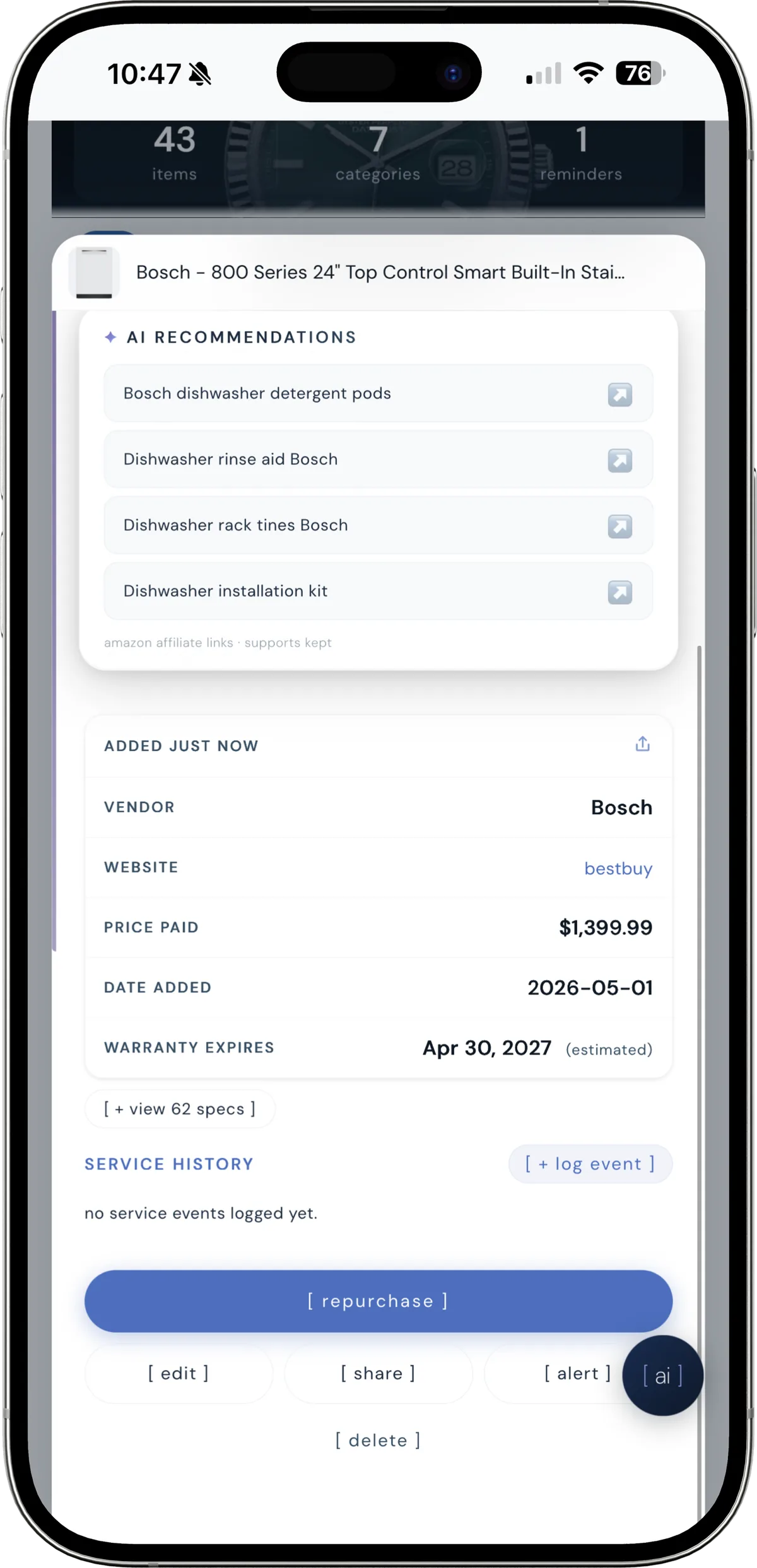
vendor, price, purchase date, warranty expiration. all saved in one scan.
The room-by-room checklist
Working room by room is the fastest way to build a complete home inventory list. You cover every corner, you don't skip rooms, and you can stop and restart without losing your place. Start with the room that has the most expensive items and work outward.
Living room
- ☐ Television (brand, model, screen size, serial number)
- ☐ Sound system, soundbar, or speakers
- ☐ Streaming devices (Apple TV, Roku, Chromecast)
- ☐ Gaming consoles and controllers
- ☐ Sofa, loveseat, and chairs (brand, material, purchase date)
- ☐ Coffee table, end tables, bookshelves
- ☐ Area rugs (brand, dimensions, material)
- ☐ Lamps and light fixtures
- ☐ Artwork and framed photos
- ☐ Window treatments (curtains, blinds, shades)
Kitchen
- ☐ Refrigerator (brand, model, serial)
- ☐ Oven/range (brand, model, serial)
- ☐ Dishwasher (brand, model, serial)
- ☐ Microwave (brand, model, serial)
- ☐ Small appliances: stand mixer, blender, coffee maker, toaster, food processor, Instant Pot
- ☐ Cookware sets and cast iron
- ☐ Knife sets
- ☐ Silverware and serving pieces
- ☐ Small electronics (tablet, smart display)
Primary bedroom
- ☐ Bed frame and headboard
- ☐ Mattress (brand, model, warranty card)
- ☐ Dressers, nightstands, wardrobes
- ☐ Jewelry (get a professional appraisal for pieces over $2,500)
- ☐ Watches
- ☐ Laptops, tablets, phones
- ☐ Television and electronics
Bedrooms (additional)
- ☐ Beds and mattresses
- ☐ Dressers and desks
- ☐ Electronics (gaming setups, monitors, speakers)
- ☐ Musical instruments
- ☐ Collectibles, trading cards, memorabilia
Home office
- ☐ Desktop computer or laptop (brand, model, serial)
- ☐ Monitors
- ☐ Printer/scanner
- ☐ Desk, chair, and bookshelves
- ☐ External hard drives and backup devices
- ☐ Camera equipment
kept is reader-supported. When you buy through links on this page we may earn a small commission, at no extra cost to you. It never changes what we recommend.
you already know you should do this. kept makes it take an afternoon, not a weekend.
Scan barcodes. Snap photos. AI fills in the model number, specs, and value. Room by room, item by item.
[ try kept free ]Bathrooms
- ☐ Electric toothbrush, water flosser
- ☐ Hair dryer, flat iron, styling tools
- ☐ Scale
- ☐ Medicine cabinet contents (high-value prescriptions)
Laundry room
- ☐ Washing machine (brand, model, serial)
- ☐ Dryer (brand, model, serial)
- ☐ Iron and steamer
Garage, basement, and attic
- ☐ Power tools: drill, circular saw, table saw, miter saw
- ☐ Hand tools: wrenches, sockets, screwdrivers
- ☐ Lawn mower, string trimmer, leaf blower
- ☐ Snow blower
- ☐ Bicycles
- ☐ Sporting equipment: golf clubs, skis, kayaks, camping gear
- ☐ Holiday decorations (these add up faster than you think)
- ☐ Off-season clothing and coats
- ☐ Luggage
- ☐ Water heater (brand, model, serial, capacity)
- ☐ Furnace/HVAC unit (brand, model, serial, filter size)
- ☐ Chest freezer
- ☐ Wine collection
Detached structures (shed, workshop, pool house)
- ☐ Riding mower or zero-turn
- ☐ Pressure washer
- ☐ Generator
- ☐ Pool equipment (pump, heater, robotic cleaner)
- ☐ Outdoor furniture sets
- ☐ Grill or smoker
Commonly forgotten items
The items people skip are the ones that hurt most during a claim. Nobody forgets the TV. Everybody forgets the $3,000 in tools hanging on the garage pegboard.
These categories get missed over and over:
- Off-season clothing stored in bins in the attic or basement. Winter coats alone can be worth $200 to $500 each.
- Sporting equipment in the garage: golf clubs ($800+), skis and boots ($1,200+), bicycles ($500 to $5,000+).
- Tools accumulate over years. A well-stocked garage easily holds $2,000 to $10,000 in hand and power tools.
- Holiday decorations add up to $500 to $2,000 for most families.
- Window treatments are expensive to replace. Custom blinds and curtains can run $300 to $1,000 per room.
- Light fixtures and ceiling fans are personal property, not part of the building structure.
- Contents of drawers: silverware, kitchen gadgets, junk-drawer electronics, batteries, chargers.
- Books, vinyl, and media collections that took decades to build.
Tip: Walk through your home with your phone camera recording a slow video. Open every drawer, every closet, every cabinet. A video walkthrough takes 15 minutes and catches items you'd never think to list individually. It's not a replacement for a detailed inventory, but it's a visual record that supports your claim.
How to value items for insurance
Your insurance policy pays out in one of two ways, and the difference matters. Replacement cost coverage pays what it costs to buy the same item new today. Actual cash value coverage deducts depreciation, so a $1,200 laptop you bought three years ago might only pay out $400.
Check your policy. If you have actual cash value coverage, consider upgrading to replacement cost. The premium difference is small compared to the payout difference after a total loss.
How to record values
- Purchase price: the amount you paid at the time. Find it in email receipts, credit card statements, or online order history.
- Estimated current value: what a comparable new item costs today. Search the current price on Amazon or the manufacturer's website.
- Proof of purchase: screenshot the order confirmation or photograph the paper receipt. If you don't have a receipt, a credit card statement line item works. So does a photo of the item with a visible serial number, which your insurer can cross-reference with manufacturer records.
For items where you can't find receipts, don't panic. A detailed photo showing the brand, model, and condition is strong proof of ownership. Registering your appliances with the manufacturer also creates a paper trail tied to your name.
The fastest ways to build your inventory
The best method is the one you'll finish. A half-done home inventory spreadsheet in Google Sheets is worth less than a complete one in any format. Pick the method that matches how you work.
Home inventory app
The fastest option. A good home inventory app lets you scan barcodes, take photos, and auto-fill product details. You build the inventory on your phone as you walk through the house. The data lives in the cloud, so it survives any event that damages your home. kept does all of this and adds AI-powered lookup, so scanning a barcode or snapping a photo fills in the model number, specs, and current value automatically.
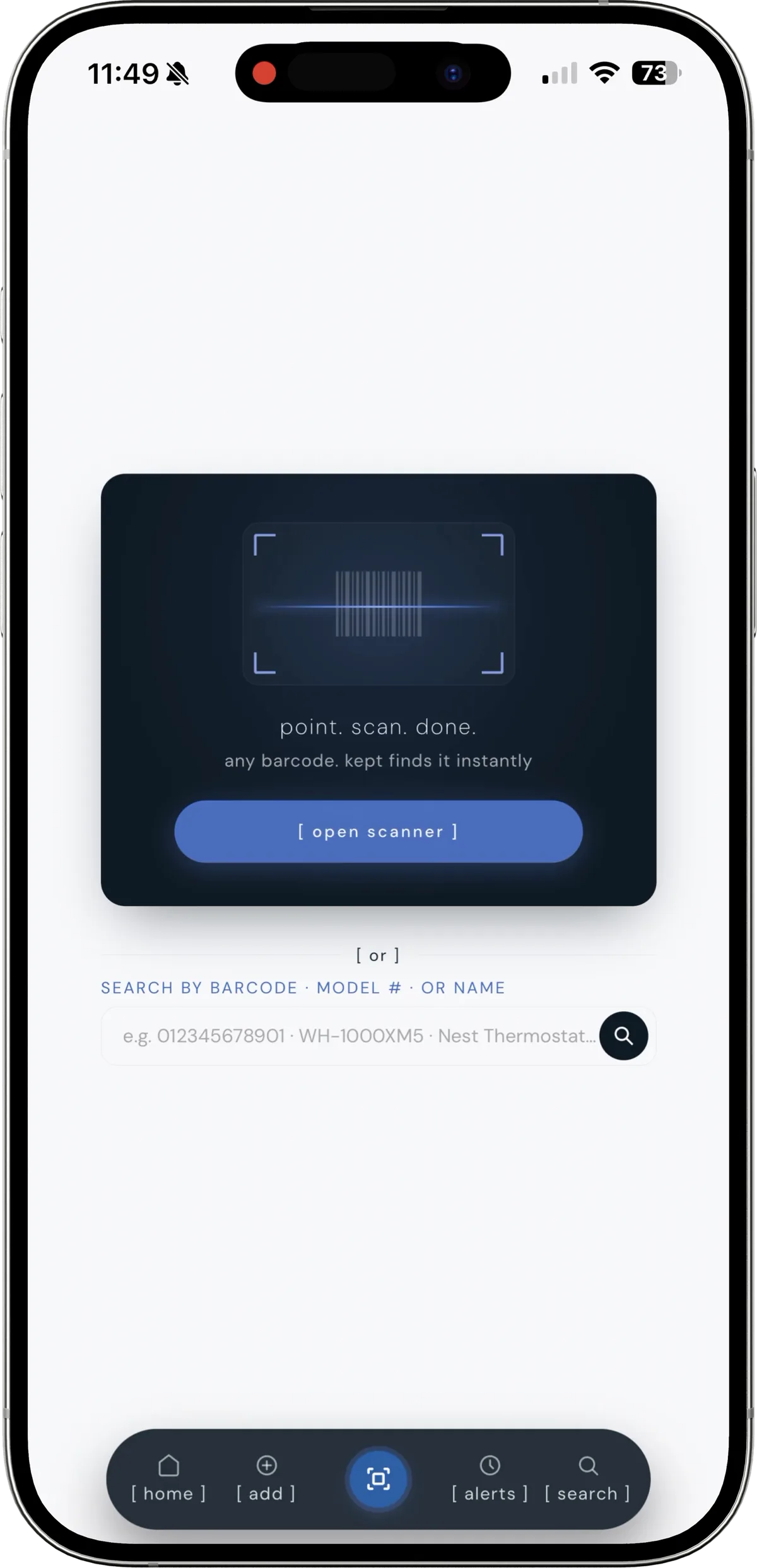
point. scan. done. kept looks up the product instantly.
Video walkthrough
Open your phone camera and record a slow walk through every room. Open drawers. Open closets. Narrate what you're seeing: "This is the kitchen. KitchenAid stand mixer, model KSM150, stainless steel." A full house takes 15 to 20 minutes. Upload the video to a secure cloud backup when you're done.
Home inventory spreadsheet
A spreadsheet works if you prefer typing to scanning. Create columns for room, item name, brand, model number, serial number, purchase date, purchase price, current value, and notes. Google Sheets or Excel both work. The downside: no photos inline, no barcode scanning, and no automatic cloud backup unless you set it up manually.
Printable PDF template
Paper checklists work for people who think better with a pen. Print a template, walk through the house, and fill it in. The risk: paper burns. If you use a paper list, photograph every page and store the photos in the cloud.
Where to store your inventory
A home inventory stored inside your home is useless after a fire. The same event that destroys your belongings destroys your list of them. Store your inventory somewhere it will survive.
- Cloud-based app: syncs automatically, accessible from any device, survives any physical disaster. The best option for most people.
- Bank safe deposit box: physical backup for paper lists, appraisal certificates, and USB drives with photos.
- Shared with a family member: email a copy of your inventory to a trusted person in a different location.
- Secure cloud storage: Google Drive, iCloud, or Dropbox. Set a calendar reminder to update the file quarterly.
The best approach combines two: a cloud-based app as your primary inventory and a PDF export stored with a family member as backup. If you're renting, the same rules apply. Our guide on home inventory for renters covers the differences.
How often to update
Update your inventory after every major purchase, every move, and at least once a year. A good time is when you change your clocks or renew your insurance policy. Add new items as you buy them. Remove items you sell or donate. The more current your list, the faster your claim gets processed.
If you're also tracking home projects, see our guide on keeping track of home improvements, which covers documenting renovations and contractor work for both resale value and insurance purposes.
Frequently asked questions
What should be included in a home inventory list?
A complete home inventory list includes every item you'd need to replace after a fire, flood, or theft. For each item, record the brand, model number, serial number, purchase date, purchase price or estimated current value, and a photo. Focus on high-value items first: electronics, major appliances, furniture, jewelry, and collectibles. Don't skip rooms people forget, like the garage, attic, and basement.
How do I make a home inventory list for insurance?
Start by walking through your home room by room. For each item, photograph it and record the brand, model number, serial number, estimated current value, and any proof of purchase you have. Your insurance company uses this list to process claims under your personal property coverage. Store the finished inventory outside your home, either in a secure cloud backup or with a trusted contact, so it survives the same event that damages your belongings.
What are some commonly forgotten items on a home inventory?
The most commonly missed items are things stored out of sight: off-season clothing, sporting equipment, tools in the garage, holiday decorations in the attic, and wine or pantry stockpiles. People also forget to document window treatments, light fixtures, area rugs, and items inside drawers like silverware and kitchen gadgets. These categories add up to thousands of dollars that go unclaimed after a loss.
How do you value household items for insurance?
Your valuation method depends on your policy type. Replacement cost coverage pays what it costs to buy the same item new today. Actual cash value coverage deducts depreciation, so a five-year-old laptop worth $1,200 new might only pay out $400. Record both the original purchase price and today's estimated value for each item. For jewelry, fine art, or collectibles worth over $2,500, get a professional appraisal and keep the certificate with your inventory.
Where should you store your home inventory list?
Never keep your only copy inside your home. A fire or flood that destroys your belongings will destroy your paper inventory too. Use a secure cloud backup like a home inventory app, store a copy in a bank safe deposit box, or share a digital version with a trusted family member. The best approach is a cloud-based app that syncs automatically, so your inventory is always current and always accessible from any device.