Storage Unit Inventory: Track What's in Your Unit
You're paying every month for a room you can't see into, full of boxes you can't list. An inventory turns that room back into your stuff. It takes one afternoon and a numbering habit.
table of contents
The monthly fee for forgetting
A storage unit is the only room of your house you pay rent on and can't peek into. That combination does something predictable to memory: within a year, most renters can name maybe half of what's inside. The rest is "boxes."
Forgetting costs real money, three ways. You rebuy things you already own because checking would mean a drive across town. You keep paying rent on a unit that a real accounting might let you downsize, and a 10x10 averaged about $75 a month nationally in early 2026 ($82 climate-controlled), according to SpareFoot. That's down from $132 in mid-2022, which also makes now a good moment to price a smaller unit. And if the facility floods or burns, the insurance claim asks for an itemized list with values, exactly the document you don't have. That last one is the same problem as a home inventory for insurance, except the stuff is a mile from where you live and out of sight year-round.
The fix is an inventory, and the standard for a good one is simple: from your couch, you can answer "do we still have the kids' ski gear, and which bin is it in?" in under thirty seconds.
How to inventory a storage unit, step by step
Do this while loading the unit if you can. Doing it after the fact works too, one shelf at a time.
- Number every container. A strip of duct tape and a marker: bin 1, bin 2, box 3. Numbers beat content labels, because "kitchen misc" stops meaning anything by February and gets rewritten every time contents shift. The number never changes; the list on your phone carries the meaning.
- Photograph inside each bin before it closes. One photo, top-down, contents visible. When you're wondering whether the fondue set is in bin 9, the photo answers without a drive.
- Make one entry per container and per large item. What it is, the bin number, and where it sits: "bin 9, back left, third shelf up." Large items (the snow blower, the sofa) get their own entries with their location.
- Record values for anything worth real money. Purchase price and date for the snow blower, the mixer, the furniture. This is your insurance list, and adding it now costs seconds per item.
- Sketch the layout once. A ten-second phone photo of the loaded unit from the door, plus "left wall: shelving, bins 1–12; back: furniture; right: seasonal" in a note. That's the map.
stop labeling bins "kitchen misc" and hoping
kept gives every bin a searchable entry with photos, contents, and its exact spot in the unit. Search from home, drive once.
[ try kept free ]The phone system that beats a spreadsheet
A spreadsheet can hold this list. What it can't do is hold the photos next to the rows, search from your pocket, or survive the moment your partner asks where something is while you're not home. This is the same reason we recommend an app over paper for a whole-home inventory: the list is only useful if it's where you are.
In kept, the storage unit becomes its own space, separate from home, so unit contents never clutter your house list. Each bin and item is an entry with photos, notes, and value:
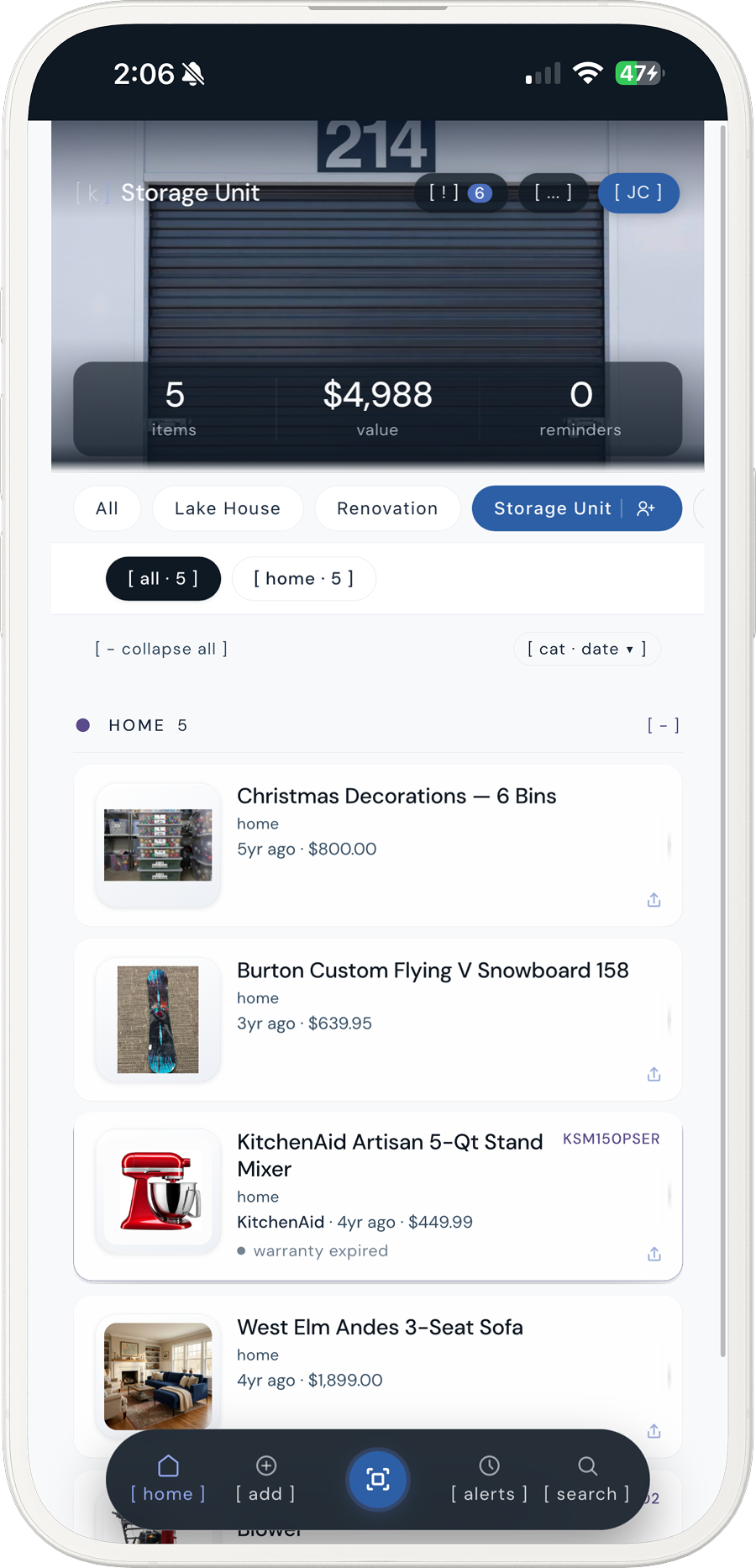
the whole unit on one screen, with what it's all worth.
The notes field does the locating. "Unit 214, bins 7–12, stacked front right. Lights bins 7–8, ornaments 9–10, wreaths 11–12" turns a December errand into a two-minute stop:
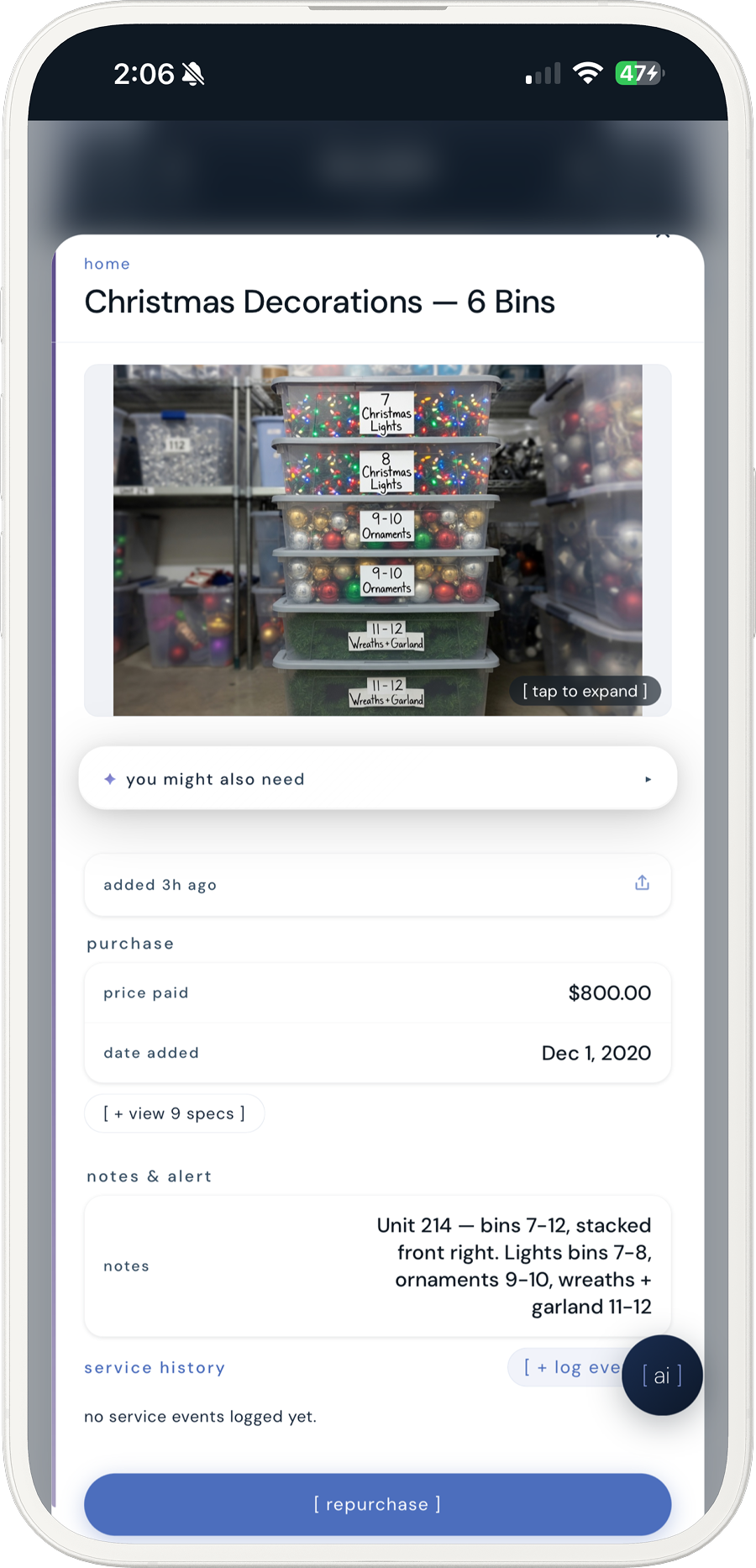
bin numbers and shelf locations in the notes: search at home, grab in one trip.
Two bonuses of doing it this way. Anything with a barcode (the snow blower, tools, electronics) can be scanned in, which fills in model numbers and specs without typing. And because the unit's total value is now a number instead of a shrug, the "is this unit still worth $130 a month?" conversation finally has data.
you've bought a second one of something the unit already holds
Search kept before you buy. Your storage unit, garage, and house live in one searchable place, with photos proving what's where.
[ try kept free ]Organizing the unit for one-trip retrieval
The inventory tells you which bin; the layout decides whether reaching that bin takes two minutes or forty. Four rules do most of the work:
- Leave a center aisle. Door to back wall, wide enough to walk. The moment the aisle disappears, every retrieval becomes an excavation, and the back third of the unit effectively stops existing.
- Frequency decides position. Holiday decorations, camping gear, and seasonal sports equipment near the door. The furniture you're keeping for a someday-house goes in the back.
- Heavy low, labels out. Books and tools on the floor or bottom shelf, light bins up top, and every number facing the aisle so you can read the unit like shelves in a library.
- Go vertical with shelving, not stacking. Freestanding steel racks along the walls turn one floor layer into four or five reachable ones. A column of six stacked bins means unstacking five to open the bottom one; a shelf means lifting one. Stand sofas and mattresses on end, covered, and disassemble bed frames with the hardware bagged and taped to the piece.
kept is reader-supported. When you buy through links on this page we may earn a small commission, at no extra cost to you. It never changes what we recommend.
Plastic bins vs. cardboard boxes
For anything staying more than a few months: plastic bins, and clear ones if you can. They stack without crushing, seal against moisture and pests, and a clear side answers "what's in here?" before the lid comes off. Uniform sizes stack into stable columns and make shelf math easy.
Cardboard's case is cost, and it's a fair case for short, climate-controlled stints. Its problems show up over time: it wicks humidity and weakens, the bottom box in a stack slowly crushes, and silverfish and rodents treat it as both housing and food. If cardboard is what you have, keep it off bare concrete, on pallets or shelves, because concrete floors sweat moisture straight up into the box.
Whichever you choose, the inventory habit is identical: number the container, photograph the contents, log it.
What never goes in a storage unit
Every rental agreement has a prohibited list, and the items on it are banned for reasons that protect your stuff as much as the facility's:
- Anything flammable. Gasoline, propane, paint thinner, fireworks. Drain the fuel from mowers and snow blowers before they go in; a full tank in a hot metal unit is the clause that voids your coverage.
- Food, all of it. Canned goods, pet food, birdseed. One renter's pantry becomes the whole building's pest problem, and the mice don't stay in that unit.
- Anything alive or wet. Plants die, and a damp couch grows mold that spreads to everything breathable in the unit.
- Irreplaceable valuables. Cash, jewelry, original documents, heirlooms. Facility rules usually forbid them, and standard storage insurance caps are far below what those items are worth. Important papers belong in a fireproof box at home, logged in your home binder.
If you're loading the unit as part of a move, our moving inventory checklist covers the box-numbering system for the whole move, and the storage unit just becomes one destination in it.
Frequently asked questions
How do you inventory a storage unit?
Number every bin and box, then create one list entry per container and per large item: what it is, its bin number, and where it sits in the unit (back left, right wall rack). Photograph the contents of each bin before it closes. Keep the list on your phone, not on paper taped inside the unit, so you can check what's there without driving over. An inventory app like kept lets you keep the storage unit as its own space, with photos and bin numbers on every item.
What is the best way to organize a storage unit for easy access?
Leave a center aisle from door to back wall so you can reach everything without unstacking. Put frequently needed items (seasonal decorations, sports gear) near the door and long-term storage in the back. Keep heavy boxes low, stack lighter ones on top, and put labels facing the aisle. Shelving units along the walls beat floor stacking, since any box on a shelf is reachable without moving another box.
Should you use plastic bins or cardboard boxes for long term storage?
Plastic bins win for long-term storage. They stack without crushing, keep out moisture and pests, and clear bins let you see contents without opening them. Cardboard is cheaper and fine for short stints in climate-controlled units, but it absorbs humidity, weakens under stacking, and invites silverfish and mice. If you use cardboard, keep it off the concrete floor on pallets or shelving, since concrete wicks moisture into the boxes.
How do you maximize vertical space in a storage unit?
Shelving is the answer. Freestanding steel racks along the walls turn one layer of floor into four or five reachable layers, and most units have 8 feet or more of height that floor stacking can't safely use. Stand sofas and mattresses on end (covered), store bed frames and tables disassembled with hardware bagged and taped to the piece, and stack bins of uniform size so columns stay stable. Keep a step stool in the unit for the top shelves.
What items should never go in a storage unit?
Nothing flammable or combustible: gasoline, propane tanks, paint thinner, fireworks. Drain fuel from mowers and snow blowers before storing them. No food of any kind, including canned goods and pet food, since it attracts pests to the whole facility. No live things (plants), nothing wet, and no irreplaceable valuables like cash, jewelry, or original documents, both because facility rules usually forbid them and because standard storage insurance caps are low. Check your rental agreement's prohibited list before your first load.