Should You Register Your Appliances? What It Actually Does
Registration cards make it sound mandatory. It isn't. But there's one reason to register that has nothing to do with the warranty, and it's the reason most people skip.

table of contents
The short answer
You buy a dishwasher. Tucked in the manual is a postcard, or a sticker on the door telling you to register online "to activate your warranty." It reads like a requirement. It isn't.
Here's the short version. Registering an appliance does not activate your standard warranty, and not registering does not void it. The purchase date on your receipt is what starts the coverage clock. Once you have that date, our free warranty check tool works out exactly where it leaves you. A manufacturer cannot legally make your warranty depend on mailing back a card.
So if registration doesn't start the warranty, why do it at all? One reason carries real weight: recalls. Registration is the only way the manufacturer can find you if your model turns out to be dangerous. Everything else on that card is optional. Below is what's worth your five minutes and what to ignore. If you also want to confirm whether something you already own is still covered, start with our guide on how to check appliance warranty status.
Does registration extend your warranty?
This is the myth the card is built on. "Register to activate your warranty" sounds like coverage hangs in the balance. It doesn't.
The Magnuson-Moss Warranty Act, the federal law covering consumer product warranties, blocks manufacturers from tying coverage to a returned registration card. Your proof of purchase, the receipt, is all a warranty claim requires. Consumer Reports puts it plainly: a warranty can't be made contingent on filling out the card. So a fridge you never registered is covered exactly the same as one you did.
There is a narrow exception worth knowing. A handful of brands offer a registration bonus: an extra month, or in some cases an extended term, but only if you register inside a window, usually 30 to 90 days from purchase. That bonus is on top of the standard warranty, never a replacement for it. Read your specific warranty card to see if your model qualifies.
One more thing people mix up: registration is not the same as an extended warranty or protection plan. Those are separate paid products you buy, often at checkout. Registering is free and changes nothing about your coverage length unless a bonus explicitly says so. If you're tracking expiry dates across the house, an appliance warranty tracker matters far more than whether you mailed a card.
The real reason to register: recalls
Here's the part the card buries under the marketing. When a product gets recalled for a safety defect, a fire risk, a shock hazard, a part that fails, the manufacturer issues a notice. But they can only reach the people they have contact details for. The single reliable way they get those details is product registration.
This is not a rare problem. Tens of millions of recalled units stay in American homes because the owners never heard. We covered five of the biggest in why most homeowners miss these hidden recalls. A registered appliance puts you on the notification list. An unregistered one leaves you finding out by accident, or not at all.
Registration has a blind spot, though. It only covers products you bought new and registered yourself. Anything secondhand, a hand-me-down dryer, a fridge that came with the house, a marketplace find, never had your details attached. For those, you check the recall database directly. Our walkthrough on how to check if an appliance is recalled covers the CPSC search, and CPSC recall alerts covers getting notified going forward.
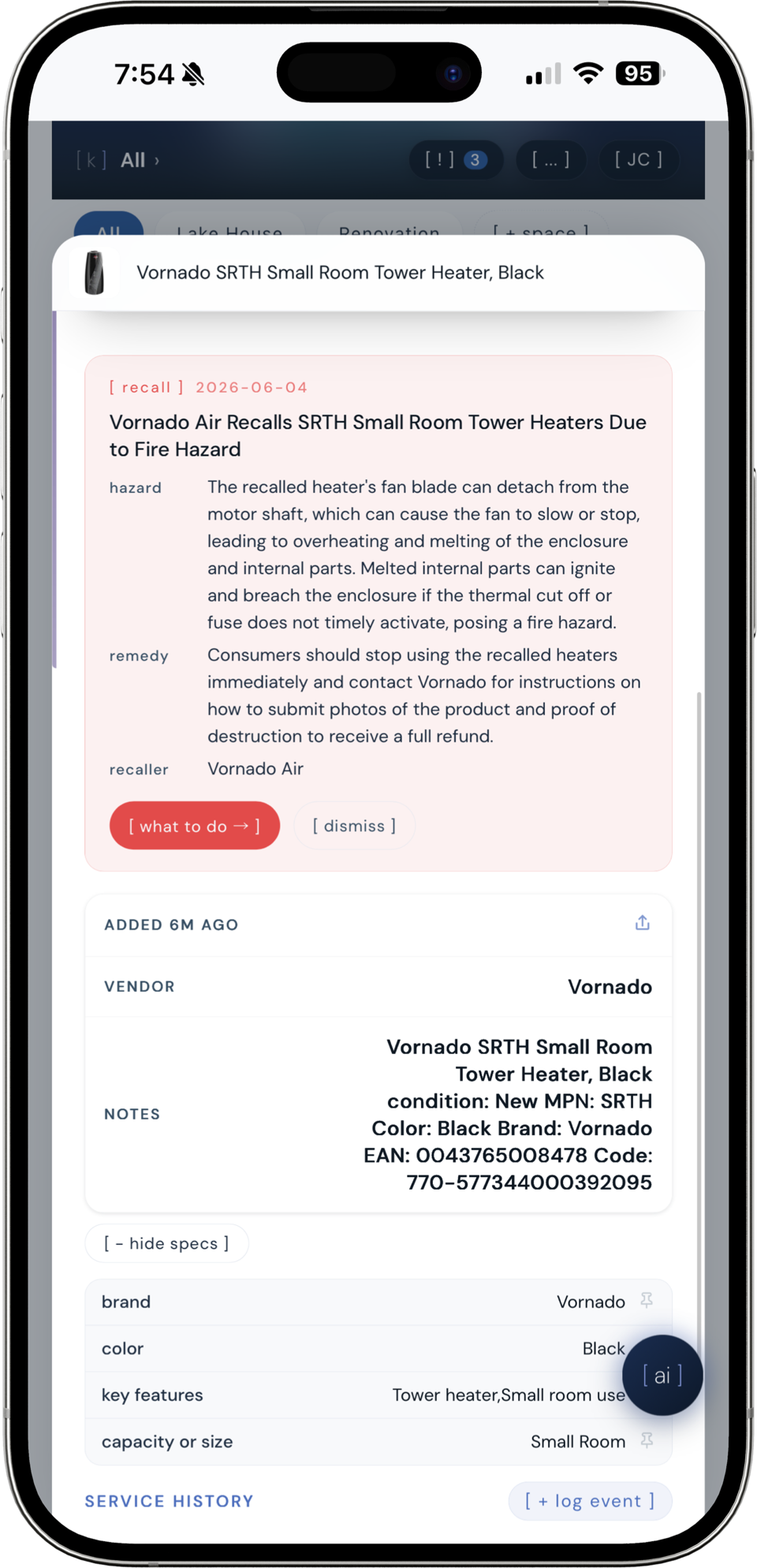
kept matches your saved items against the CPSC database and flags a recall on the item itself, even for things you never registered.
How to register an appliance in 5 minutes
You don't need the box, the manual, or the receipt. You need two numbers: the model and the serial. Both live on the data plate, a metal or printed sticker on the appliance itself. Not sure where to look? Our guide on where to find your appliance model number covers every appliance type.
The steps
- Find the data plate. Inside the fridge door, the edge of the dishwasher door, the back of a washer, the front panel of a furnace. Note the model and serial.
- Go to the brand's site. Search the brand name plus "register," for example "Whirlpool register product." Whirlpool, GE, Samsung, LG, Bosch, and most others have an online form.
- Enter model, serial, and purchase date. That's the core of it. The purchase date sets your warranty clock on their records.
- Opt out of marketing email. Uncheck the promotional boxes. Keep safety and recall notices on. More on that next.
- Save the confirmation. Screenshot the confirmation page or keep the email. That's your record that you're on the recall list.
you already crawled behind the dryer for the serial number
Scan it into kept once and the model, serial, and purchase date are there next time you register, claim, or check a recall.
[ try kept free ]What to fill out, what to skip
Paper registration cards ask for more than they need. Alongside your name and the model number, you'll see questions about household income, number of kids, hobbies, and what other brands you own. None of it has anything to do with your warranty or a recall. It's market research, and the answers can be packaged and sold to advertisers.
Privacy advocates have said the same for years: fill in the basics and leave the rest blank. The Electronic Privacy Information Center's long-standing advice is to give your name and address and stop there. Because federal rules forbid tying coverage to the card, you lose nothing by skipping the lifestyle questions.
Fill out only this
- ☑ Name, address, email
- ☑ Brand, model number, serial number
- ☑ Date and place of purchase
- ☐ Household income (skip)
- ☐ Number of people in household, ages (skip)
- ☐ Hobbies, other products owned, how you heard of us (skip)
Online registration is usually the cleaner route. You can uncheck promotional email while leaving safety notices on, and there's no card to lose in a drawer for three years.
Which appliances are worth registering
You don't have to register every gadget you own. Prioritize by two things: how much the item cost, and how much damage it could do if it failed. That points you straight at the big, safety-critical machines.
Register first: anything with a heating element, anything that holds water, and anything expensive enough that you'd file a claim. Refrigerators, washers, dryers, dishwashers, ranges and ovens, water heaters, microwaves, and HVAC equipment all clear that bar. Children's products belong at the very top, since they lead every recall list. Knowing the typical home appliance lifespan also tells you which machines are old enough that a recall or a claim is more likely to land.
kept is reader-supported. When you buy through links on this page we may earn a small commission, at no extra cost to you. It never changes what we recommend.
Skip the low-stakes stuff if you want. A $20 toaster isn't worth a form. But the calculation flips the moment something has a battery that can overheat or a cord that can short, which is why power tools and small kitchen appliances still show up in recalls.
Where to keep your registrations
Registering is the easy part. The hard part is what happens to the record afterward. The confirmation email gets buried under a year of inbox. The paper card photo lands in a camera roll with 4,000 others. By the time a recall notice or a warranty claim comes around, you can't find the model number, the serial, or proof of when you bought it.
This is the job kept was built for. You scan the barcode or snap the data plate once, and the brand, model, serial, purchase date, and price live in one place you can actually search. The warranty window gets tracked for you. And kept checks your saved items against the CPSC recall database automatically, which closes the gap registration leaves for secondhand gear.
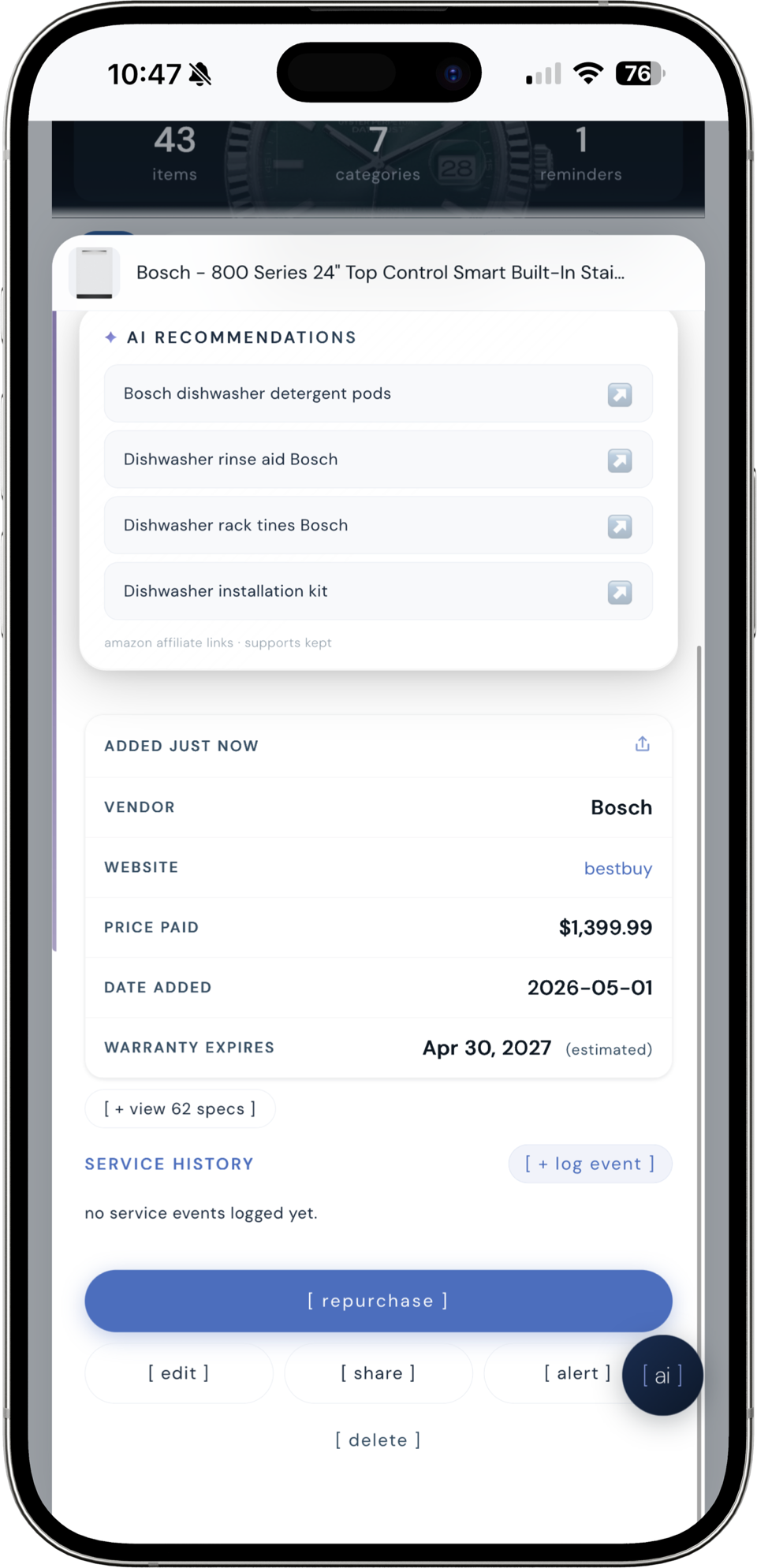
one item in kept: vendor, price paid, purchase date, and warranty expiry, the same details every registration form asks for.
That record does double duty. The model and serial make registration and future claims fast. The purchase date and price are exactly what an adjuster wants if you ever document what you own for insurance. You gather it once, then stop hunting for it.
Frequently asked questions
Do you have to register an appliance for the warranty to be valid?
No. Under the federal Magnuson-Moss Warranty Act, a manufacturer can't make your warranty depend on returning a registration card. Your receipt is the proof of purchase that matters. Registering is optional, and skipping it doesn't void your coverage.
Does registering an appliance extend the warranty?
Not by itself. Standard coverage is the same whether you register or not. Some brands offer a bonus, like an extra month or an extended term, but only if you register inside a set window, usually 30 to 90 days from purchase. Read the warranty terms to see if a registration bonus applies to your model.
Why should you register your appliances if it's optional?
One reason stands out: recalls. Registration is the only way a manufacturer can contact you directly if your exact model is recalled for a safety defect. It also puts your purchase date on file, which makes a future warranty claim faster, and it counts as extra proof of ownership for an insurance claim.
Is it safe to fill out an appliance registration card?
Yes, if you stick to the basics. Fill in your name, address, email, and the model, serial, and purchase date. Leave the lifestyle and demographic questions blank. Those are optional and exist to build marketing profiles. Federal rules bar tying your warranty to any of it, so you lose nothing by skipping them.
How do I register an appliance without the original paperwork?
You don't need the paperwork, you need the model and serial number. Both are printed on the data plate on the appliance itself. Go to the manufacturer's website, search for the brand name plus the word register, enter the model and serial, and add your purchase date. It takes a few minutes per appliance.