MERV vs MPR vs FPR: The Conversion Chart Filter Brands Hope You Never Find
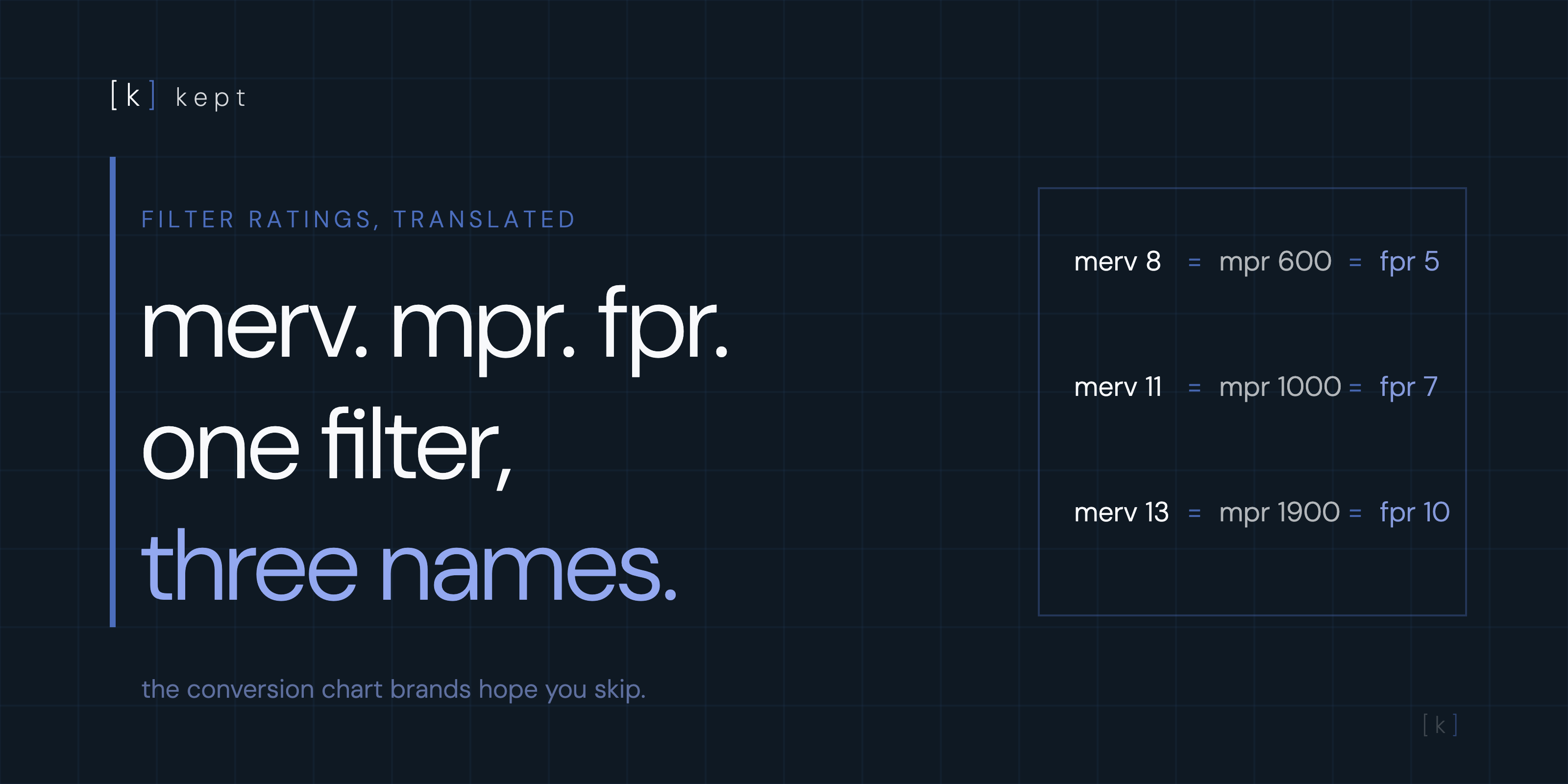
Your furnace manual says MERV 11. The 3M box says MPR 1000. Home Depot's shelf says FPR 7. Those are all roughly the same filter. Here's the translation, and why the confusion exists in the first place.

table of contents
The conversion chart
The equivalences are approximate because each system tests slightly differently, but this is the table that settles the filter aisle:
| MERV (standard) | MPR (3M Filtrete) | FPR (Home Depot) | What it captures |
|---|---|---|---|
| MERV 6 | MPR 300 | n/a | Dust, lint, carpet fibers |
| MERV 8 | MPR 600 | FPR 5 | Adds pollen, dust mites, basic mold spores |
| MERV 11 | MPR 1000 to 1200 | FPR 7 | Adds pet dander, fine dust, smoke residue |
| MERV 12 | MPR 1500 | FPR 8 to 9 | Adds a higher share of sub-micron particles |
| MERV 13 | MPR 1900 to 2200 | FPR 10 | Adds smoke particles, bacteria, virus-carrying droplets |
Not sure which row your house needs? That's a separate question from translation, and we answered it in our guide to what MERV rating you actually need. Short version: MERV 8 to 11 fits most homes, MERV 13 for severe allergies or smoke if your system supports it.
kept is reader-supported. When you buy through links on this page we may earn a small commission, at no extra cost to you. It never changes what we recommend.
Why there are three rating systems
MERV came first. ASHRAE, the HVAC industry's standards body, built it as a 1-to-16 scale measuring how well a filter captures particles from 0.3 to 10 microns. Every filter sold in the US can be MERV-rated, regardless of brand. It's the only scale your furnace manufacturer uses.
Then marketing happened. 3M built MPR (Microparticle Performance Rating) for its Filtrete line. The scale runs to 2800 and focuses specifically on particles under 1 micron, the sizes where 3M's filters test well. Home Depot built FPR (Filter Performance Rating), a color-coded 4-to-10 scale, for brands on its own shelves.
Neither brand scale is dishonest. Both are designed so you can't stand in their aisle and directly compare their box against a competitor's box at another store. A bigger number on a different scale feels better, and MPR 1900 sounds much more impressive than MERV 13.
The fix is simple: most boxes print the MERV equivalent somewhere in small type. Find it, compare on MERV, and the marketing fog lifts.
Is Filtrete 1000 the same as MERV 8?
No, and this is the most common mix-up in the aisle. Filtrete 1000 means MPR 1000, which translates to roughly MERV 11. It's a step up from MERV 8, not equal to it.
The confusion costs money in both directions:
- If you need MERV 11 protection, a basic MERV 8 filter doesn't replace a Filtrete 1000, even though "8" and "1000" both sound like model numbers.
- If you only need MERV 8 protection, you don't need to pay the Filtrete 1000 premium. The Filtrete 600 family, or any store-brand MERV 8 pleated filter, covers it for less.
Same logic for the higher tiers: Filtrete 1500 is roughly MERV 12, and Filtrete 1900 is roughly MERV 13, with the airflow caveats that come with any MERV 13 filter in a 1-inch slot.
MPR 1000 vs 1500 vs 1900
Within the Filtrete line, here's where the steps actually land:
- MPR 1000 (about MERV 11). Pet dander, fine dust, smoke residue. The right tier for most homes with a pet or mild allergies.
- MPR 1500 (about MERV 12). Catches a noticeably higher share of sub-micron particles. Worth the jump for moderate allergy households.
- MPR 1900 (about MERV 13). Smoke, bacteria, virus-carrying droplets. The wildfire-season and asthma tier. Confirm your system handles MERV 13 density before committing, and budget for more frequent replacement because it loads up faster.
Past 1900 (the 2200 and 2800 tiers), you're paying steep prices for gains most homes never notice. At that point a room HEPA purifier usually delivers more clean air per dollar.
FPR, decoded
FPR runs 4 to 10 with color coding: good, better, best, premium. It appears on Honeywell and other brands sold at Home Depot. The translation is loose but workable: FPR 5 is roughly MERV 8, FPR 7 is roughly MERV 11, and FPR 10 is roughly MERV 13.
One quirk worth knowing: FPR factors in things beyond particle capture, like filter weight gain over its life. That's why FPR-to-MERV conversions sometimes disagree by a step between sources. When precision matters, find the MERV number printed on the packaging instead of converting.
kept stores the exact rating and size for every filter in your house so you never convert between scales at the store again.
[ try kept free ]Which number to actually buy by
Buy by MERV, and record three things about the filter that works in your house:
- The size, printed on the frame as width x height x depth, like 20x25x1. No filter in the slot to read? Here's how to find your furnace filter size anyway. Central AC returns have their own sizes too.
- The MERV rating your system supports and your household needs.
- The replacement interval that matches that rating: 90 days for MERV 8, 60 to 90 for MERV 11, 60 or less for MERV 13.
Those three facts make every future filter decision a 10-second errand, on any brand's scale, at any store. Lose them and you're back here in 90 days, squinting at a chart.
Frequently asked questions
Is Filtrete 1000 the same as MERV 8?
No. Filtrete 1000 (MPR 1000) is roughly equivalent to MERV 11, a step above MERV 8. MPR is 3M's own scale, and it weights particles smaller than 1 micron more heavily than MERV does. If your goal is basic MERV 8 protection, the cheaper Filtrete 600 family already covers it.
What is the difference between MPR 1000 and MPR 1500?
MPR 1000 corresponds to roughly MERV 11 and captures pet dander, fine dust, and smoke residue. MPR 1500 corresponds to roughly MERV 12 and captures a higher share of particles under 1 micron. For homes with moderate allergies, the jump from 1000 to 1500 is noticeable. Past 1500, returns shrink unless someone has severe allergies or asthma.
What MERV rating is equivalent to MPR 1900?
MPR 1900 is roughly equivalent to MERV 13. It captures smoke particles, bacteria, and virus-carrying droplets. Before buying one, confirm your furnace supports MERV 13: many systems with 1-inch filter slots strain against filters this dense.
Is FPR the same as MERV?
No. FPR (Filter Performance Rating) is Home Depot's proprietary 4-to-10 color-coded scale used on brands they sell, like Honeywell. It tracks MERV loosely: FPR 5 is roughly MERV 8, FPR 7 is roughly MERV 11, and FPR 10 is roughly MERV 13. MERV is the industry standard, so use the MERV number when comparing across stores.
Why do air filter brands use different rating systems?
MERV is the industry standard set by ASHRAE. 3M created MPR and Home Depot created FPR as proprietary scales for their own shelves. The brand systems emphasize the particle sizes their filters score well on, and they make direct price comparison against competitors harder. Most filter boxes also print the MERV equivalent in small type, which is the number worth reading.
Is a higher MERV rating always better for your furnace?
No. Higher MERV means denser fibers, and denser fibers restrict airflow more. A system designed for MERV 8 forced to breathe through a MERV 13 filter has to work harder, which can shorten the blower motor's life and, in extreme cases, cause the system to freeze up. Check your furnace or AC manual for its maximum supported MERV before buying anything above 11 — the filtration only helps if the airflow behind it stays healthy.