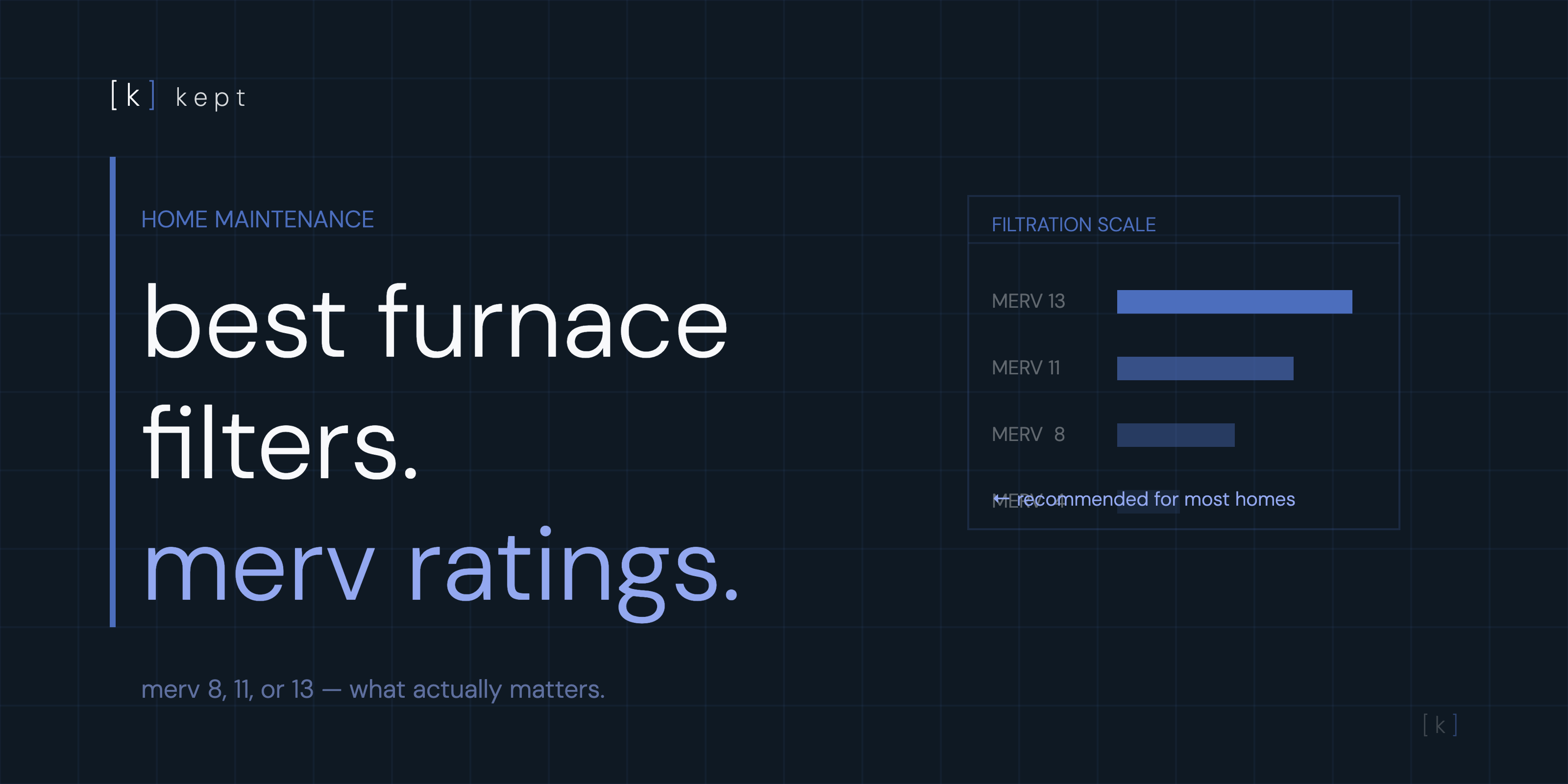
Best Furnace Filters for 2026: MERV 8, 11, and 13 Picks
MERV 8, 11, or 13? The picks that fit most homes, what the numbers actually mean, and how to know which one your system can handle.

- The best furnace filters, ranked
- What is a MERV rating?
- MERV ratings compared
- MERV 8 vs MERV 11 vs MERV 13: the real difference
- MPR and FPR: what Home Depot and 3M are doing
- Filter thickness: 1-inch vs 4-inch
- How often to change your furnace filter
- What size filter do you need?
- Brands worth buying
- FAQ
You're standing in the filter aisle at Home Depot. There are forty options. They all say things like "allergen defense" and "maximum filtration" and have numbers that mean nothing to you. You pick one that feels right and leave.
Then three months later you do it again, probably buying a different one this time.
Here's everything you need to know to stop guessing.
The best furnace filters, ranked
If you just want the answer, here it is. These are the picks that fit most homes, sorted by situation. The reasoning, the MERV breakdown, and how to size them are all further down.
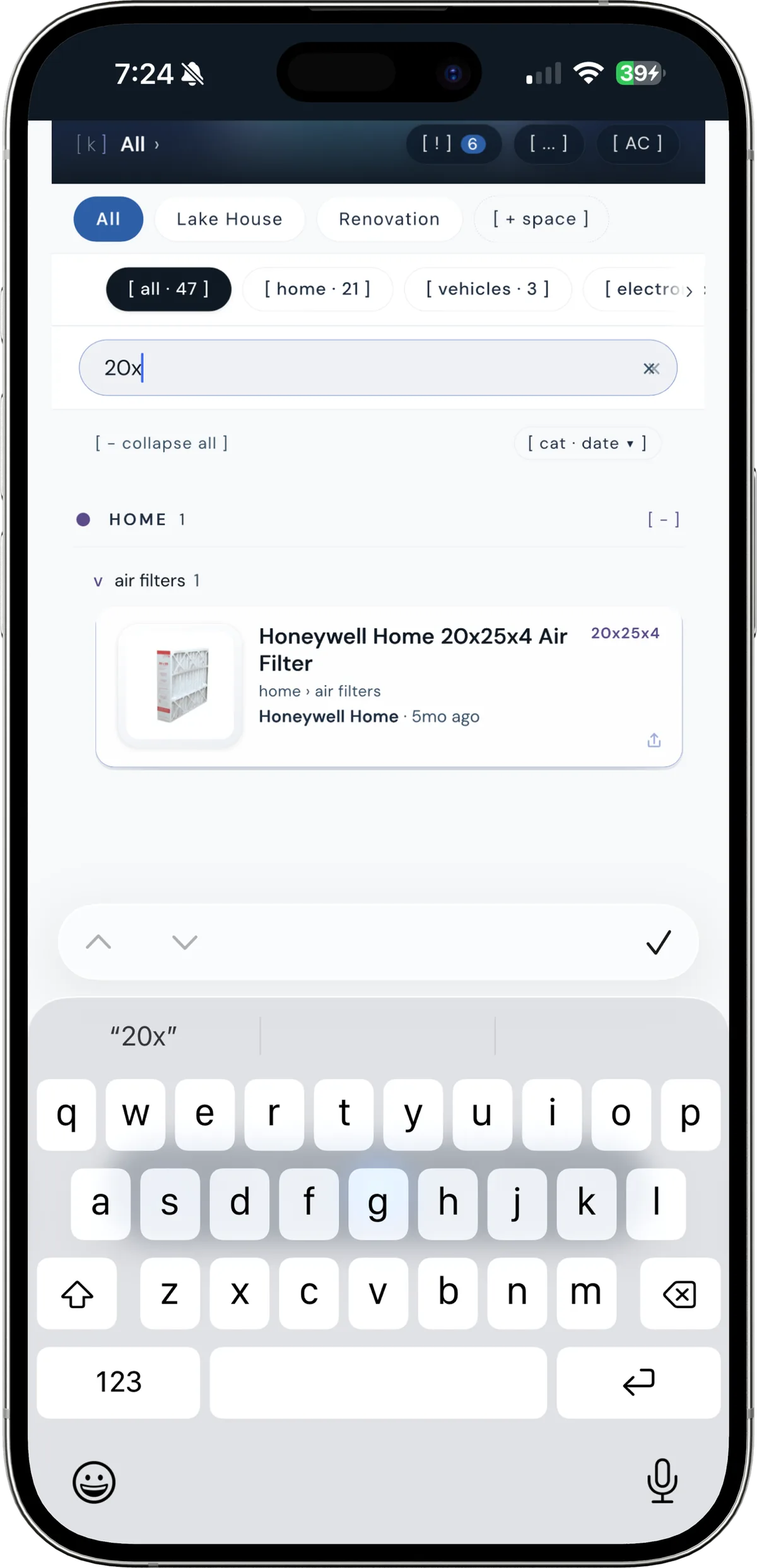
save the size once. search it instead of measuring again next time.
kept is reader-supported. When you buy through links on this page we may earn a small commission, at no extra cost to you. It never changes which filters we recommend.
| Pick | Filter | Rating | Best for |
|---|---|---|---|
| Best overall | Filtrete MPR 1000 or Nordic Pure MERV 11 | MERV 11 | Most homes, best balance of clean air and airflow |
| Best for allergies | Filtrete MPR 1500 | MERV 13 | Allergy or asthma homes, if the furnace allows it |
| Best on a budget | Honeywell Home MERV 8 | MERV 8 | Older systems and tight budgets |
| Best long-life | Nordic Pure 4-inch MERV 11 | MERV 11 | Homes with a 4-inch or 5-inch filter cabinet |
The one-line answer: buy MERV 11 for most homes, MERV 13 only if you have allergies and a compatible furnace, and never anything below MERV 8. Before you order a multipack, confirm your exact filter size, since the wrong size is the most common mistake. If you're comparing brands that use different numbers, our MERV vs MPR vs FPR conversion guide translates all three.
What is a MERV rating?
MERV stands for Minimum Efficiency Reporting Value. It's the industry standard for measuring how well a filter captures airborne particles, specifically particles between 0.3 and 10 microns in size.
The scale runs from 1 to 20. Higher numbers mean the filter captures smaller particles. Residential filters typically fall between MERV 4 and MERV 13. Hospitals use MERV 14–16. MERV 17–20 is HEPA territory, used in cleanrooms.
The key thing to understand: a higher MERV rating isn't automatically better for your home. Denser filters restrict airflow, which puts more strain on your HVAC system. There's a tradeoff.
MERV ratings compared
| MERV | What it catches | Best for | Verdict |
|---|---|---|---|
| 1–4 | Large dust, carpet fibers, pollen | Protecting the HVAC equipment only | skip it |
| 5–7 | Mold spores, dust mites, pet dander | Vacation homes, minimal use | below average |
| 8 | All of the above + finer dust, some smog | Most homes as a minimum | good |
| 11 | Dust, pollen, pet dander, mold, fine particles | Most homes, best balance | recommended |
| 13 | All of the above + bacteria, smoke, virus carriers | Allergy/asthma households | good if compatible |
| 14+ | Very fine particles, hospital-grade filtration | Commercial/medical, not residential | not for homes |
The short version: Buy MERV 11 for most homes. Buy MERV 13 only if you have allergies or asthma, and only if your furnace manual says it's compatible. Don't buy anything below MERV 8.
MERV 8 vs MERV 11 vs MERV 13: the real difference
MERV 8: the practical minimum
MERV 8 filters catch about 70% of particles in the 3–10 micron range. That covers most household dust, pollen, lint, and pet dander. They're cheaper, widely available, and easy on your HVAC system. If you have an older system or a budget constraint, MERV 8 is fine. It's meaningfully better than the cheap fiberglass filters and won't strain your blower.
Typical price: $8–$15 per filter.
MERV 11: the right choice for most homes
MERV 11 catches 85–95% of particles in the 1–3 micron range, which includes fine dust, pet dander, mold spores, and auto emissions. The filtration improvement over MERV 8 is real and noticeable, especially in homes with pets. The airflow restriction is modest enough that modern HVAC systems handle it without issue.
This is the filter most HVAC technicians recommend for standard residential use. Buy a multipack, the per-filter cost drops significantly and you'll always have one on hand.
Typical price: $12–$20 per filter, $40–$60 for a 6-pack.
MERV 13: for allergy and asthma households
MERV 13 captures over 90% of particles down to 0.3 microns, including bacteria, smoke particles, and the droplet nuclei that can carry viruses. If someone in your household has asthma, severe allergies, or a compromised immune system, MERV 13 is worth the upgrade.
The caveat: MERV 13 filters are significantly denser. On an older or lower-capacity HVAC system, the restricted airflow can reduce efficiency, freeze the evaporator coil in summer, and strain the blower motor over time. Before buying MERV 13, check your furnace manual for the maximum recommended MERV rating. Most systems made after 2010 handle it fine. Older systems may not.
Typical price: $18–$30 per filter.
MPR and FPR: what Home Depot and 3M are doing
If you've shopped at Home Depot or bought Filtrete filters, you've seen different rating systems. They measure the same thing but use proprietary scales.
| MERV | Filtrete MPR (3M) | Home Depot FPR | Filtration level |
|---|---|---|---|
| 8 | 600–800 | 5–6 | Good |
| 11 | 1000–1200 | 7 | Better |
| 13 | 1500–1900 | 10 | Best |
They're all just different labels for the same filtration performance. MERV is the standard, when in doubt, use that number to compare.
Filter thickness: 1-inch vs 4-inch
Most furnaces take a 1-inch filter. Some have a dedicated filter cabinet that takes a 4-inch or 5-inch thick filter. If yours takes a thick filter, use it, here's why:
A 4-inch MERV 11 filter has dramatically more surface area than a 1-inch MERV 11 filter. More surface area means less airflow restriction for the same filtration level, and a much longer service life. A 4-inch filter at MERV 11 can last 6–12 months. A 1-inch filter needs changing every 60–90 days.
If your furnace has a standard 1-inch slot, don't try to retrofit a thick filter. It won't seal properly and unfiltered air will bypass it around the edges. The same sizing logic applies to AC systems, see the complete AC filter size guide if you have a central air unit or mini-split.
How often to change your furnace filter
The standard recommendation is every 90 days for a 1-inch filter. That's the right baseline, but the real answer depends on your situation:
- Every 30–60 days: You have multiple pets, someone in the home has allergies, or you run the system heavily year-round
- Every 90 days: Average household, one or no pets, normal use
- Every 6 months: Single occupant, no pets, mild climate with limited HVAC use
- Every 6–12 months: 4-inch or 5-inch thick filter
The simplest system: set a calendar reminder the same day you install a new filter. When it goes off, go change it. Takes three minutes. If you want a broader seasonal schedule for your whole home, a home maintenance checklist covers every task from gutters to water heater flushes alongside filter changes.
Quick visual check: Hold the dirty filter up to a light. If you can't see light through it, change it, regardless of when you last did it. A clogged filter restricts airflow more than a too-dense filter.
What size filter do you need?
The size is printed on the frame of your current filter, something like 16x25x1 or 20x25x4. Those three numbers are width × height × thickness in inches.
If you don't know your filter size, pull out the existing filter and read it off the frame. If it's not labeled, measure the slot opening. The nominal size (what you order) is usually about ½ inch larger than the actual measurement, and that's normal.
Common residential sizes: 16x20x1, 16x25x1, 20x20x1, 20x25x1, 20x25x4. But there are dozens of sizes, always confirm yours before ordering a multipack.
Not sure how to find your filter size or furnace model number? This guide walks through it step by step.
Brands worth buying
Most major filter brands use the same basic materials. The differences are in construction quality and how accurately they're cut to size (a poorly cut filter leaves gaps around the edges, which lets unfiltered air bypass it entirely).
Filtrete (3M): the most widely available and consistently well-made. Their MPR 1000 and MPR 1500 are MERV 11 and MERV 13 equivalents and easy to find at any home improvement store. Good choice.
Nordic Pure: highly rated by HVAC professionals for accurate sizing and consistent quality. Available on Amazon in almost any size. If you're ordering online, this is the brand to try.
Honeywell Home: solid mid-range option, widely available. Good for MERV 8 if you're price-sensitive.
Store-brand fiberglass filters: the thin blue or gray ones near the floor at the hardware store. Avoid them for air quality purposes. They exist to protect the HVAC equipment, not to filter your air.
kept reminds you when it is due and remembers the exact size so you can reorder without pulling the old one out.
[ try kept free ]FAQ
What MERV rating furnace filter should I use?
For most homes, MERV 11 is the right answer. It catches the things that actually matter, dust, pollen, pet dander, mold spores, without restricting airflow enough to strain your system. Go to MERV 13 only if someone in your home has allergies or asthma, and confirm your furnace can handle it first.
Is a higher MERV rating always better?
No. Higher MERV filters are denser, which restricts airflow more. On an older or lower-powered HVAC system, a MERV 13 can reduce efficiency, cause the evaporator coil to freeze in summer, and shorten the blower motor's life. Check your furnace manual for the maximum recommended rating before upgrading.
How often should you change a furnace filter?
Every 90 days is the standard for a 1-inch filter with average household use. Change more often with pets, heavy use, or allergies. Thick 4-inch filters can go 6–12 months. The easiest method: set a reminder the day you install a new filter.
What is the difference between MERV, MPR, and FPR?
MERV is the industry standard. MPR is Filtrete/3M's proprietary scale, FPR is Home Depot's. They all measure the same thing with different numbers. MERV 11 ≈ MPR 1000–1200 ≈ FPR 7. When comparing across brands, convert everything to MERV.
Can I use a MERV 13 filter in any furnace?
Not safely in every furnace. Most systems built after 2010 handle MERV 13 without issue. Older systems with smaller blower motors may not. Check your furnace manual for the maximum MERV rating, or ask your HVAC technician. If you're unsure, MERV 11 is the safe choice.
Should I buy furnace filters in bulk?
Yes, if you know your size. Multipacks drop the per-filter cost significantly, often by 30–40%, and having filters on hand means you'll actually change them on schedule instead of putting it off until your next hardware store trip.