Home Maintenance Log: Track Every Repair and Service Call
Most homeowners don't have a maintenance log. They have a pile of receipts, a vague memory of "sometime last spring," and a contractor's number saved under "HVAC guy."

table of contents
A home maintenance log sounds like something organized people have. The kind of people with labeled binders and color-coded calendars. It's actually just a list of what got done, when, and by whom. It pays for the time it takes to keep it every time you need it.
When your furnace breaks down mid-January and the tech asks when it was last serviced, you want to know the answer. When you sell your house, a documented service history is a genuine selling point. When you're trying to figure out if the water heater is still under warranty, the difference between knowing and not knowing could be $800.
This is what a good home maintenance log actually looks like, what to put in it, and the easiest way to keep it current.
What a home maintenance log actually needs to contain
Most templates overcomplicate this. You don't need 40 columns or a Gantt chart. You need to answer five questions for every piece of work done on your house:
- What was serviced or repaired? Be specific: "furnace" not "HVAC system." "Kitchen faucet" not "plumbing."
- What was the date? Month and year is fine for routine maintenance; exact date matters for warranty work.
- What was done? "Annual tune-up" or "replaced heat exchanger." Enough detail that you'd know what happened a year from now.
- Who did it? Name and phone number of the contractor, or "DIY" if you did it yourself.
- When is the next service due? This turns your log into a reminder system instead of just a history file.
That's it. Everything else is nice to have.
the five questions, answered once, with the next-due reminder set at the same time.
The things worth tracking (and how often)
Here's a practical starting point organized by how frequently things need attention. Use this as the backbone of your log.
Monthly
| Task | Notes |
|---|---|
| Check furnace/AC filter | Replace every 1–3 months depending on filter type and household. Know your filter size before you go to the store. |
| Test smoke and CO detectors | One press of the test button. 30 seconds. |
| Run water in unused fixtures | Prevents P-trap evaporation in guest baths, basement drains. |
Every 3–6 months
| Task | Notes |
|---|---|
| Replace furnace filter | Even if it looks okay. Log the date and the filter size before you head to the store. |
| Check water softener salt | Add salt as needed; note the brand and type you use. |
| Clean dryer vent | Lint buildup is a fire hazard. Log the date and note whether the vent run is long; those need more frequent cleaning. |
| Inspect caulk around tubs and showers | Re-caulk any cracked or separating areas before water gets behind the tile. |
kept is reader-supported. When you buy through links on this page we may earn a small commission, at no extra cost to you. It never changes what we recommend.
Annually
| Task | Notes |
|---|---|
| HVAC tune-up | Schedule in fall for heat, spring for AC. Log the technician's name so you can request the same one next year. |
| Flush water heater | Sediment buildup reduces efficiency and shortens life. Note the model and age. Water heaters older than 10 years are living on borrowed time. |
| Clean gutters | Spring and fall if you have trees overhead. Log it so you can spot the year you skipped it when the fascia starts rotting. |
| Inspect roof | After any major storm, and once a year otherwise. Note anything that looks off even if it doesn't need immediate repair. |
| Service garage door | Lubricate hinges, rollers, and springs. Test the auto-reverse. Note the model of the opener; parts are model-specific. |
| Chimney inspection and cleaning | If you use a wood-burning fireplace. Log the sweep's name and contact. |
Every 2–5 years
| Task | Notes |
|---|---|
| Repaint exterior trim | Log the paint color name and brand. You'll need it for touch-ups. How to find and save your exact paint color. |
| Seal driveway | Asphalt every 3–5 years; concrete less frequently. Log the product used. |
| Service septic system | Pump every 3–5 years depending on household size. This one has real consequences if you miss it. |
| Replace smoke detector batteries | Or the detectors themselves. Most have a 10-year lifespan. |
What to log alongside the service history
A maintenance log is most useful when it lives next to the other information about each item in your home. On its own, "furnace serviced 11/2024" is fine. But "furnace serviced 11/2024, Carrier model 59SC5, serial number 2315A12345, filter size 16x25x1, serviced by Mike at AirPro, 603-555-0192" is genuinely useful.
The log works best when it's connected to:
- Appliance model and serial numbers: so you can pull specs, find compatible parts, and track warranty status. Here's where to find the model number on every major appliance.
- Contractor contacts: the plumber who knows your house, the electrician who already pulled the permits. How to build a contractor contact list worth keeping.
- Filter sizes, paint colors, and other specs: the things you look up at the worst possible moments.
That's what turns a maintenance log into a home management system: not more columns in a spreadsheet, just the right information linked together.
Where most people go wrong
Logging after the fact instead of at the time
The receipt goes in a junk drawer. The contractor's card ends up in the car. Two months later, you remember the HVAC was serviced "sometime this fall" but not the date, not the tech's name, and definitely not what they said about the secondary heat exchanger. Log it the day it happens. It takes two minutes.
Keeping it somewhere inconvenient
A binder in the basement is better than nothing, but it's not with you when the tech is standing in your living room asking questions. A spreadsheet on your laptop is fine until you're at the hardware store trying to remember your filter size. Whatever system you use, it needs to be on your phone.
Tracking maintenance but not the appliances themselves
Knowing your furnace was serviced in November is only half the picture. Knowing it's a 2017 Carrier with a 20-year heat exchanger warranty turns a service date into actual information. Start with the model numbers. The maintenance log is more useful once the appliance specs are in there.
Not logging DIY work
Replaced the garbage disposal yourself? Changed the water heater anode rod? Log it the same way you'd log a contractor visit. Future you, or a buyer's home inspector, will want to know.
kept stores your maintenance history on your phone so the record is always where you are.
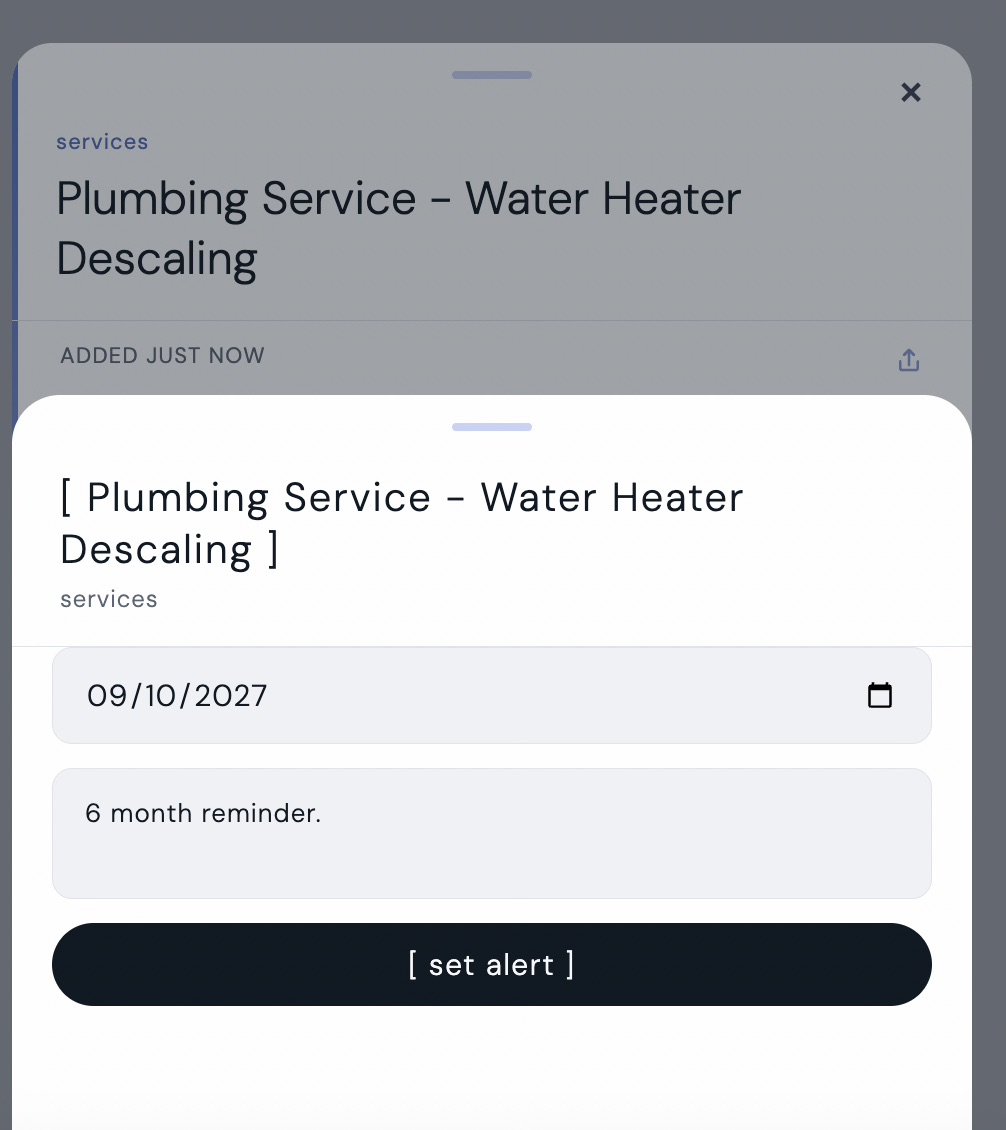
[ try kept free ]One real example: a water heater descaling logged in kept, with the service date, a note, and a reminder set for the next round. No spreadsheet. No sticky note on the water heater.
Paper, spreadsheet, or app
Paper binder
The old-school approach: a binder with tabbed sections for each system or appliance, receipts in sheet protectors, a simple log sheet per section. It's not searchable, not with you when you need it, and doesn't survive a basement flood. Better than nothing, and some people genuinely prefer it. If you go this route, leave it somewhere obvious and commit to filing things the same day.
Spreadsheet
A Google Sheet or Excel file works well for logging dates and notes, and it's free. The problem: it lives on one device, it's annoying to use on a phone, and there's no natural place to store a photo of the water heater label next to the service history. Most people start with a spreadsheet and stop updating it within a year.
A dedicated home management app
The right tool connects the maintenance history to the appliance it's about: model number, filter size, warranty date, contractor contact, all in one record. kept lets you scan a barcode to add an appliance, then attach service notes, dates, and contacts to that item. When the tech asks when the water heater was last flushed, you open the app and read it off.
If you're also thinking about documenting what you own for insurance purposes, a home inventory app and a maintenance log overlap more than most people expect. The same model numbers and purchase dates that go in a home inventory for insurance belong in your maintenance log too.
FAQ
What should I include in a home maintenance log?
Date, what was serviced, what was done, who did it (with contact info), and when the next service is due. For appliances, add the make, model, and serial number so the history is tied to a specific unit.
How do I start a home maintenance log?
Start with what you already know. Pull the current furnace filter and note the size. Write down the last time you had the HVAC serviced. Find the model numbers on your major appliances. That's the foundation. From there, log every service, repair, or DIY task the day it happens. You need: date, what was done, who did it, and when the next service is due. If you use kept, scan the barcode on each appliance and add a service note. You can cover the highest-value systems in about 20 minutes.
Is a spreadsheet good enough for tracking home maintenance?
It works, but most people abandon it within a year. The bigger problem is that a spreadsheet doesn't naturally connect service history to the appliance specs, contractor contacts, and filter sizes you need alongside it. It's a log without context.
Does keeping a home maintenance log help when you sell your house?
Yes. A documented service history gives buyers confidence that the house has been cared for. They can see when the roof was last inspected, when the HVAC was serviced, and whether appliances are still under warranty. Real estate agents consistently say well-documented maintenance records reduce buyer objections and support the asking price. Keep model numbers, service dates, and contractor contacts alongside the log and you have something you can hand directly to a buyer's agent.
Do I need home maintenance records for taxes?
Potentially. Capital improvements can affect your cost basis when you sell. Routine maintenance generally isn't deductible on a primary residence, but documenting everything protects you either way. Ask your accountant what qualifies in your situation.