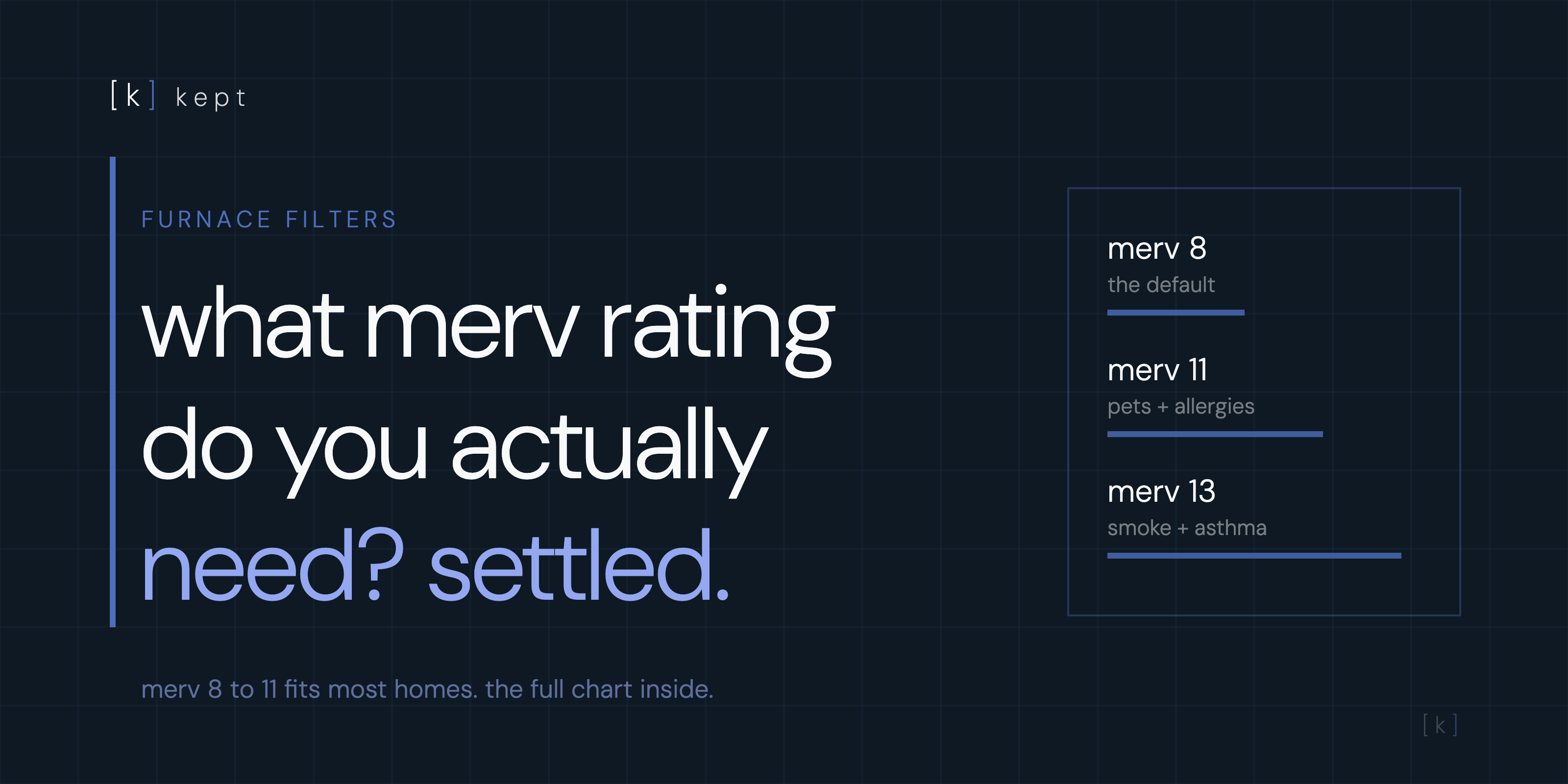
What MERV Rating Do You Actually Need? Furnace Filter Ratings, Settled
You're standing in the filter aisle. One box says MERV 8, one says MERV 11, one says MERV 13 and costs three times as much. The expensive one must be better, right? Not always. Sometimes it's actively worse for your furnace.

table of contents
What a MERV rating actually measures
MERV stands for Minimum Efficiency Reporting Value. It's a 1-to-16 scale, set by ASHRAE, that measures one thing: how well a filter captures particles between 0.3 and 10 microns. Higher number, smaller particles caught.
That's the entire system. A MERV 4 hardware-store fiberglass filter stops carpet fibers and not much else. A MERV 8 catches dust and pollen. A MERV 11 adds pet dander and finer dust. A MERV 13 catches smoke particles and the droplets that carry bacteria and viruses.
Once you know your number, our guide to the best furnace filters names specific MERV 8, 11, and 13 picks by home type and budget.
One thing MERV does not measure: airflow. Two filters with the same rating can breathe very differently depending on pleat depth and build quality. That gap is where most filter confusion lives, and it's why the answer to "which rating?" depends on your system, not just your lungs.
If your store sells filters labeled MPR or FPR instead, those are brand-specific scales from 3M and Home Depot. Our MERV vs MPR vs FPR conversion chart translates between all three.
Which MERV rating should you use?
Match the rating to your household, then confirm your furnace can handle it. This table covers the realistic residential range:
| MERV rating | What it captures | Who it's for |
|---|---|---|
| MERV 6 | Dust, lint, carpet fibers | Rentals, mild climates, minimum protection for the equipment itself |
| MERV 8 | Adds pollen, dust mites, basic mold spores | Most homes with no pets and no allergies. The default |
| MERV 11 | Adds pet dander, finer dust, smoke residue | Homes with pets, mild to moderate allergies |
| MERV 13 | Adds smoke particles, bacteria, virus-carrying droplets | Severe allergies, asthma, wildfire areas, immune-compromised households |
| MERV 14+ | Near-HEPA capture | Hospitals and clean rooms. Not homes |
Price tracks the rating. A basic MERV 8 runs $5 to $10 per filter. MERV 11 runs $10 to $18. MERV 13 runs $15 to $25. Buying in multi-packs roughly halves all of those numbers.
kept is reader-supported. When you buy through links on this page we may earn a small commission, at no extra cost to you. It never changes what we recommend.
The rating is only half the label. You also need the size, printed on the cardboard frame as width x height x depth. If you don't know yours, pull the current filter out and read the frame, or use our guide to finding your furnace filter size when there's no filter to read.
Is a higher MERV rating always better?
No. This is the single most expensive misunderstanding in the filter aisle.
A filter works by forcing air through a mesh. Tighter mesh catches smaller particles, and tighter mesh also fights the blower motor on every cycle. HVAC techs call this resistance static pressure. When it climbs too high, three things happen:
- Weaker heating and cooling. Less air moves through the system, so rooms take longer to reach temperature.
- Higher energy bills. The blower runs longer and works harder to move the same air.
- Shorter equipment life. Sustained strain burns out blower motors and, in summer, can freeze the AC evaporator coil.
The damage is quiet. Nothing breaks the day you install an overly restrictive filter. It shows up months later as a repair bill that never gets connected back to the filter choice.
So the real question is not "what's the best MERV rating?" It's "what's the highest rating my system moves air through comfortably?" For most modern systems that's MERV 11, and for many it's MERV 13. For an older furnace with a thin 1-inch filter slot, it might be MERV 8. The answer is printed in your owner's manual, and that's the number that wins any argument with a filter box.
The right rating for allergies, pets, and smoke
Allergies
MERV 11 is the allergy workhorse. It captures pollen, dust mite debris, mold spores, and pet dander, the particles behind most seasonal and indoor allergy symptoms. If symptoms persist on MERV 11, or anyone in the house has asthma, MERV 13 is the next step, system permitting.
Pets
One dog or cat is a MERV 11 situation. Dander particles are smaller than pollen and slip through MERV 8. Multiple shedding pets push you toward MERV 13, and toward replacing the filter every 60 days instead of 90, because hair and dander load the pleats fast.
Wildfire smoke
Smoke particles run well under 1 micron. MERV 13 is the minimum rating that meaningfully captures them. If you live in a wildfire region and your system tops out at MERV 8 or 11, run the highest rating your system allows and add a standalone HEPA air purifier for the rooms you live in. That combination beats forcing a too-tight filter into the furnace.
Will MERV 13 hurt your furnace?
It depends entirely on what your furnace was built to push air through. Here's how to find out in five minutes:
- Check the filter slot depth. A 1-inch slot is the riskiest place for MERV 13, because thin filters have less surface area and restrict more. A 4-inch or 5-inch media cabinet handles MERV 13 easily; the deep pleats keep air moving.
- Check the manual or data plate. Most manufacturers list a maximum supported MERV rating, commonly 11 or 13. The data plate sticker is on the front panel of the furnace or inside the blower door.
- When in doubt, ask the tech. If you get annual service, the question takes thirty seconds: "what's the highest MERV this system handles?" Write the answer down somewhere permanent.
If you do run MERV 13, replace it on schedule without fail. A high-MERV filter clogs faster, and a clogged MERV 13 restricts far more air than the rating alone ever would. A dirty "better" filter is the worst filter in the building.
Replacement schedule changes with the rating
Higher ratings catch more, so they fill up faster. The schedule on the box assumes an average house; adjust for yours:
| Filter | Typical replacement | With pets or allergies |
|---|---|---|
| MERV 8, 1-inch | Every 90 days | Every 60 days |
| MERV 11, 1-inch | Every 60 to 90 days | Every 45 to 60 days |
| MERV 13, 1-inch | Every 60 days | Every 30 to 45 days |
| MERV 11 to 13, 4-inch media | Every 6 to 12 months | Every 6 months |
Nobody remembers a 60-day cycle on their own. Put the swap on your home maintenance checklist, or set a recurring reminder in kept tied to the filter itself. The cheapest air quality upgrade in your house is changing the filter you already own on time.
The part everyone forgets: writing it down
Here's the loop most homeowners live in. Research ratings, pick a filter, install it, forget everything. Ninety days later: stand in the basement, squint at a dusty frame, photograph it, lose the photo. Repeat four times a year, for every filter in the house, including the AC return vents that take a different size.
Break the loop once. Add each filter to kept with its size, its MERV rating, and the date you last changed it. Set the reminder interval. Done. Next quarter your phone tells you it's time, shows you "20x25x1, MERV 11," and you reorder in one tap. The same record helps when you move into a new house and need to capture all of this from scratch.
kept stores your furnace filter specs so you reorder the exact same rating every time without second-guessing.
[ try kept free ]Frequently asked questions
What MERV rating should I use in my home?
MERV 8 to 11 covers most homes. Pick MERV 8 if nobody has allergies and you want the cheapest filter that still does its job. Pick MERV 11 if you have pets or mild allergies. Step up to MERV 13 for severe allergies, asthma, or wildfire smoke, but confirm your system supports it first. Most furnace manuals list a maximum MERV rating.
Is a higher MERV rating always better?
No. A higher MERV rating catches smaller particles, but it also restricts airflow. Push past what your blower can handle and you get weaker heating and cooling, higher energy bills, and extra strain on the motor. MERV 14 and above is hospital-grade filtration and does not belong in a standard residential furnace.
Will a MERV 13 filter damage my furnace?
It can, on the wrong system. Older furnaces and systems with thin 1-inch filter slots often struggle with MERV 13. Systems with 4-inch or 5-inch media cabinets usually handle it fine because the deeper pleats keep airflow up. Check the owner's manual or the sticker on the air handler for a maximum MERV rating before upgrading, and replace a MERV 13 filter on schedule because it loads up with dust faster.
What MERV rating is best for allergies?
MERV 11 handles most allergy households. It captures pollen, pet dander, dust mite debris, and mold spores. If allergies are severe, someone has asthma, or you deal with wildfire smoke, MERV 13 adds capture of smoke particles, bacteria, and virus-carrying droplets, provided your system can push air through it.
What is the difference between MERV 8 and MERV 11?
MERV 8 captures dust, lint, pollen, and dust mites: the big stuff. MERV 11 captures everything MERV 8 does plus finer particles like pet dander, smoke residue, and smaller mold spores. The practical difference shows up in homes with pets or allergy sufferers, where MERV 11 noticeably reduces dust and dander circulating through vents. MERV 11 costs a few dollars more per filter.