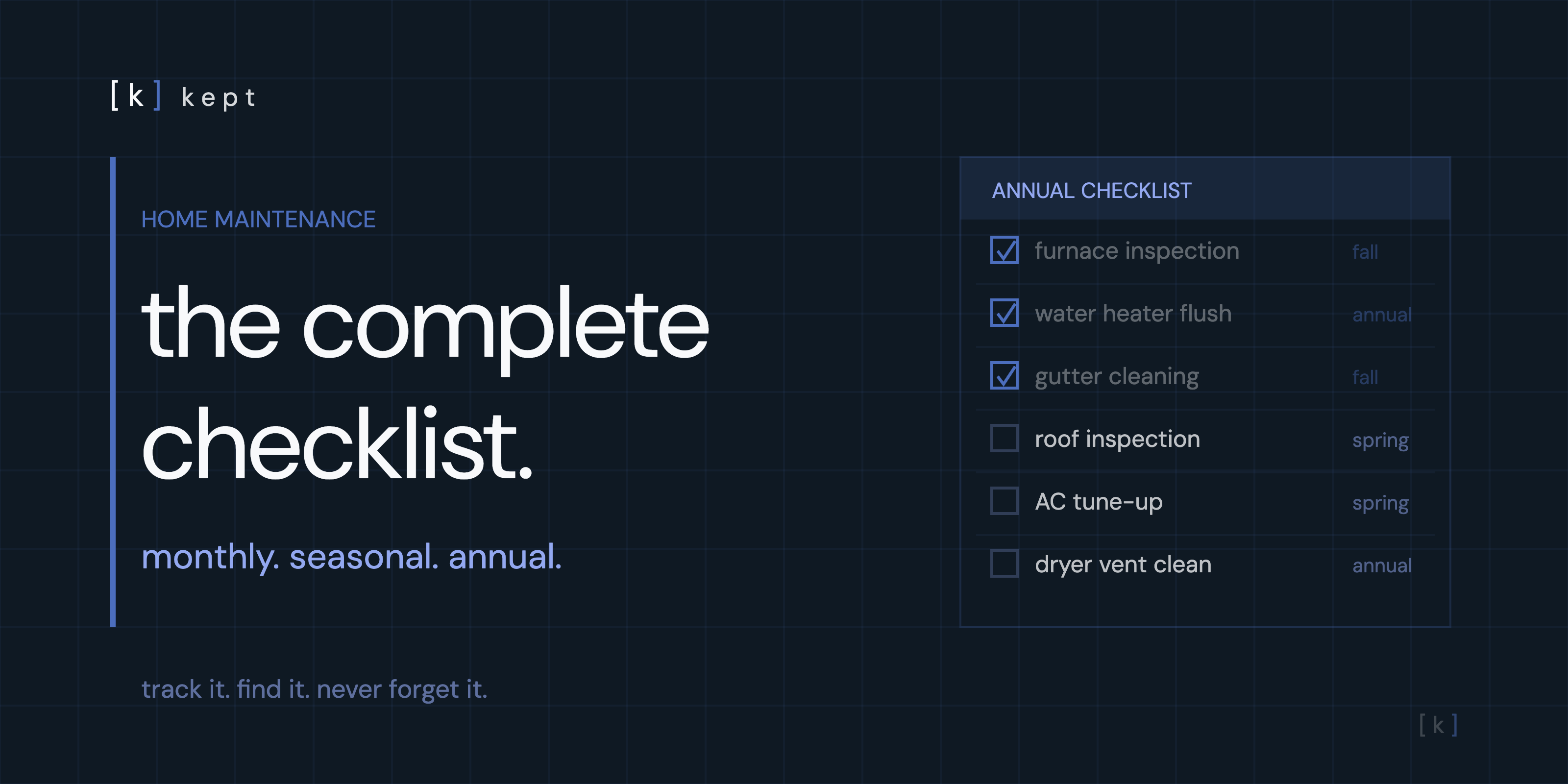
The complete home maintenance checklist
Monthly, seasonal, and annual tasks — organized so nothing falls through the cracks.
Most home maintenance problems aren't surprise failures. They're deferred tasks. The furnace that dies in January wasn't serviced in October. The water heater that floods the basement hadn't been flushed in six years. The roof leak that shows up in March started as a missing shingle last fall.
A home maintenance checklist doesn't prevent every problem. But it catches the ones that could've been caught — before they become the $4,000 version of the problem.
Here's everything, organized by how often it needs to happen.
Monthly home maintenance checklist
These are the tasks that actually need to happen every month — not the ones that get pushed to "quarterly" and then never happen.
monthly tasks
The HVAC filter is the one most people miss. If you have pets or allergies, you're changing it every month. A standard home without those factors can stretch to every 90 days — but set a reminder either way. A clogged filter makes your system work harder, raises your energy bill, and shortens the life of your furnace or AC. The U.S. Department of Energy recommends checking filters monthly and replacing them as needed.
Shop: HVAC filters on Amazon
stop guessing when you last changed your filter
kept lets you log your HVAC filter size, the brand you use, and the last date you changed it — so you always know exactly what to buy and when. Scan the barcode on your current filter and it saves everything automatically.
[ try kept free ]Seasonal home maintenance checklist
Seasonal tasks are where most homeowners fall behind. The window closes and the task gets forgotten until next year. Here's what to do each season.
spring maintenance checklist
summer maintenance checklist
fall maintenance checklist
winter maintenance checklist
Fall is the season most homeowners regret skipping. Getting your furnace serviced before the heating season means you're not calling an HVAC company on a 10-degree night. Cleaning gutters after the leaves fall prevents ice dams — which prevent water getting under your roof, which prevents the kind of water damage that costs tens of thousands to fix.
Annual home maintenance checklist
These are once-a-year tasks — some you can do yourself, some require a professional. Put them on a recurring calendar event so they don't disappear.
annual maintenance tasks
how often to flush your water heater
Once a year is the standard recommendation — and most homeowners never do it. Sediment builds up at the bottom of the tank, making the heater less efficient and shortening its lifespan significantly. If you have hard water, flush it every six months. It takes about 20 minutes: attach a garden hose to the drain valve at the bottom, run it outside or to a floor drain, open the valve, and let it run until the water is clear. The Department of Energy estimates that flushing sediment can improve efficiency by up to 10%.
Shop: water heater flush kits on Amazon
furnace and AC maintenance schedule
These are the two systems that most homeowners ignore until they fail. An annual inspection catches worn belts, dirty coils, low refrigerant, and cracked heat exchangers before they become emergency calls. The inspection itself costs $80–150. The emergency call at 11pm in February costs significantly more.
When you book the inspection, write down the technician's name, the company, what was serviced, and what was flagged for next time. That information is the difference between a homeowner who knows their house and one who starts from zero every service call.
log your service history in kept
Every time a contractor visits — HVAC, plumber, pest control, roofer — log it in kept. The date, what they did, what they said, their contact info. Next time something goes wrong, you'll know exactly who fixed it last and what they found.
[ start your home log ]House maintenance checklist by system
If you prefer to think about your home by system rather than by season, here's the same tasks organized by what they maintain.
HVAC maintenance checklist
plumbing maintenance checklist
electrical maintenance checklist
roof and exterior maintenance checklist
How to keep track of home maintenance
A checklist is only useful if you know when you last did each item. The problem most homeowners have isn't knowing what to do — it's knowing when they last did it.
Paper and spreadsheets work until they don't. Paper gets lost. Spreadsheets require you to remember to open them. What actually works is a dedicated home log — something you update when the task is done and can reference the next time a contractor asks when the system was last serviced.
The best home maintenance log captures three things: the date, what was done, and who did it (if a contractor). That's enough to answer 90% of the questions you'll get asked about your house — by insurance companies, buyers, contractors, and yourself.
kept is a free app designed exactly for this. You can log maintenance tasks and their dates, store contractor contacts, track appliance model numbers for the parts you'll eventually need, and scan barcodes to auto-fill product details. It's the home memory most homeowners wish they'd started keeping from day one.
Frequently asked questions
What should be on a home maintenance checklist?
A complete home maintenance checklist includes monthly tasks (HVAC filter, smoke detectors, leak check), seasonal tasks (gutters, AC/furnace service, winterizing), and annual tasks (water heater flush, roof inspection, GFCI testing). The right checklist depends on your home's age, systems, and climate — but those categories cover the majority of what matters.
How often should you do home maintenance?
Some tasks are monthly (HVAC filter, smoke detector tests), some are seasonal (gutters, AC tune-up, winterizing), and some are annual (water heater flush, furnace inspection, roof walk). The key is having a schedule with actual dates — not vague intentions.
What is an annual home maintenance checklist?
Annual tasks are the once-a-year items that tend to get skipped because there's no seasonal trigger: water heater flush, roof inspection, pest check, dryer vent cleaning, GFCI outlet testing, attic inspection, and a full exterior walk-around. These are also the ones with the highest cost when deferred too long.
What is a monthly house maintenance checklist?
Monthly tasks are the short list that keeps small problems from becoming big ones: check the HVAC filter, test smoke and CO detectors, check under sinks for drips, run water in unused drains, and check the fire extinguisher gauge. It takes about 10 minutes a month if you're consistent.
How do I keep track of home maintenance?
A dedicated home log — either an app or a physical notebook kept with your home files — works better than spreadsheets or memory. Log each task with the date and any relevant details (what was replaced, what the contractor said, what model number was used). kept is built for exactly this: free, no account required, stores everything in one place.