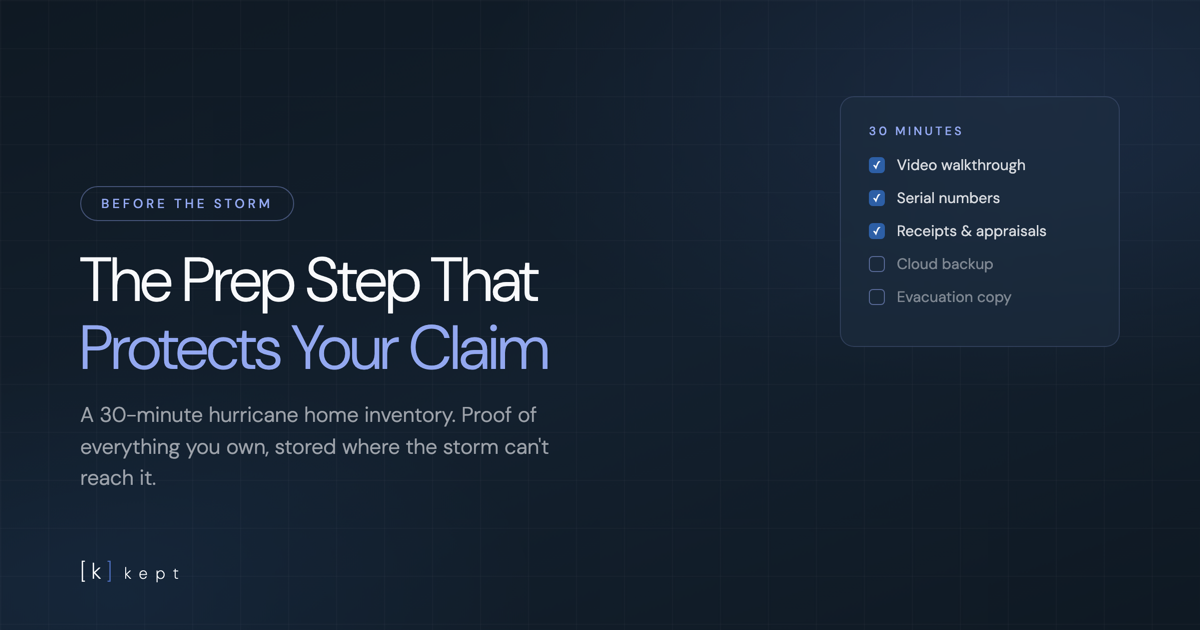
Hurricane Home Inventory: The 30-Minute Prep That Pays Off
Every hurricane checklist covers water, batteries, and plywood. Almost none of them cover the step that decides how much money you get back: proving what you owned before the storm took it.

table of contents
- Did the quiet 2026 season let you skip this?
- The prep step most people skip
- What your insurer will ask for after the storm
- The 30-minute hurricane inventory
- What to document first when time is short
- Where to store it (your phone is not enough)
- Same list, different disaster: wildfire and evacuation
- After the storm: using your inventory in the claim
- FAQ
Did the quiet 2026 season let you skip this?
No, and 2026 itself is the proof. The season runs through November 30, so this still applies this year, and the reason is worth understanding before next June too.
NOAA's outlook for the 2026 Atlantic season calls for 8 to 14 named storms, 3 to 6 of them hurricanes, and 1 to 3 major hurricanes at Category 3 or above. The agency puts the odds at 55% for a below-normal season, against 35% near-normal and 10% above-normal. An average season runs 14 named storms and 7 hurricanes, so 2026 is forecast to land under that.
NOAA trimmed that further in its August 6 update, to 7 to 13 named storms, 2 to 6 hurricanes, and 0 to 2 majors. The season then ran historically quiet: as of mid-October there had been nine named storms and no hurricane until October 8, tying 1905 for the latest first hurricane on record. That first hurricane was Isaias. It formed in the Bay of Campeche, peaked as a Category 3 with 120 mph winds, and came ashore near Destin, Florida, on the night of October 9 with 105 mph winds. For a lot of Panhandle households, a below-normal year was the year they filed a claim. Track active storms at the National Hurricane Center.
Here is the part that matters for your house. A seasonal forecast counts storms across the whole basin. It says nothing about whether one of them arrives at your address, and the historical record is blunt about this. The 1992 Atlantic season produced only six named storms, comfortably below average. One of them was Andrew, which went from a Category 1 to a Category 5 in about thirty hours and became the most destructive hurricane in Florida's history by structures damaged, holding the costliest title for twenty-five years until Irma.
A quiet season and a quiet season for you are different claims. The inventory below takes half an hour and covers every version of the forecast, including the one where nothing happens and you have a documented list of what you own anyway.
The prep step most people skip
Fewer than half of American homeowners have any kind of home inventory. The Insurance Information Institute puts the number at 47%, based on a Triple-I and Munich Re consumer survey. Everyone else plans to reconstruct the contents of their house from memory, after the most stressful week of their lives, for an adjuster whose job is to verify every line.
Memory fails at exactly the wrong time. Quick: how many pairs of shoes are in your closet? What did you pay for the TV in the bedroom? What brand is your microwave? Now imagine answering those questions about a house you can't walk through anymore, with a claim worth tens of thousands of dollars riding on the answers.
An inventory flips the situation. Instead of negotiating from memory, you hand over dated proof: this existed, this is its condition, this is what it cost. Claims move faster, disputes shrink, and forgotten items (the stuff in the garage, the linen closet, the junk drawer) actually make it into the payout.
What your insurer will ask for after the storm
Adjusters need two things for every item you claim: proof you owned it and evidence of what it was worth. How much proof depends on the item.
- Everyday items (clothes, kitchenware, books, decor): photos or video showing the item in your home before the storm are usually enough. Room-level shots work here. Nobody expects a receipt for every coffee mug.
- Electronics and appliances: adjusters want brands and model numbers, and serial numbers strengthen the claim. A photo of the TV is good. A photo of the TV plus its model and serial plate is better. If you cannot find the plate on a given appliance, our model number finder gives you the exact spots to check by appliance and brand.
- High-value items (jewelry, art, collectibles, firearms, high-end tools): expect requests for receipts, credit card statements, or appraisals. Many of these categories also carry per-item coverage caps unless you added a rider, which is worth checking before the season, not after.
One more thing adjusters care about: dates. A video with a timestamp from before the storm is strong evidence of pre-storm condition. This matters for the "was that water damage already there?" conversations. The details of that process are covered in our guide to filing a home insurance claim.
The 30-minute hurricane inventory
A perfect inventory lists every item with purchase dates and values. You do not have time for perfect when a storm is three days out. You have time for this:
Minutes 0 to 15: the video walkthrough
Take your phone and record one continuous video per floor. Walk slowly. Narrate as you go: "Samsung fridge, bought around 2023. KitchenAid mixer. That rug was about $400." Open every closet. Open every cabinet. Pull out every drawer, including the junk drawer. Pan across the garage shelves, the attic boxes, the shed.
Narration matters more than camera work. Saying "there are eight suits in this closet and the watch box on the shelf was my father's" turns a blurry pan into a documented claim item.
Minutes 15 to 30: high-value close-ups
Now go back for the expensive stuff. For each item, get one photo of the item itself and one of its data plate or serial number. Grab receipts where you have them, even as a photo of the receipt. Priority order: electronics, appliances, jewelry, tools, instruments, anything you'd list separately on a claim.
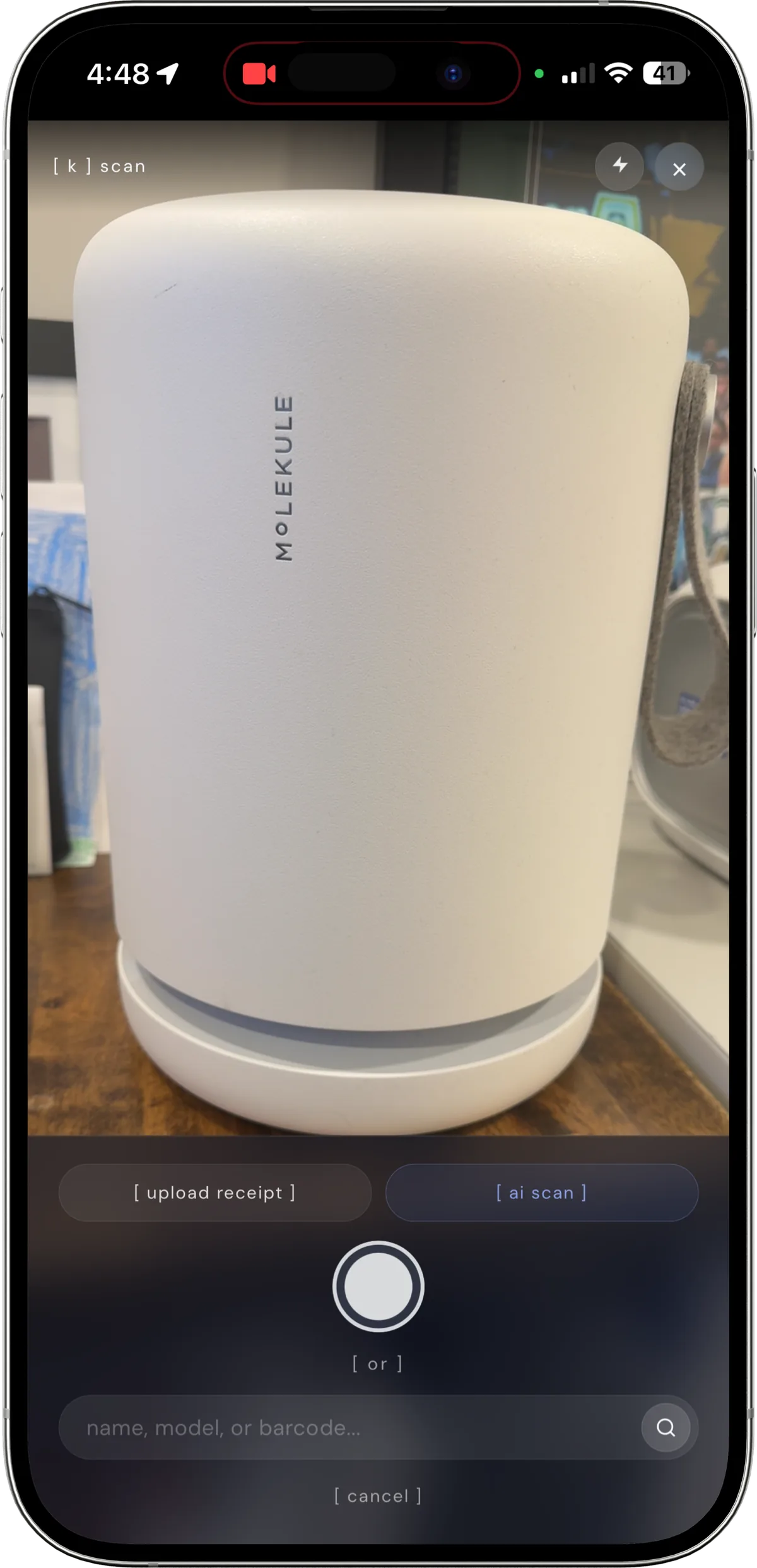
point kept at an item and it fills in the brand, model, and category for you.
This is where an inventory app earns its place over a camera roll. When you scan a barcode or snap an item in kept, it pulls the product name, model, and specs automatically, so your inventory ends up organized by room and category instead of buried between vacation photos. The full room-by-room version, for when there's no storm on the map, is in our home inventory checklist.
kept is reader-supported. When you buy through links on this page we may earn a small commission, at no extra cost to you. It never changes what we recommend.
What to document first when time is short
If landfall is tomorrow and you have ten minutes, work this list top to bottom:
Priority documentation, in order
- ☐ One narrated video pass of the main living areas
- ☐ Electronics: TVs, computers, consoles, cameras (photo + serial)
- ☐ Major appliances: fridge, washer, dryer, range (photo + model plate; our guide to finding appliance model numbers shows where each plate hides)
- ☐ Jewelry, watches, and anything with an appraisal
- ☐ Tools and outdoor equipment, including what's in the shed
- ☐ Closets and drawers, opened on camera
- ☐ Receipts, appraisals, and policy documents (photograph them)
Renters: everything here applies to you too. The building is your landlord's problem. Everything inside your unit is yours to prove. Renters policies pay out the same way, against the same documentation. More in our home inventory guide for renters.
Where to store it (your phone is not enough)
Here's the failure mode nobody plans for: the storm that destroys your living room also drowns the phone in your pocket. Or the house fire takes the fireproof-rated box that turned out to be fire-resistant for 30 minutes. An inventory that lives only inside the disaster zone is not an inventory. It's a casualty.
The rule is one copy outside the house, minimum. In practice:
- Cloud first. An inventory app that syncs to the cloud, or at minimum your phone's automatic photo backup. Confirm the backup actually ran before the storm. A video that never uploaded protects nothing.
- A second format somewhere else. Email the video files to yourself, share them with a relative in another state, or drop them on a drive you take when you evacuate.
- Paper for the paper. Insurance policy, appraisals, and key receipts go in a waterproof bag in the evacuation kit.
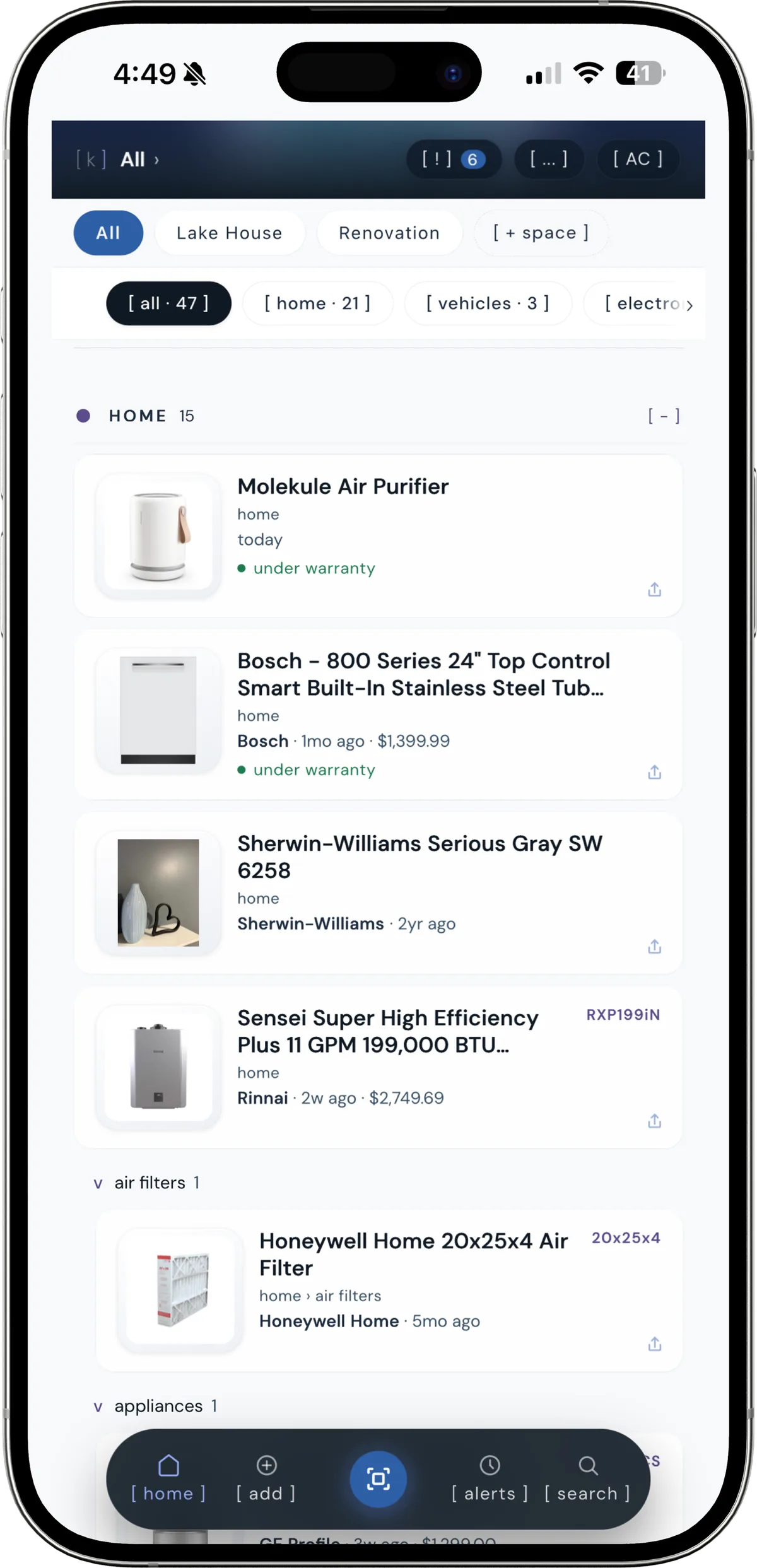
synced to the cloud, your inventory opens on any device, even if your phone doesn't make it.
kept stores your items and photos in the cloud automatically when you create an account, so the inventory survives whatever happens to the device that made it. Sign in from any phone or laptop and it's all there.
kept keeps every item, photo, and serial number synced in the cloud, searchable from any device.
[ try kept free ]Same list, different disaster: wildfire and evacuation
Everything above applies to wildfire country, with two changes.
First, the timeline is worse. Hurricanes give you days of warning. Evacuation orders give you hours, sometimes minutes. That means the inventory has to exist before fire season, not the night the wind shifts. The 30-minute version is a this-weekend job, not a when-the-alert-comes job.
Second, fire is total in a way water often isn't. After a flood, adjusters can walk the house and see the ruined couch. After a fire, there may be nothing to walk through, which makes your pre-fire documentation the only record that your belongings existed at all. Total-loss claims without documentation turn into line-by-line negotiations that drag on for months.
The same logic covers any leave-in-a-hurry scenario: flood zones, tornado alley, even a move where things go missing between trucks. Document once, and the record covers all of it.
After the storm: using your inventory in the claim
When the claim starts, your inventory becomes the working document. A few things speed the payout:
- Report fast, document the damage too. Photograph and video the damage before you clean up or throw anything away. Before-and-after is the strongest evidence pair you can hand an adjuster.
- Match claim items to inventory entries. When your claimed TV lines up with a serial number in a dated video, there's nothing to argue about.
- Don't guess values from memory. Pull them from your receipts and inventory notes. Guessing low costs you money. Guessing high invites scrutiny of the whole claim.
- Know your policy's payout basis. Replacement cost pays what it takes to buy new. Actual cash value subtracts depreciation. Your documentation of brand and condition directly affects the depreciation math.
Our walkthrough on creating a home inventory for insurance goes deeper on what adjusters look for line by line.
Frequently asked questions
What should be included in a hurricane home inventory?
Every room's contents, with extra detail on high-value items: electronics, appliances, furniture, jewelry, and tools. For each item worth documenting, capture a photo, the brand and model, the serial number where it has one, and the rough purchase price and date. A narrated video walkthrough of every room, closet, and drawer covers the rest. The goal is proof you owned it and evidence of its condition before the storm.
What will my insurance company ask for after a hurricane?
Proof of what you owned and what each item was worth. Photos and video establish ownership and condition. For higher-value items, adjusters may ask for receipts, credit card statements, or appraisals. A dated inventory made before the storm carries far more weight than a list reconstructed from memory afterward, and it speeds up the whole claim.
What is the fastest way to make a home inventory before a storm?
Record a narrated video walkthrough of every room on your phone, opening every closet, cabinet, and drawer. That takes about 15 minutes for a typical house. Then spend another 15 minutes on high-value items: photograph each one up close with its serial number and any receipt you can find. An inventory app like kept speeds this up by pulling model and warranty details from a barcode scan.
Where should I store my home inventory?
Not only on your phone, and never only on paper inside the house. The same storm that takes your belongings can take the phone and the paperwork. Store the inventory in the cloud so it survives whatever happens to your devices, and keep a second copy somewhere outside your home, like an email to yourself or a relative's drive.
Does homeowners insurance cover hurricane damage?
Standard homeowners policies generally cover wind damage, though coastal policies often carry a separate hurricane or windstorm deductible calculated as a percentage of your dwelling coverage. Flood damage is not covered by standard homeowners insurance at all. That requires a separate flood policy through the NFIP or a private insurer, and new flood policies typically have a 30-day waiting period.