How to Check If a Product Has Been Recalled (Most People Never Do)
Roughly 300 consumer products get recalled every year, and most reach fewer than one in ten of the people who own them. Nobody calls you. Here's how to run the check yourself, in minutes, for everything in your house.
table of contents
The three databases that cover everything
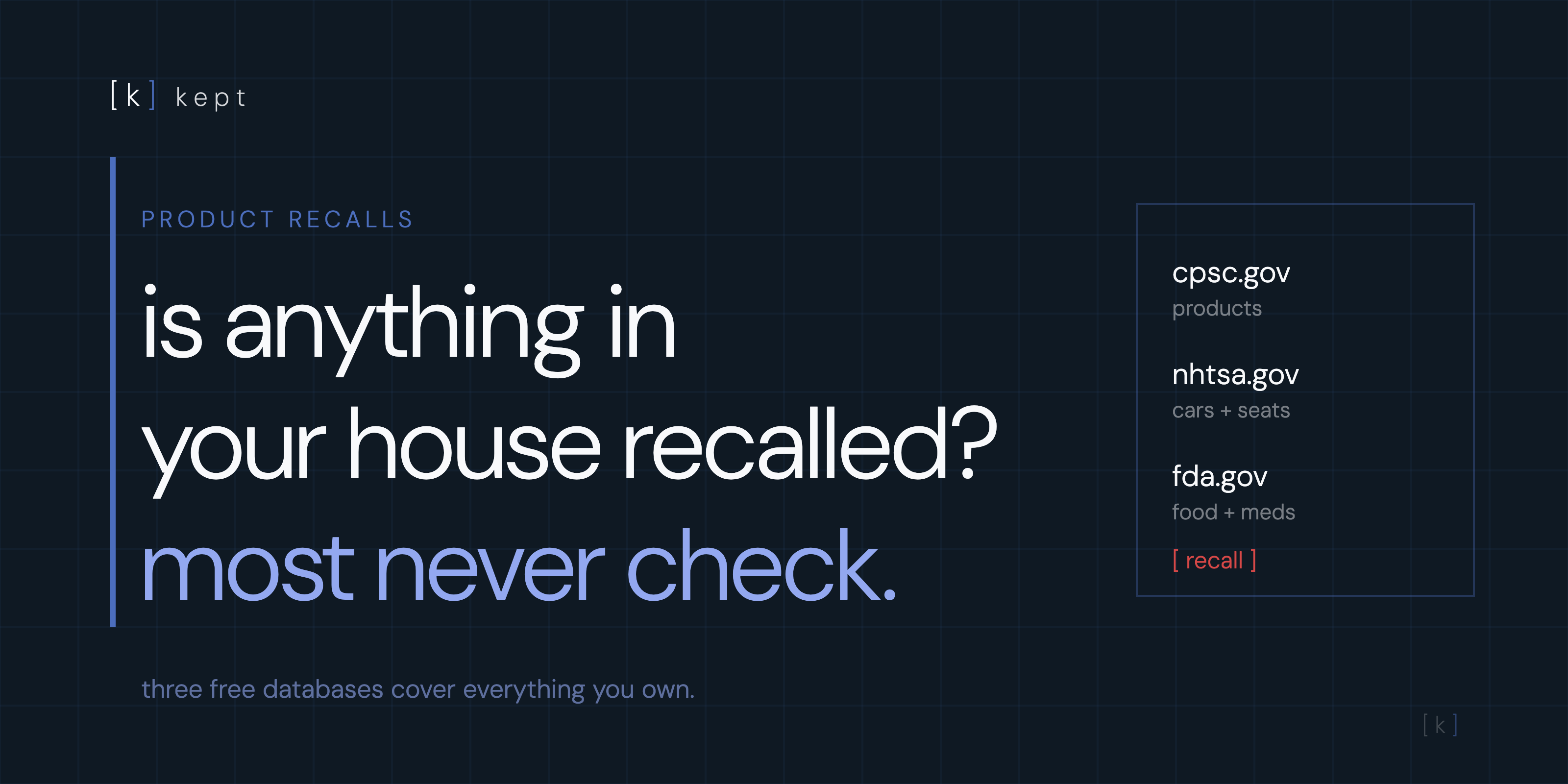
Recall data is public, free, and split across agencies by product type. Here's the full map:
| Database | Covers | How you search |
|---|---|---|
| cpsc.gov/Recalls | Household products, appliances, toys, furniture, electronics, nursery gear | Product name, brand, or category. Filter by year |
| nhtsa.gov/recalls | Vehicles, tires, car seats | VIN for cars (exact answer for your unit), brand and model for car seats |
| fda.gov | Food, drugs, medical devices, cosmetics, pet food | Browsable list, searchable by product or brand |
| recalls.gov | All of the above plus USDA (meat and poultry) and EPA | One search box that fans out to every agency |
For most household stuff, start at the CPSC. We wrote a full walkthrough of the CPSC recall search and app if you want the click-by-click version.
How to search so you actually find it
The databases are easy. Matching a recall to your specific unit is where people stumble, because recalls almost never cover an entire product line. They cover manufacturing runs: certain model numbers, serial ranges, or date codes.
So before you search, grab the identifying details:
- Brand and product name, off the label, not from memory. "Hamilton Beach blender" finds it; "the blender" doesn't.
- Model number, on the data plate or molded into the plastic. This is what the recall notice keys on.
- Serial number or date code, for confirming whether your unit sits inside the affected range.
Search the brand first, then scan results for your product type. If you get a hit, open the notice and check your model and serial against the affected ranges before assuming the worst. Half of all "my thing is recalled" scares end at this step, because the recall covers a different production year.

Why nobody told you
Here's the part that surprises people: in most cases, no one is required to contact you directly. Companies announce recalls through the CPSC, a press release, and a page on their website. Direct notice only goes to customers the company can identify, which mostly means people who mailed in a registration card or bought directly from the brand.
The result: recall response rates regularly sit below 10 percent. The other 90 percent of affected products stay in kitchens, garages, and nurseries, working fine until they don't.
Two exceptions worth knowing. Vehicle recalls reach you by mail, because registration data ties every VIN to an owner. And nursery products (cribs, bassinets, play yards) have a federal registration requirement precisely so companies can notify owners directly. For everything else, checking is on you. Our breakdown of recalls most homeowners never hear about shows how big that gap gets.
kept monitors your saved items against active recalls. You save the product once; kept watches it for you.
[ try kept free ]What you're owed when something hits
A recall notice names one of three remedies, and it costs you nothing:
- Refund, full or prorated by age. Common for products that can't be made safe.
- Free repair, often a mail-out fix kit or a technician visit. Common for appliances.
- Replacement with a corrected unit.
You almost never need a receipt: the model and serial number prove your unit is affected. Follow the claim instructions in the notice, and if the company stonewalls, report it to the CPSC at 800-638-2772 or saferproducts.gov.
One thing not to do: keep using a recalled product while you wait, especially chargers, heaters, and anything with a lithium battery. The remedy is free; the house fire is not. If something already went wrong, document everything before you file, the same way you would for a home insurance claim.
The one-time house sweep
Set aside 30 minutes and run the high-risk categories through cpsc.gov. In order of payoff:
recall sweep checklist
- ☐ Nursery gear: crib, bassinet, stroller, high chair, car seat (check NHTSA for the seat)
- ☐ Anything with a lithium battery: e-bikes, scooters, power banks, cordless tools
- ☐ Space heaters, dehumidifiers, and air fryers (recall regulars, fire hazards)
- ☐ Washer, dryer, dishwasher, range (search brand + model)
- ☐ Furniture taller than 27 inches (tip-over recalls)
- ☐ Smoke and CO detectors (recalled units fail silently)
- ☐ Hand-me-downs and secondhand buys, all of the above, double priority
The standing problem: recalls happen weekly
The sweep above protects you today. The CPSC publishes new recalls every week, so a clean check in June says nothing about October. Sustainable options, pick one:
- Subscribe to CPSC email alerts at cpsc.gov. Free, comprehensive, and noisy: you'll scan dozens of notices for products you don't own.
- Check seasonally. Put a 15-minute recall check on your home maintenance checklist alongside the filter swaps.
- Keep an inventory that does the remembering. The reason recall checking feels hard is that the hard part is knowing what you own. A current inventory in kept turns "do we have one of those?" from a basement expedition into a two-second search.
The pattern behind every option is the same one that runs through warranties and coverage checks: the information about your stuff is only useful if you captured it before you needed it.
Frequently asked questions
How do I find out if a product I own has been recalled?
Search the official databases: cpsc.gov/Recalls for household products, toys, and appliances; nhtsa.gov for vehicles and car seats; fda.gov for food, drugs, and cosmetics. Recalls.gov aggregates all of them in one search. Type the brand or product name, then confirm the model number and date range match your unit, since recalls usually cover specific manufacturing runs.
Do companies have to notify me when a product is recalled?
Usually not directly. Companies must announce recalls publicly through the CPSC and press releases, but they can only contact you individually if they have your information from a product registration or direct purchase. That's why most recalls reach under 10 percent of affected owners. If you never register products, the burden of finding out falls entirely on you.
What am I entitled to if my product is recalled?
One of three remedies, chosen by the company in the recall notice: a full or partial refund, a free repair, or a replacement. The fix is free, including shipping in most cases. You do not need the original receipt for most consumer product recalls; the model and serial number identify an affected unit.
Can I get a recall remedy without a receipt?
Yes, in most cases. Consumer product recalls are tied to the model and serial number, not proof of purchase. Check the recall notice for the affected ranges, and if your unit matches, follow the claim instructions. Vehicle recalls work by VIN and are always free at the dealer, no paperwork needed.
How do I check baby products for recalls?
Search the brand and product at cpsc.gov/Recalls before first use, and again for hand-me-downs, since cribs, bassinets, inclined sleepers, and strollers are recalled more often than almost any other category. Register new baby gear with the manufacturer: it's the one category where registration cards genuinely matter, because companies must notify registered owners of nursery product recalls.