
Recent Product Recalls in 2026: The Latest Waves and Why Tracking What You Own Matters
A single summer brought recalls on 6.3 million cleaners, seven separate adult bed rails, and 165,000 tip-over dressers that Walmart shipped again after the first recall. Here are the biggest 2026 recalls, and the one reason most of them never reach the people who own the products.

table of contents
The summer of recalls
Open any news feed this year and a recall is on it. The volume is real, not a headline trick. Between June 1 and September 6, 2026, the U.S. Consumer Product Safety Commission published more than 160 separate recalls of consumer products. That is more than ten a week, and it does not count food, drugs, or cars, which run through other agencies.
Some were huge. Clorox pulled 6.3 million bottles of cleaner. Walmart re-recalled 165,000 dressers. Some were tiny, a few hundred units of an off-brand item sold on Amazon. The pattern underneath them is the same: a product you already brought into your home turns out to be dangerous, and the only way you find out is if you go looking. Most people never do.
This post walks through the recalls that made the news, then gets to the part the news skips: what you actually do about the ones sitting in your house right now. If you just want to check a specific product, start with our guide on how to check if a product is recalled.
The biggest recalls of 2026 so far
Here are the recalls with the largest reach or the most serious hazard from the summer. Every number and hazard below comes from the official notice at CPSC.gov.
| Product | Units | Hazard | Remedy |
|---|---|---|---|
| Clorox Mistolin & Lestoil cleaners | 6.3 million | Bacteria (Pseudomonas aeruginosa) | Refund |
| Walmart Mainstays 9-drawer dressers | 165,250 | Tip-over, entrapment | Refund |
| Goal Zero YETI 3000X power stations | 46,200 | Fire, burn | Free firmware repair |
| Skip Hop Elmo silicone teethers | 22,660 | Choking (eyes detach if frozen) | Refund |
| Amana window/wall AC & heat pumps | 13,514 | Fire, burn | Refund |
| Hampton Bay Halwin ceiling fans | 9,460 | Blades separate, impact | Refund or store credit |
| Adult portable bed rails (7 brands) | ~27,000 combined | Entrapment, asphyxiation | Refund |
Two things jump out. First, the remedy is almost always a refund, which means real money is waiting for anyone who owns one and files. Second, the hazards are not cosmetic. Fire, choking, and asphyxiation show up over and over. These are the recalls worth catching.
The adult bed rail wave
The strangest story of the summer is adult portable bed rails, the grab bars people clamp to a mattress to help someone get in and out of bed, or to keep them from rolling out. The CPSC recalled at least seven different brands of them between June and September 2026: Loyoda, Liuqibax, MNIENT, Noerishia, Moodooy, Hopelight, and Nimood, most of them sold on Amazon by third-party sellers.
Every one was recalled for the same reason. Per the CPSC notices, the rails "violate the mandatory standard for adult portable bed rails because users can become entrapped within the bed rail or between the bed rail and the side of the mattress," posing a risk of "serious injury or death from entrapment and asphyxiation." These are products bought to keep a vulnerable person safe. The refund process for most of them requires you to cut the strap, write "RECALLED" on the rail in permanent marker, photograph it, and email the photo to claim your money.
If you bought one for an older parent, this is the kind of recall you want to know about the day it posts, not the day something goes wrong.
Bought it for someone who can't check for themselves?
Log the products in your parents' home once. kept watches the CPSC feed and tells you if a rail, walker, or heater they rely on gets recalled.
set up a recall watchTip-over furniture keeps coming back
Dressers that tip over onto children have been recalled for years, and 2026 added a long list of them, mostly cheap multi-drawer chests sold online. The one that made news was different. In August, Walmart re-announced a recall of about 165,000 Mainstays nine-drawer fabric dressers, because after the first recall in May, some of the recalled dressers were sent to liquidators and sold to shoppers anyway.
The hazard is the classic one: the dresser is "unstable if not anchored to the wall," which can crush or trap a child. If you own a dresser and are not sure whether it was part of a recall, our roundup of how to check whether something you own is recalled shows exactly where to look up the model.
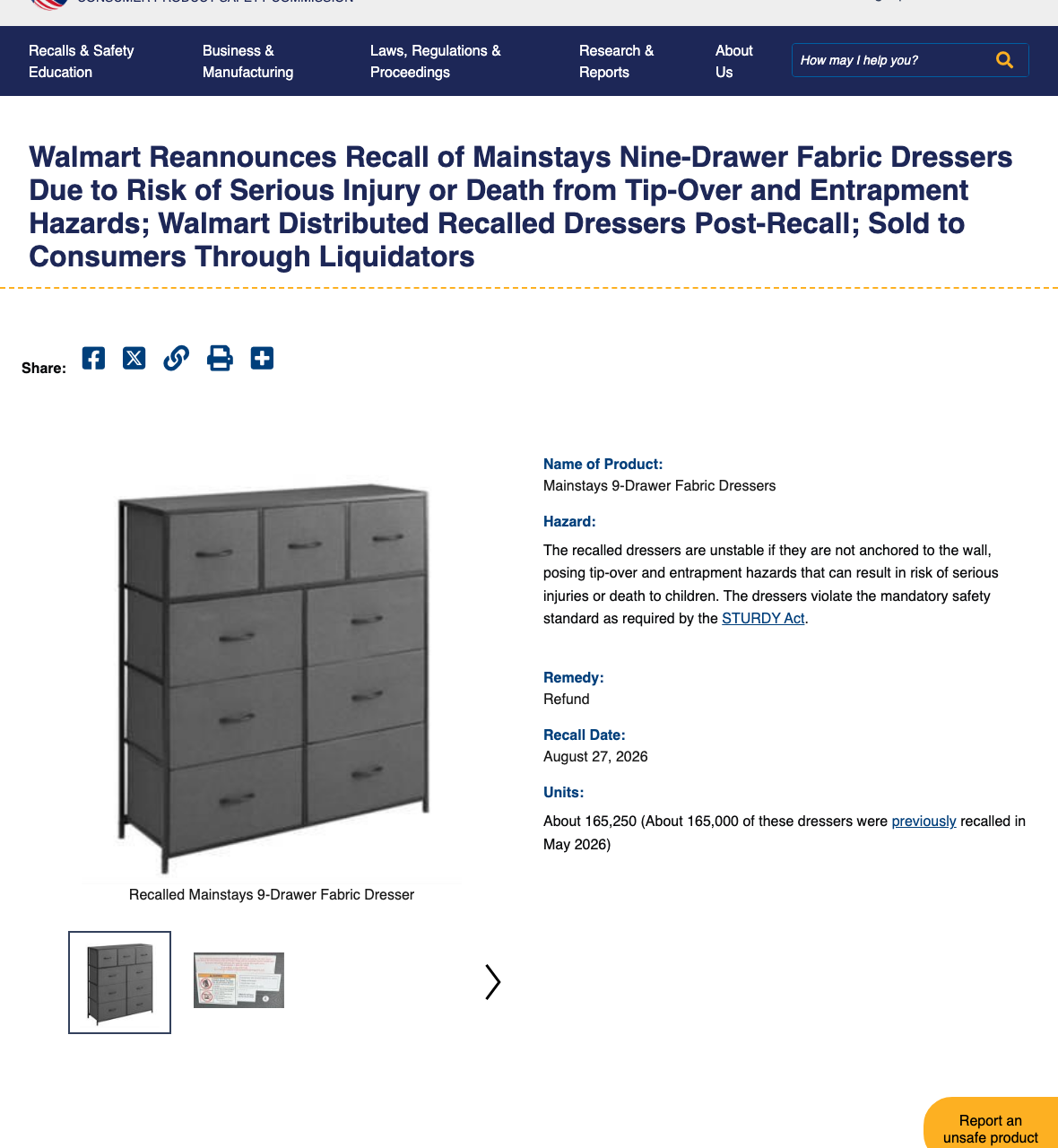
the official notice for the Walmart Mainstays dresser re-recall (CPSC.gov, August 27, 2026).
Fire risks: appliances and power stations
The scariest recalls are the ones that can burn your house down while you sleep. Three from this summer stand out.
Amana air conditioners and heat pumps. Daikin recalled Amana units twice in 2026. A June recall covered about 13,514 window and wall units whose heating element could "remain energized during a ground fault, despite being turned off," and a September recall added more wall units whose control board "snubber circuit can emit flames if it shorts." The remedy is a full refund, but to get it you cut the cord and upload a photo of the serial number. No serial, no refund.
Goal Zero YETI 3000X power stations. About 46,200 of these popular backup batteries were recalled in August after four caught fire, overheated, or smoked. The fix here is a free firmware update through the Goal Zero app, which is easy, but only if you know your unit is affected.
Hampton Bay Halwin ceiling fans. About 9,460 of these Home Depot fans were recalled after 11 reports of blades separating from the motor mid-spin. The refund needs proof of purchase or a photo of the serial number inside the mounting plate.
Notice the pattern in all three: the money is real, but the claim depends on the serial number or proof of purchase. That detail matters more than it looks, and we come back to it below. If your recalled item is a major appliance, our guide to appliance recalls and what to do covers the refund and repair path in more detail.
Kids and baby products
Children's products are a big share of every recall cycle because the safety standards are strict and the hazards are severe. This summer's list included the Skip Hop Sesame Street Elmo silicone teethers (about 22,660 units), where "the black eyes can detach from the recalled teether if frozen," a choking risk. It also included Kmaier infant walkers that failed the mandatory walker standard by fitting through a doorway and not stopping at a step, plus a run of magnetic building cubes and squishy toys pulled for ingestion hazards.
If you have young kids or buy gifts for them, it is worth a standing check. We keep two running guides current: infant toy and baby product recalls and the recent Target Cat & Jack sandal recall, which shows how a single kids' product recall plays out from notice to refund.
Worth knowing: a recalled kids' product that fails a mandatory standard usually cannot be legally resold, but it still turns up at yard sales, on resale apps, and handed down between families for years. The recall notice is the only thing standing between it and the next child.
Why the recall never reaches you
Here is the uncomfortable part. A company that recalls a product is required to report the defect to the CPSC and publish the recall. It is not required to knock on your door, and in most cases it has no idea who you are.
Think about how you bought the recalled dresser or the teether or the power station. You paid, you took it home, and you never told the manufacturer your name. The only buyers who get a mailed notice are the ones who filled out the little warranty registration card, and almost nobody does. The only people who get an email are the ones who signed up for alerts on a government site they have already forgotten about.
So the recall gets announced, the news writes it up for a day, and then it sits on CPSC.gov where you will never think to look. That is why a product recalled in May can still be in a nursery in the following March. The information exists. It just never travels the last mile to the person holding the product. Our explainer on CPSC recall alerts and how to get notified breaks down every notification channel and where each one falls short.
What to do if you own a recalled item
If you find out something you own is on the list, the steps are simple and the same almost every time.
- Stop using it. This is the whole point of a recall. Unplug it, take it away from the child, move the dresser somewhere kids cannot reach it.
- Read the official notice. Find the recall at CPSC.gov and read the exact remedy. It will be a refund, a free repair, or a replacement.
- Gather your proof. Almost every refund needs the model and serial number, and many need a receipt or the purchase date. Fire recalls often ask you to cut the cord and photograph it. Have this ready before you file.
- File the claim. Follow the notice. No receipt is usually fine, most programs refund the manufacturer's suggested retail price without one, so file anyway.
Step 3 is where people get stuck. The refund is sitting there, but you cannot remember what you paid, you never saved the receipt, and the serial number is on a plate you now have to crawl behind the unit to read. If you had logged the item when you bought it, this step takes ten seconds instead of an afternoon.
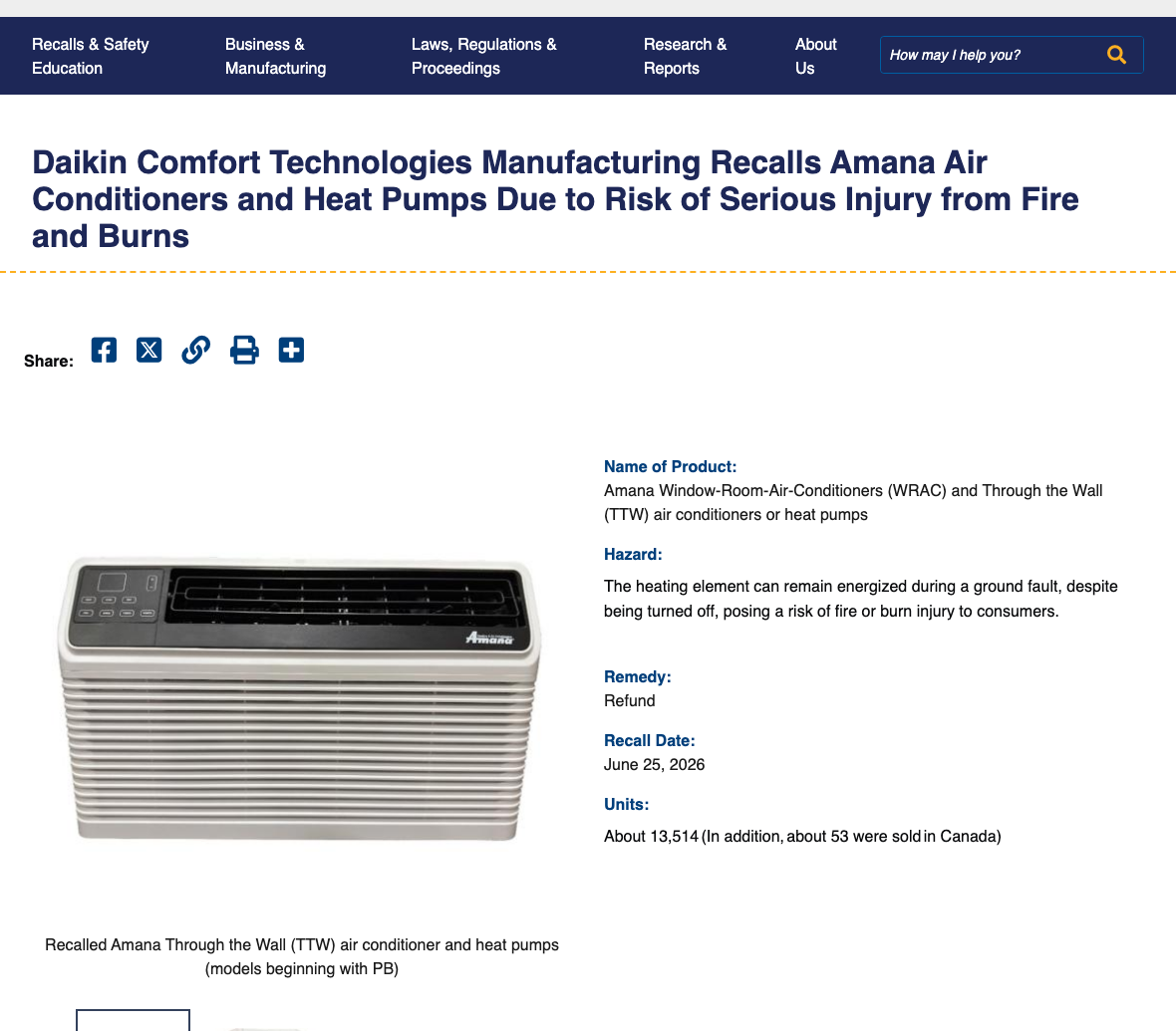
the notice lists the remedy, but the refund still needs your model and serial number to claim it (CPSC.gov, June 25, 2026).
How to actually stay alerted
You have two real options. You can check CPSC.gov yourself on a schedule you will not keep, or you can flip the problem around: write down what you own once, and let something watch the recall feed for you.
That second approach is what a home inventory app is for, and it is what kept was built to do. You add an item by scanning its barcode or snapping the data plate, which captures the brand, model, and serial. From then on, kept checks each new CPSC recall against your list and alerts you when one matches something you actually own. No daily searching, no warranty card, no depending on the manufacturer to find you.
The same record does double duty. When a recall hits, you already have the serial number and purchase date the refund demands. When an appliance breaks, you have the model for the repair. When you file an insurance claim, you have the whole inventory. The recall alert is the reason to start, but the record is useful long after.
Frequently asked questions
How do I find out if a product I own has been recalled?
Search the product at CPSC.gov/Recalls or Recalls.gov, which cover consumer products, food, drugs, and vehicles. Match on the brand, model number, and the date code or serial on the label, not the product name alone, because recalls often cover only specific batches. The faster method is to log what you own once, then let a tool check the CPSC feed against your list and alert you. kept does that automatically.
What should I do if I own a recalled product?
Stop using it immediately, then read the recall notice for the exact remedy. It is usually a refund, a free repair, or a replacement. Most refunds require proof: a photo of the serial number, sometimes the cut cord, and often a receipt or purchase date. Gather that before you file. If you cannot find the receipt, many companies pay the manufacturer's suggested retail price instead, so file anyway.
Do you get your money back for a recalled product?
Usually yes. The three standard remedies are a full refund, a free repair, or a free replacement, and the company running the recall pays for it. Refunds are common when a product cannot be made safe. A receipt gets you the exact price you paid, but most programs will refund the retail price without one. You almost always need the model and serial number to prove your unit is covered.
How will I be notified if something I bought is recalled?
You mostly will not, unless you took action first. Mailed recall notices only reach people who filled out a warranty registration card, and email alerts only reach people who signed up. The CPSC posts every recall at CPSC.gov, but nobody checks it daily. The reliable path is to register products where you can and use an app that watches the recall feed against a list of what you actually own.
Are companies required to tell you about a recall?
Companies must report a defect to the CPSC and publish the recall, but they are not required to reach every individual buyer, and most have no way to. They rarely have your contact details unless you registered the product. That gap is why dangerous items stay in homes for years after a recall. The responsibility to check falls on you, which is exactly why keeping a record of what you own matters.