Are Extended Warranties Worth It? Run the Math First
The cashier asks while your card is already out. You have eight seconds to decide, no numbers, no fine print. Here are the numbers, so you can decide before you're standing there.
table of contents
Are extended warranties really worth the money?
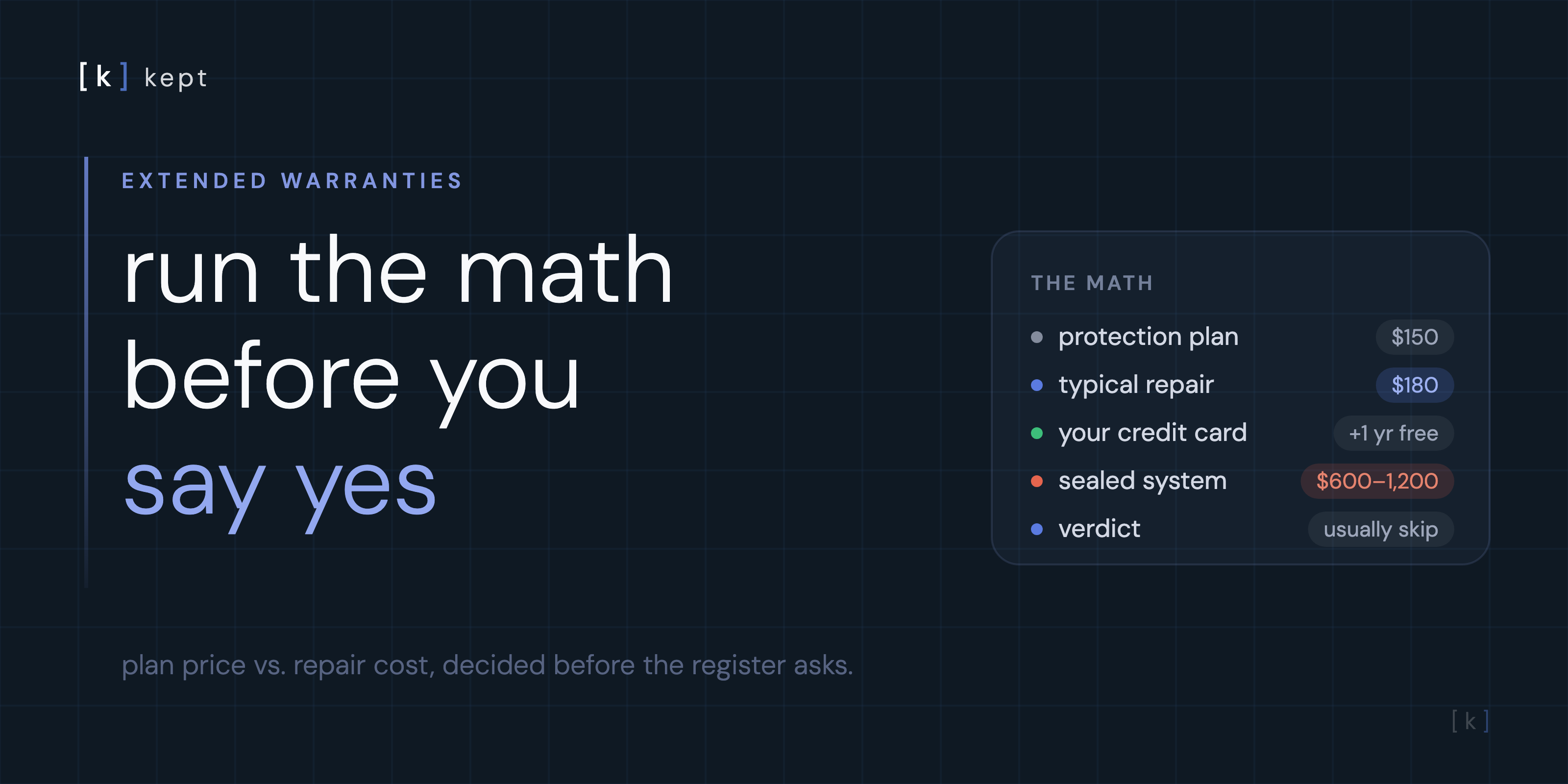
For most purchases, no. Consumer Reports has surveyed appliance owners on this question for years, and the pattern holds steady: products seldom break inside the extended warranty window, and when they do break, the median repair cost sits uncomfortably close to what the plan cost in the first place. You pay $140 to maybe save $180. That's not insurance. That's a coin flip with a fee.
Retailers know this. Protection plans carry some of the highest margins in the store, which is why the pitch happens at every register and every online checkout. The employee offering it often has a quota. None of that makes plans a scam, but it should tell you who the math usually favors.
The honest answer has a second half, though. "Usually not worth it" is a statement about averages. Your dishwasher doesn't fail on average. It either fails or it doesn't. So the real question is narrower: for this specific appliance, at this price, with this repair profile, does the plan beat self-insuring? Sometimes it does. The rest of this post is how to tell.
The math: plan price vs. repair odds
Three numbers decide it. The plan price. The likely repair cost. The odds you'll use it.
| Appliance | Typical 3–5 yr plan | Common out-of-warranty repair | Does the plan math work? |
|---|---|---|---|
| Dishwasher ($500–$800) | $100–$160 | Pump/motor assembly, $200–$400 | Marginal. One repair roughly breaks even, and most units never need it. |
| Refrigerator ($2,000+) | $150–$300 | Sealed system or compressor, $600–$1,200 | Closest to worth it. Failure is costly enough to matter. |
| Washer ($700–$1,100) | $120–$200 | Drum bearings, $350–$600 | Marginal. Bearings usually fail late, sometimes after the plan ends. |
| Microwave ($150–$400) | $40–$80 | Magnetron, $100–$200 | No. Repair cost rivals replacement cost. Skip it. |
| Range/oven ($800–$1,500) | $130–$220 | Control board, $250–$600 | Case by case. Electronic-heavy models fail more. |
Notice the pattern. The cheaper the appliance, the worse the plan. A $60 plan on a $250 microwave protects you from a repair nobody would pay for anyway. When a cheap appliance dies, you replace it. The plan only earns its price when the repair it covers is both plausible and painful, and that combination is mostly a big-refrigerator problem.
One more input most people skip: appliance age. A protection plan on a machine already in year 8 of a 10-year expected life is paying to insure a retirement. Check our guide to how long every major appliance lasts before extending coverage on something that's nearly done either way.
stop guessing which appliances are still covered
kept saves the purchase date and warranty terms when you add an appliance, then works out the coverage end date for you. Free, works on any phone.
[ try kept free ]Coverage you already have and forgot about
Before you pay for more coverage, add up what you're already holding. Most people are covered from three directions and can't name one of them.
The manufacturer warranty
Before you buy any extended plan, check what you still have: our free warranty check tool works out the end date of the coverage that came in the box. Almost every major appliance ships with one year of parts and labor. Some brands go further on specific components: many compressors carry 5 or 10 years, some drum motors carry 10. That component coverage survives after the general one-year window closes, and it's exactly the coverage that matters, because compressors and motors are the expensive failures. If you're not sure where your appliance stands, here's how to check whether your appliance is still under warranty, even without the receipt, and a brand-by-brand warranty lookup directory with each manufacturer's phone number.
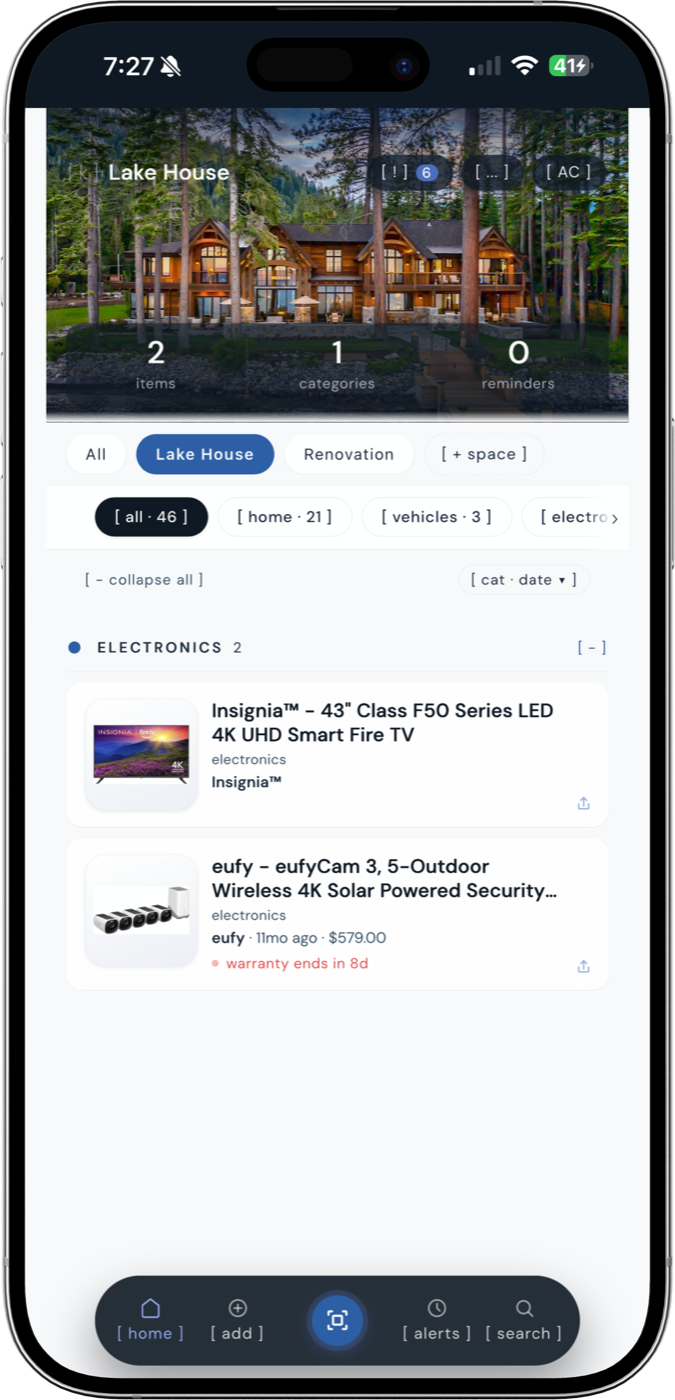
kept flags coverage before it ends, while a repair is still free.
Your credit card
This is the one that surprises people. Extended warranty protection is still a standard benefit on many American Express cards and on a lot of Visa Signature cards, depending on the bank. Amex's version adds up to one extra year on manufacturer warranties of five years or less, capped at $10,000 per item and $50,000 a year. Mastercard is the exception: it dropped extended warranty as a network-wide benefit in 2019, and banks like Barclays and Capital One removed it from their Mastercards after that, so don't assume yours has it. Bought a $900 washer on the right card? You may already own two years of coverage, free, before the store plan enters the conversation.
Two catches. You must have paid with that card, and you'll need documentation when you claim: the receipt, the card statement, and the manufacturer's warranty terms. The benefit is real, but it rewards people who keep records. Which, statistically, is not most people. It takes one photo of the receipt on the day you buy to be in the covered group.
The retailer's return window and registration perks
Some retailers extend coverage quietly: Costco adds a second year on major appliances bought there, and some manufacturers add months of coverage just for registering the product. Registering your appliances takes five minutes and also puts you on the list for safety recall notices, which matters more than the bonus coverage.
Before buying any protection plan, confirm
- ☐ The manufacturer warranty length, including component warranties (compressor, motor, drum)
- ☐ Whether the credit card you used adds extended warranty coverage
- ☐ Whether your retailer already extends coverage (Costco, some club stores)
- ☐ Whether registering the product adds coverage or perks
- ☐ That you have the receipt saved somewhere you can find in 4 years
What an appliance protection plan usually covers
Protection plans cover mechanical and electrical failure from normal use, starting after the manufacturer warranty ends. Failed pump, dead control board, burned-out motor: covered. That's the headline, and it's genuine.
The exclusions section is where plans earn their margin. Common carve-outs:
- Cosmetic damage. Dents, scratches, discoloration, rust. Not covered, even when the rust is arguably a defect.
- Accidents and misuse. Dropped, flooded, overloaded, wrong detergent. The claim adjuster decides what counts as misuse.
- Pre-existing conditions. Anything that started before the plan did, which gets interesting when you buy the plan at year 2.
- Consumables and wear parts. Filters, hoses, gaskets, bulbs, racks. The parts most likely to actually need replacing.
- Food loss caps. Refrigerator plans often cap spoiled-food reimbursement at $150–$300, well under a full freezer's contents.
- "No lemon" thresholds. Many plans replace the unit only after 3+ qualified repairs of the same failure. Each repair attempt takes weeks.
Read the exclusion list before buying, not during a claim. If the seller can't show you the full terms at the register, that alone is an answer.
kept keeps the receipt photo, the model number, and the warranty terms together on each appliance, everything a claim asks for.
[ try kept free ]The repairs that actually hurt
If you're going to insure against anything, know what the worst case looks like. These are the out-of-warranty repairs that produce the phone-call pause:
- Refrigerator sealed system, $600–$1,200. Compressor, evaporator, condenser. Refrigerant work requires a certified tech and hours of labor. This is the single best argument for a plan that exists.
- Washer drum bearings or drum assembly, $350–$600. The load-of-bricks spin sound. Labor-heavy because the machine comes fully apart.
- Oven or range control board, $250–$600. Modern ranges are computers that get hot. Boards fail, and board prices are whatever the manufacturer says they are.
- Dishwasher pump and motor assembly, $200–$400. Common enough to be the reason dishwasher plans are priced where they are.
- Dryer heating element and blower, $150–$350. Cheaper, but frequent, and often DIY-able if you know the model number.
On a $400 appliance, every number on that list means replacement. On a $2,500 appliance, most of them mean repair. That asymmetry, not the checkout pitch, is what should drive the decision.
kept is reader-supported. When you buy through links on this page we may earn a small commission, at no extra cost to you. It never changes what we recommend.
When an extended warranty is worth it
The plan earns its price in a few specific situations:
- Big-ticket refrigerators. High repair cost, real failure rate, and the one appliance whose downtime costs you money in spoiled food. If you buy one plan in the house, this is it.
- A thin emergency fund. The textbook answer says self-insure, and the textbook assumes $1,000 sitting idle. If a surprise $600 repair means a credit card balance at 24% interest, a $150 plan is rational peace of mind, not innumeracy.
- Feature-stuffed models. Touchscreens, cameras in the door, wifi everything. More electronics means more failure points, and board replacements are priced like the manufacturer would rather sell you a new unit.
- Landlords and rentals. When you can't control how the appliance gets used, the plan hedges tenant wear you'd otherwise eat.
And skip it when the appliance is cheap, when your card already extends the warranty, or when the plan costs more than a third of the likely repair. In every one of those cases you're better off putting the plan price in a savings account labeled "when something breaks."
Track what you have before buying more
Here's the part nobody at the register mentions: most warranty money is lost not because people bought the wrong plan, but because they couldn't prove coverage they already had. The repair tech asks for a purchase date. The card benefit asks for a receipt. The manufacturer asks for a model and serial number. Four years later, all three are gone.
This is the actual job kept does. Scan the barcode or snap a photo when the appliance arrives, and kept files the model number, serial, purchase date, and receipt photo together. It works out when the factory coverage ends, shows a status pill on every appliance, and flags coverage before it expires, while a free repair is still on the table.
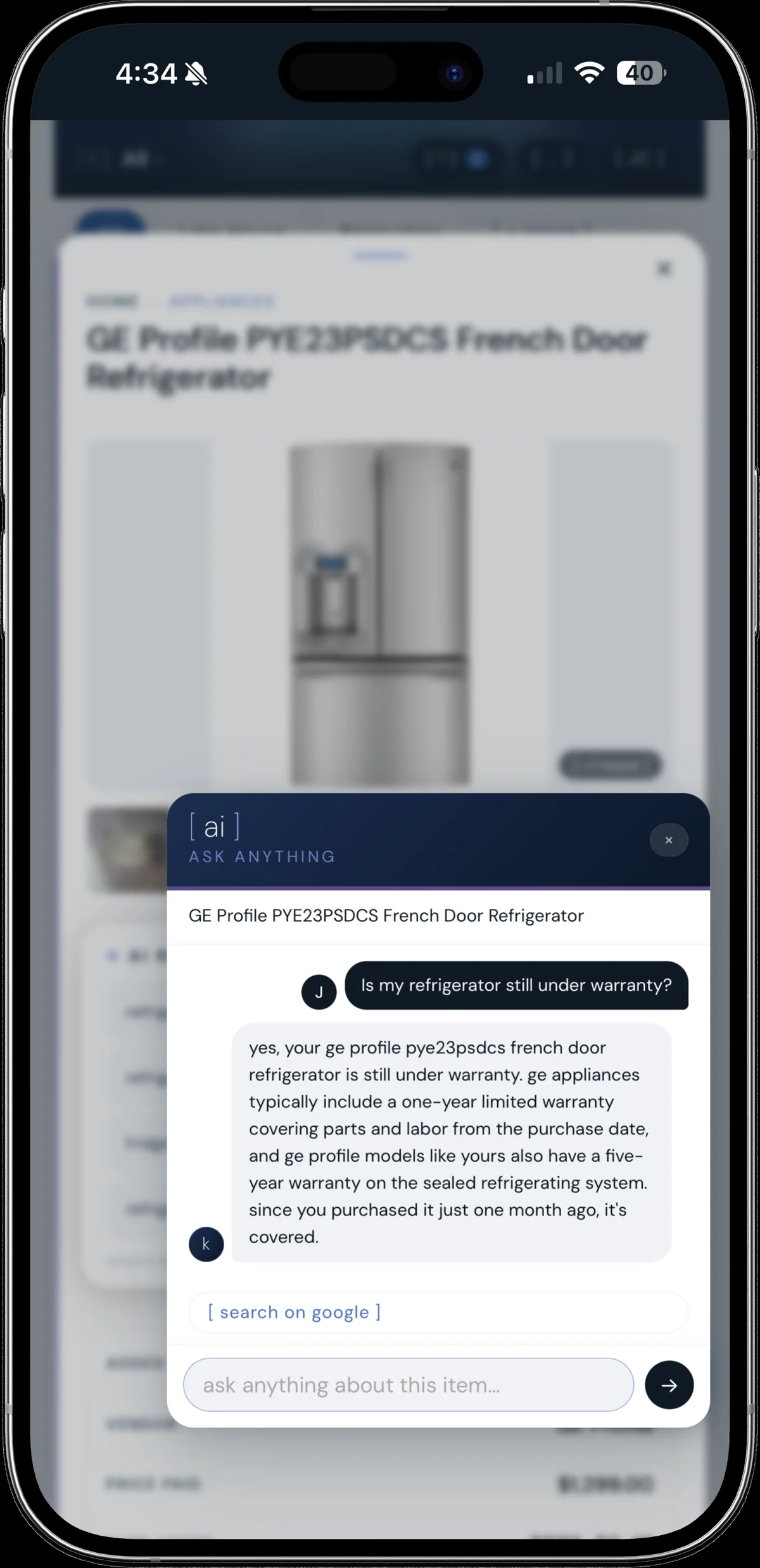
ask kept "is my dishwasher under warranty?" and get an answer with dates, not a filing cabinet search.
Then the checkout question gets easy. "Would you like the protection plan?" becomes a two-second check of what you already have, instead of a shrug and $150.
Frequently asked questions
Are extended warranties really worth the money?
For most products, no. Consumer Reports has surveyed appliance owners for years and consistently found that products rarely break during the extended warranty window, and when they do, the average repair bill lands close to what the plan cost. Retailers push plans hard because the margin on the plan beats the margin on the appliance. The exceptions: products with known high repair costs, or households where one surprise repair bill would be a genuine problem.
Is an extended warranty worth it for my appliance?
Run three numbers: the plan price, the typical repair cost for that appliance type, and the odds it breaks in years 2 through 5. A $150 plan on a $500 dishwasher rarely pays off because a full repair often costs about the same as the plan. A plan can make sense on a $3,000 refrigerator with a sealed-system failure risk, since those repairs can run $600 to $1,200. Price the plan against the specific repair it would cover, not against the fear of it breaking.
What does an appliance protection plan usually cover?
Most plans cover mechanical and electrical failures from normal use after the manufacturer warranty ends: failed motors, pumps, control boards, and compressors. They typically exclude cosmetic damage, damage from accidents or misuse, pre-existing conditions, food loss beyond a small cap, and normal-wear parts like filters, hoses, and light bulbs. Read the exclusions list before buying. It is usually longer than the coverage list.
What appliance repairs are most expensive after a warranty expires?
Refrigerator sealed-system repairs (compressor, evaporator, condenser) are the most expensive, commonly $600 to $1,200 with labor. Other budget-breakers: washer drum bearings or a full drum assembly ($350 to $600), oven and range control boards ($250 to $600), and dishwasher pump-and-motor assemblies ($200 to $400). On a budget appliance those numbers usually mean replacement, not repair, which is why blanket extended warranties on cheap appliances rarely pay off.
Do credit cards double manufacturer warranties on appliances?
Some do, but fewer than a few years ago. Extended warranty protection is still standard on many American Express cards and on many Visa Signature cards, depending on the bank. Amex adds up to one extra year on manufacturer warranties of five years or less, capped at $10,000 per item. Mastercard dropped it as a network-wide benefit in 2019, so most Mastercards no longer include it. You must have bought the appliance with that card, and you will need the receipt and the original warranty terms when you file. Check your card's benefits guide before paying for a store plan that duplicates coverage you already have for free.