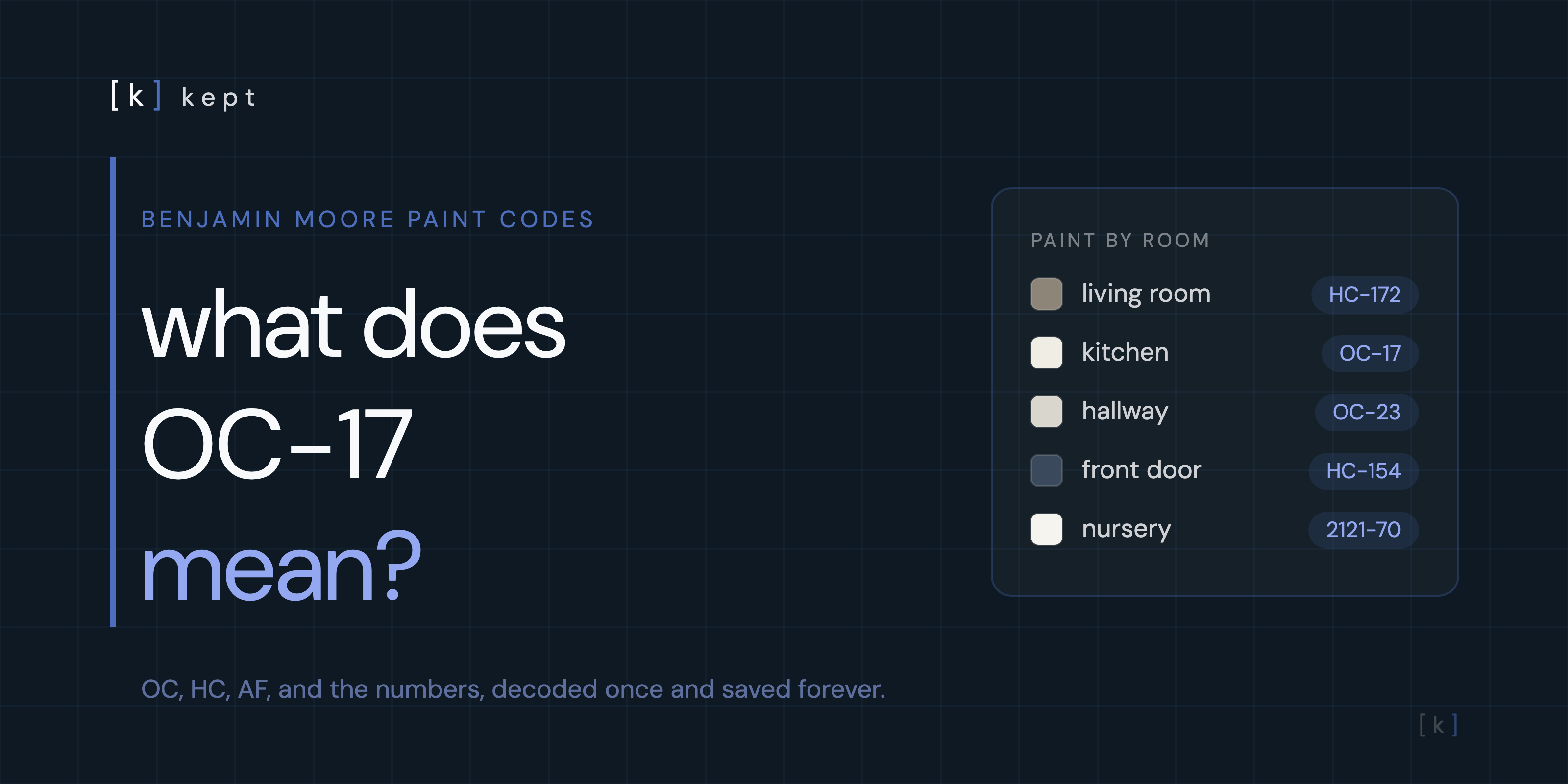
Benjamin Moore Paint Codes: OC, HC, AF, and the Numbers
The can in the garage says HC-172. The designer's mood board says Revere Pewter. The fan deck at the store says both. Here's how Benjamin Moore's numbering works, why one color can carry two codes, and how to get an exact remix years from now.
table of contents
How Benjamin Moore codes work
Take the sticker on a real can: HC-172 Revere Pewter, Regal Select, eggshell, base 1. Four facts, four jobs:
- HC-172: the color code. HC names the collection (Historical Colors), 172 is the color's slot in it. This pair identifies one exact color at every Benjamin Moore dealer in the country.
- Revere Pewter: the marketing name. Great for searching online, but names alone are risky at the counter because Benjamin Moore has retired and reused names over the decades. The number is the contract.
- Regal Select, base 1: the product line and the base can the colorants went into. The same code mixed into a different line or base can read differently on the wall.
- Eggshell: the sheen. Two walls of HC-172 in flat and semi-gloss look like neighbors, not twins. If sheen names blur together, our paint finishes guide sorts flat through gloss in plain terms.
Under those lines sits the tint formula, the colorant doses the mixing machine dispensed. You never need to read it. If the code is legible, the formula is redundant. If the code has faded, a clear photo of the formula lines lets a dealer rebuild the color.
Every prefix, decoded
Benjamin Moore organizes its catalog into collections, and the prefix on the code tells you which one a color belongs to:
| Code format | Collection | Famous example |
|---|---|---|
| OC-1 to OC-152 | Off-White Collection | OC-17 White Dove, OC-65 Chantilly Lace |
| HC-1 to HC-191 | Historical Colors | HC-172 Revere Pewter, HC-154 Hale Navy |
| AF-### | Affinity | AF-690 Metropolis |
| CW-### | Williamsburg | CW-715 Carter Plum |
| CSP-### | Color Stories | CSP-1000s, full-spectrum colors |
| 001 to 1680 | Classic catalog | 1548 Classic Gray |
| 2000-## style | Color Preview | 2121-70 Chantilly Lace |
Two things the prefixes are not: a quality tier and a price tier. OC and HC are curation labels. Every color mixes into every product line, from ben to Aura, at whatever sheen you ask for. The one caveat is Color Stories (CSP): those are full-spectrum formulas designed for Aura, so dealers mix them in Aura only.
The Color Preview suffix carries real information: the two digits after the hyphen mark depth on the strip. 2121-70 sits at the lightest end of its strip, 2121-10 at the darkest. Handy when you're eyeballing a faded chip and wondering whether you had the light gray or the lighter gray.
stop re-deriving the hallway color every touch-up
kept saves the code, product line, sheen, and room together, so "what's the trim color?" is a search, not an excavation. Free, works on any phone.
[ try kept free ]Why one color has two numbers
This is the Benjamin Moore quirk that fills forum threads. Some colors live in more than one collection, and each collection gives them its own number:
- Classic Gray is 1548 in the classic catalog and OC-23 in the Off-White Collection.
- Chantilly Lace is OC-65 and 2121-70.
- White Dove is OC-17, and older chips mark it PM-19.
Either number mixes the identical paint. So when the designer's spec sheet says OC-23 and the can in your garage says 1548, nobody made a mistake. Check the color name before concluding you have two different grays.
The flip side of the same lesson: a number without its brand is worthless. "172" means Revere Pewter at a Benjamin Moore counter and nothing at a Sherwin-Williams one. Our hub guide on whether paint codes are universal covers the cross-brand mess in full.
Where the code hides
- On the can: the mixing sticker on the lid or upper side, applied at tinting. Code, name, line, base, sheen, formula.
- On a chip or fan deck: printed directly under the color name.
- Online: search the name at benjaminmoore.com and the code sits on the color page, with RGB and hex values for digital matching.
- From your dealer: Benjamin Moore sells through independent local dealers, and most keep purchase history by customer name or phone number. One call can recover every color mixed for your house, including the previous owner's if you know which store they used.
No can, no chip, no dealer history? A paint store can scan a physical sample with a spectrophotometer. Cut a chip from behind a switch plate and bring it in. It also pays to grab the codes early: collecting paint colors room by room is one of the first-week jobs in our new house information checklist.
kept is reader-supported. When you buy through links on this page we may earn a small commission, at no extra cost to you. It never changes what we recommend.
Mixing Benjamin Moore colors elsewhere
Can Home Depot mix White Dove? Not really, and the reason is chemistry as much as licensing. Benjamin Moore tints with its proprietary Gennex colorant system. Another store can scan a sample and produce its own nearest formula, but different colorants shift undertones under different light. The internet's "OC-17 equivalent" charts are starting points, not answers. Test a sample board before repainting a room around one.
Going the other direction works the same way: a Benjamin Moore dealer can color-match a Sherwin-Williams chip, and the result gets a new formula in their system. If you're juggling codes from both brands, our guide to reading Sherwin-Williams paint codes is the companion to this one.
The only path to a true remix is staying in-brand with the code. Which is the whole argument for writing it down once, properly.
you've photographed that can sticker before. where's the photo?
kept files the code, sheen, and room together and finds them by search, so the photo isn't lost in 4,000 others.
[ try kept free ]Make the code permanent
Every method above works today and gets harder every year: stickers fade, cans get tossed, dealers close, previous owners stop answering texts. The durable version of this knowledge is a record you control:
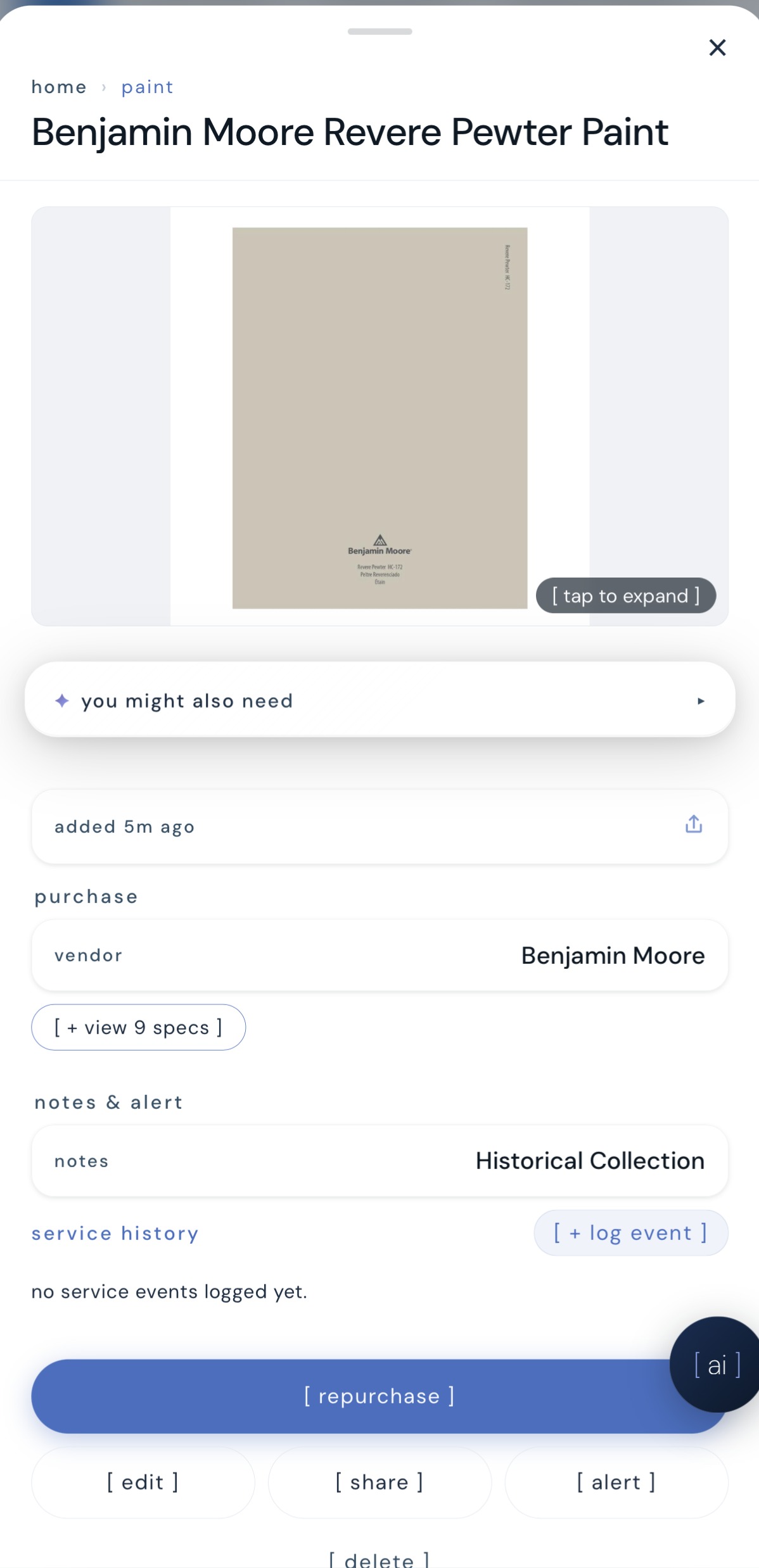
HC-172 Revere Pewter saved with a chip photo, vendor, and collection note. found by search, not by digging.
the per-room paint record
- ☐ Brand (Benjamin Moore) and color code (HC-172)
- ☐ Color name (Revere Pewter)
- ☐ Product line (ben, Regal Select, Aura) and base
- ☐ Sheen (flat, matte, eggshell, satin, semi-gloss)
- ☐ A photo of the mixing sticker
- ☐ Where and when it went up ("living room + hall, spring 2025")
Save that in kept per room and the paint joins the rest of your house's memory, next to the filter sizes and model numbers, alongside the receipts in your home improvement records. The next touch-up starts with a ten-second search instead of a garage archaeology session.
HC-172. saved once. found in seconds.
kept stores every paint code, sheen, and room in your house, searchable from your phone at the paint counter.
[ try kept free ]Frequently asked questions
What does OC mean in Benjamin Moore paint?
OC stands for Off-White Collection, Benjamin Moore's curated set of whites and barely-tinted neutrals, running from OC-1 to OC-152. OC-17 is White Dove, OC-65 is Chantilly Lace. The prefix tells you which collection a color was curated into, not anything about quality or price. Any Benjamin Moore dealer can mix any OC color from the code alone.
What is the difference between Benjamin Moore HC and OC colors?
OC is the Off-White Collection (whites and near-whites). HC is Historical Colors, a set of muted, traditional shades inspired by 18th and 19th century American architecture, like HC-172 Revere Pewter. The prefixes are curation labels, not quality tiers. Both mix the same way at the counter, in any product line and sheen.
What are the numbers on Benjamin Moore paint cans?
The code is a collection prefix plus a number that identifies one exact color: HC-172 is Revere Pewter, OC-17 is White Dove. Plain four-digit numbers like 1548 come from the classic catalog, and Color Preview codes like 2121-70 use the last two digits to mark depth on the strip. Some colors carry two numbers (Classic Gray is both 1548 and OC-23); either mixes the identical paint. Any Benjamin Moore dealer can remix from the code.
Can Home Depot look up Benjamin Moore paint colors?
Not from the code. Benjamin Moore numbers only exist in Benjamin Moore's system, and its Gennex colorants are proprietary, so Home Depot can't type HC-172 into its machine. What it can do is scan a physical sample, a paint chip or a brushed-out swatch, with a spectrophotometer and mix the closest Behr equivalent under a new code. For an exact remix, take the code to a Benjamin Moore dealer.
Can Behr match Benjamin Moore paint colors?
Behr, sold at Home Depot, can color-match a physical Benjamin Moore sample with a spectrophotometer and mix its nearest version under a new Behr formula. It's usually close to the eye, but different pigment bases shift undertones under different light, so it's a match, not the same paint. Test a sample on your wall before committing to a room, and expect a new Behr code rather than the Benjamin Moore number.