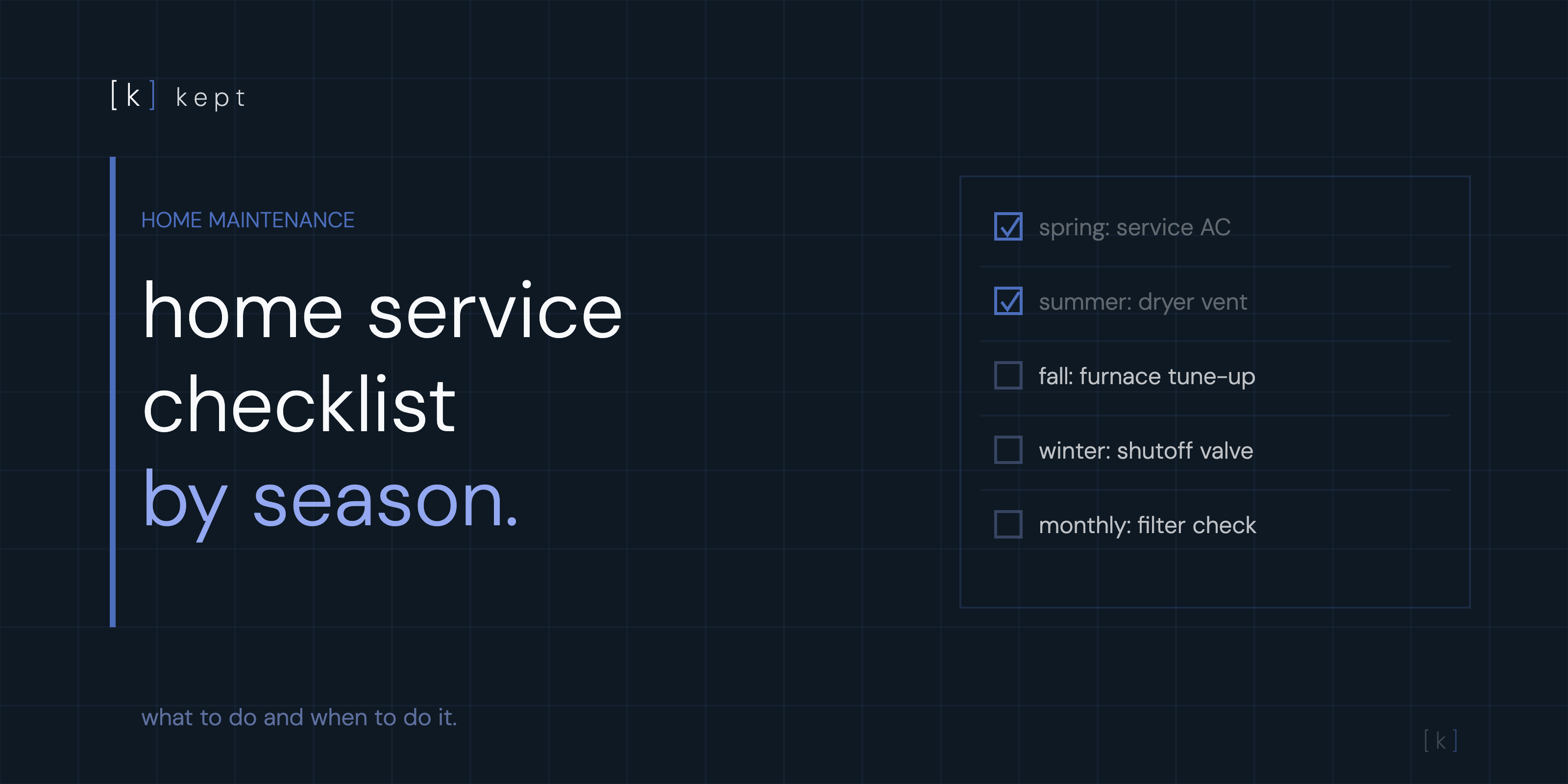
Home Service Checklist: Everything Your House Needs and When
Most home maintenance doesn't fail suddenly — it gets skipped, then skipped again, then becomes an expensive emergency. Here's what to do and when.

table of contents
Home maintenance is one of those things that feels optional right up until it isn't. The furnace filter you haven't changed in 14 months. The gutters that have been on the list since October. The dryer vent you've never once thought about.
None of these are hard. They just need to be on a list, with a date. Here's that list.
Monthly tasks
The short list you actually do
- Check the HVAC filter. Replace if gray and visibly clogged. Standard 1-inch filters need changing every 1–3 months depending on pets and air quality.
- Test smoke and CO detectors. Press the test button. 10 seconds of effort.
- Run water in unused fixtures. Guest bathrooms, utility sinks — run the faucet and flush the toilet to prevent P-trap evaporation and sewer gas.
- Check under sinks. A slow drip caught early is a $15 repair. Discovered after three months, it's subfloor damage.
Shop: bulk HVAC filters on Amazon — buying a 6-pack means you always have one on hand
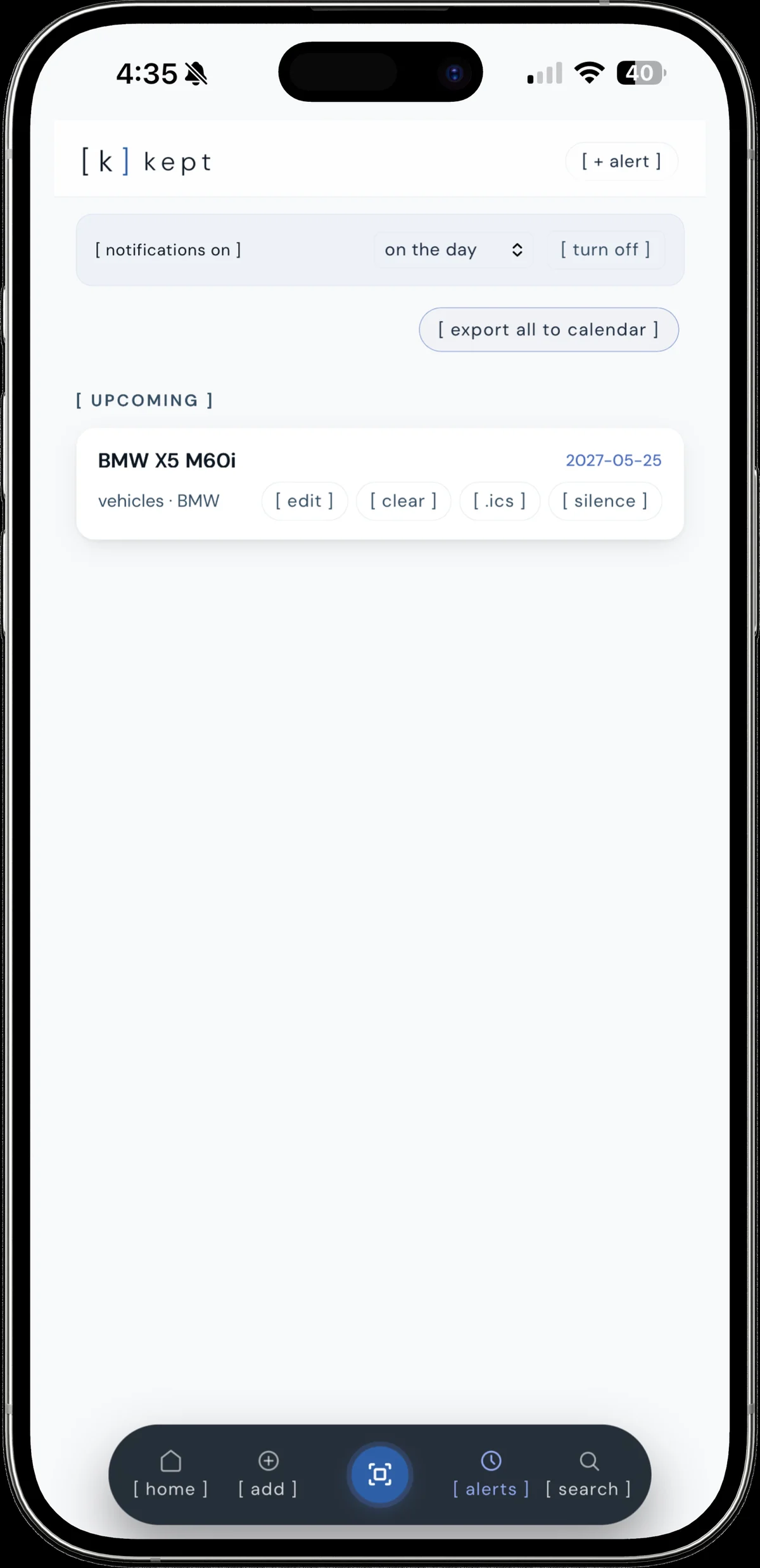
the monthly list only works if something reminds you. set it once and export to calendar.
Spring checklist
After the cold, before the heat
- Inspect the roof. Walk the perimeter and look for lifted or missing shingles, damaged flashing around chimneys and vents. Binoculars work fine — you don't need to climb up.
- Clean gutters. Winter debris accumulates. Clogged gutters route water into the foundation and fascia.
- Service the AC. Have an HVAC tech check refrigerant, coils, and electrical connections before the first hot day — not during it when every tech is booked.
- Check exterior caulking. Around windows, doors, and where siding meets trim. Cracked caulk lets water in. A $5 tube addresses it in 20 minutes.
- Inspect driveway and walkways. Freeze-thaw cycles crack concrete and asphalt. Seal small cracks before they expand.
- Test outdoor faucets and irrigation. Open the shutoff valves slowly and check for leaks from freeze damage.
- Check window screens. Repair or replace before bugs are an issue, not after.
Summer checklist
While things are accessible
- Clean the dryer vent. The most overlooked fire hazard in the house. Disconnect the dryer, clean the duct from both ends, and check the exterior vent flap opens and closes freely. Do this annually at minimum.
- Inspect attic ventilation. Check that soffit and ridge vents are clear. Poor attic ventilation bakes the roof deck and shortens shingle life.
- Check deck and fence for rot. Press a screwdriver into wood posts near the ground — soft spots mean rot. Address it now rather than a structural failure later.
- Service the lawn mower and outdoor equipment. Change the oil, replace the spark plug, sharpen the blade.
- Check basement humidity. Summer humidity spikes. If your basement is consistently above 60% relative humidity, run a dehumidifier. Sustained moisture breeds mold.
Fall checklist
Before the freeze
- Service the furnace. Schedule an HVAC tune-up in September or October — before heating season, when techs aren't slammed. They'll clean the heat exchanger, check the flue, and test the ignition.
- Clean gutters again. After leaves fall, not before. A second pass in late November catches the bulk of the debris.
- Shut off and drain outdoor faucets. Turn off the interior shutoff valve, then open the exterior faucet to drain remaining water. Skipping this causes burst pipes.
- Inspect weatherstripping. Around all exterior doors and the garage door. Daylight showing through the frame means cold air and higher heating bills.
- Check the fireplace and chimney. If you use it, have it inspected annually. Creosote buildup is a fire hazard. If you don't use it, make sure the damper closes fully.
- Reverse ceiling fans. Clockwise rotation on low speed in winter pushes warm air down from the ceiling. A small thing that actually helps.
- Replace smoke detector batteries. The twice-a-year clock change is the standard reminder. Do it regardless of whether the low-battery chirp has started.
Winter checklist
The watch list
- Know where your main water shutoff is. If a pipe bursts, seconds matter. Everyone in the house should know the location.
- Keep cabinet doors open during cold snaps. Pipes under exterior walls in kitchens and bathrooms are freeze-vulnerable. Open the cabinet doors to let warm air reach them.
- Check for ice dams. After heavy snowfall, ice buildup at the roof edge can back water under shingles. Remove snow from the lower 3–4 feet of the roof if you see ridging forming.
- Monitor the basement after a heavy rain or thaw. Spring thaw and winter rain are the two highest-risk periods for basement water intrusion.
- Check the water heater. Look for rust around the base or connections, and listen for unusual sounds. A failing water heater announces itself before it fails completely.
Annual tasks (pick a month and keep it)
These don't have a specific season — they just need to happen once a year. Assign each one to a specific month and put it in your calendar once.
- Flush the water heater — removes sediment that reduces efficiency and shortens tank life
- Test GFCI outlets — press the test/reset button on every bathroom, kitchen, and garage outlet
- Inspect the electrical panel — look for tripped breakers, corrosion, or burning smells
- Check attic insulation — compressed or missing insulation means higher energy bills
- Inspect foundation exterior — cracks wider than a quarter-inch should be evaluated by a structural engineer
- Service garage door — lubricate springs and rollers, test the auto-reverse safety feature
- Check plumbing supply valves — turn every shutoff valve (under sinks, behind toilets) slightly off and back on to prevent them from seizing
Shop: home maintenance essentials on Amazon
How to actually track all of this
The list is only useful if you record when things were done. "I think I changed the filter a few months ago" is not a maintenance record — it's a guess.
The simplest system that works: after every task, note the date and what you did. For anything involving a contractor, note their name and what was serviced. For anything involving a replaceable part — filter, detector battery, water heater anode rod — note the spec so you buy the right thing next time.
kept stores all of this alongside your appliance records. Your HVAC service history lives on the same card as your furnace model number and filter size. Your water heater service date is next to its serial number and age. Everything you need is in one place — not in a pile of receipts in a kitchen drawer.
kept stores every service date, provider, and cost so you never wonder when the last visit was.
[ try kept free ]frequently asked questions
What home maintenance should be done every year?
Annually: service the HVAC system, clean the dryer vent, inspect the roof and gutters, test smoke and CO detectors, flush the water heater, check caulking around tubs and windows, and inspect the attic for moisture or pest intrusion.
What is the most important home maintenance task?
Changing your HVAC filter regularly is the single highest-impact low-cost maintenance task. A clogged filter strains the system, raises energy bills, and shortens equipment life. After that: cleaning gutters to prevent water intrusion and testing smoke detectors.
How do I keep track of home maintenance?
The most reliable system is one you'll actually use. A simple list with dates in a notes app beats a complicated spreadsheet you abandon after two months. kept stores service dates alongside your appliance records, so your maintenance history lives with the equipment it describes.
How much should I budget for home maintenance each year?
The traditional rule is 1% of your home's value per year. On a $400,000 home, that's $4,000 annually. Older homes and homes with aging systems should budget higher. Consistent preventive maintenance reduces emergency costs significantly.
What home maintenance can I do myself vs. hire out?
DIY-friendly: changing filters, cleaning gutters, testing detectors, replacing weatherstripping, caulking, and basic landscaping. Hire out: HVAC servicing, electrical work, roof inspection and repair, plumbing beyond basic fixtures, and anything involving the main water or gas line.