Are Paint Codes Universal? Behr, Sherwin, Benjamin Moore Guide
The color name isn't enough. The code is what gets you the exact same color when you need to repaint.

table of contents
What a paint code actually is
The color name on a paint can, "Agreeable Gray," "White Dove," "Naval," is marketing. The paint code is the formula. It's the alphanumeric identifier that tells the mixing machine exactly how much of each pigment to add.
The distinction matters because color names can change, get discontinued, or get reformulated. The code is what you actually need to remix your exact wall color, even years later.
Think of it like a recipe. The name of the dish tells you what it is. The recipe tells you how to make it.
Are paint codes universal?
No, paint color codes are not universal. Every brand runs its own numbering system, so a code from one brand means nothing at another. Sherwin-Williams SW 7029 has no equivalent number at Benjamin Moore or Behr, because each brand uses different pigment bases and its own formula index. There is no master code that works across brands.
The codes do not translate. SW 7029 means Agreeable Gray at Sherwin-Williams and means nothing at Benjamin Moore. There is no master database that converts one brand's code to another's.
Three things follow from that:
- You need the brand AND the code. "7029" alone is not enough to remix a color.
- A different store can match the color but not the code. Home Depot can scan a chip of SW 7029 and mix a close Behr equivalent, but it gets a new Behr code in their system.
- Cross-brand "equivalents" you find online are approximations. The pigment bases differ, so the same wall can read slightly warmer or cooler between brands.
That's why writing down "gray, from Home Depot, 2023" doesn't save you. Record the brand, the full code, and the finish together, or plan on a spectrophotometer match later.
Where to find it on the can
On most paint cans, the code is on the lid, either printed by the manufacturer or added as a custom label sticker by the store when the color was mixed for you.
Look for a combination of letters and numbers. It may be labeled "Color Code," "Formula Number," or just printed alongside the color name with no label at all. On custom-mixed cans, the store often applies a sticker to the rim of the lid with the formula details.
If the lid sticker is missing or illegible, check the side of the can near the bottom. Some brands print the base coat information there, which can help the store reconstruct the formula.
Paint codes by brand
Each major paint brand formats their codes differently. Here's what to look for:
| Brand | Code format | Example | Where to find it |
|---|---|---|---|
| Sherwin-Williams | SW followed by 4 digits | SW 7029 | Lid label, or on the swatch card |
| Benjamin Moore | BM or HC followed by numbers, or just a number | HC-172 or 2163-40 | Lid label or swatch |
| Behr (Home Depot) | Letter + 3 digits + dash + 2 digits | N510-4 | Store sticker on lid |
| PPG (Lowe's) | PPG followed by numbers | PPG1025-3 | Store sticker on lid |
| Valspar | 4–6 digit number, sometimes with letter prefix | 4003-1B | Store sticker on lid |
If you're not sure what brand was used, look at the base of the can. The manufacturer name and logo are usually there even if the color label has worn off.
Decoding a specific brand's code
Each brand uses its own format. Sherwin-Williams codes start with "SW" and four digits (SW 7029 is Agreeable Gray); Benjamin Moore and Behr each run their own systems, and a code from one brand can't be mixed in another's paint. For the full label walkthrough, where each code hides on the can and how to decode it brand by brand, see our guide to reading Sherwin-Williams paint codes (plus Benjamin Moore and Behr). Benjamin Moore's letter prefixes are their own puzzle, so we broke down what OC, HC, AF, and the numbers mean on Benjamin Moore paint separately.
What to do when you don't have the can
This is the situation most people end up in. The can got thrown out, it dried up, or you moved into a house and have no idea what was used.
Check your records first
Before assuming the code is gone, look in these places:
- Email receipts from Home Depot, Lowe's, or the paint store. Many include the color code in the order confirmation
- Photos you took of the can lid (sometimes people do this without thinking about why)
- Old text messages to or from a contractor who painted the room
- The previous homeowner. If you bought the house recently, they may have the records
If the code is truly gone: the paint chip method
Cut a small piece of paint from a hidden area: behind an outlet cover, inside a closet, behind a door. Take it to any paint or hardware store with a spectrophotometer. They'll scan the chip and mix the closest match. This accounts for the wall's age and fade, which actually makes it more accurate than using an old formula on a faded wall anyway.
Shop: paint touch-up supplies on Amazon
Use a color-matching app as a starting point
Apps like Sherwin-Williams ColorSnap or Benjamin Moore Color Portfolio can scan your wall and suggest the closest match in their catalog. They're not precise, lighting throws them off, but they can give you a color name and code to start from, which you can verify with a physical chip.
How to save your paint codes so you always have them
The frustrating part about paint codes is that they're completely findable right now, while you're looking at the can, and completely unfindable three years later when you need them.
The solution is simple: the moment you finish a paint job, save the code. You want to capture:
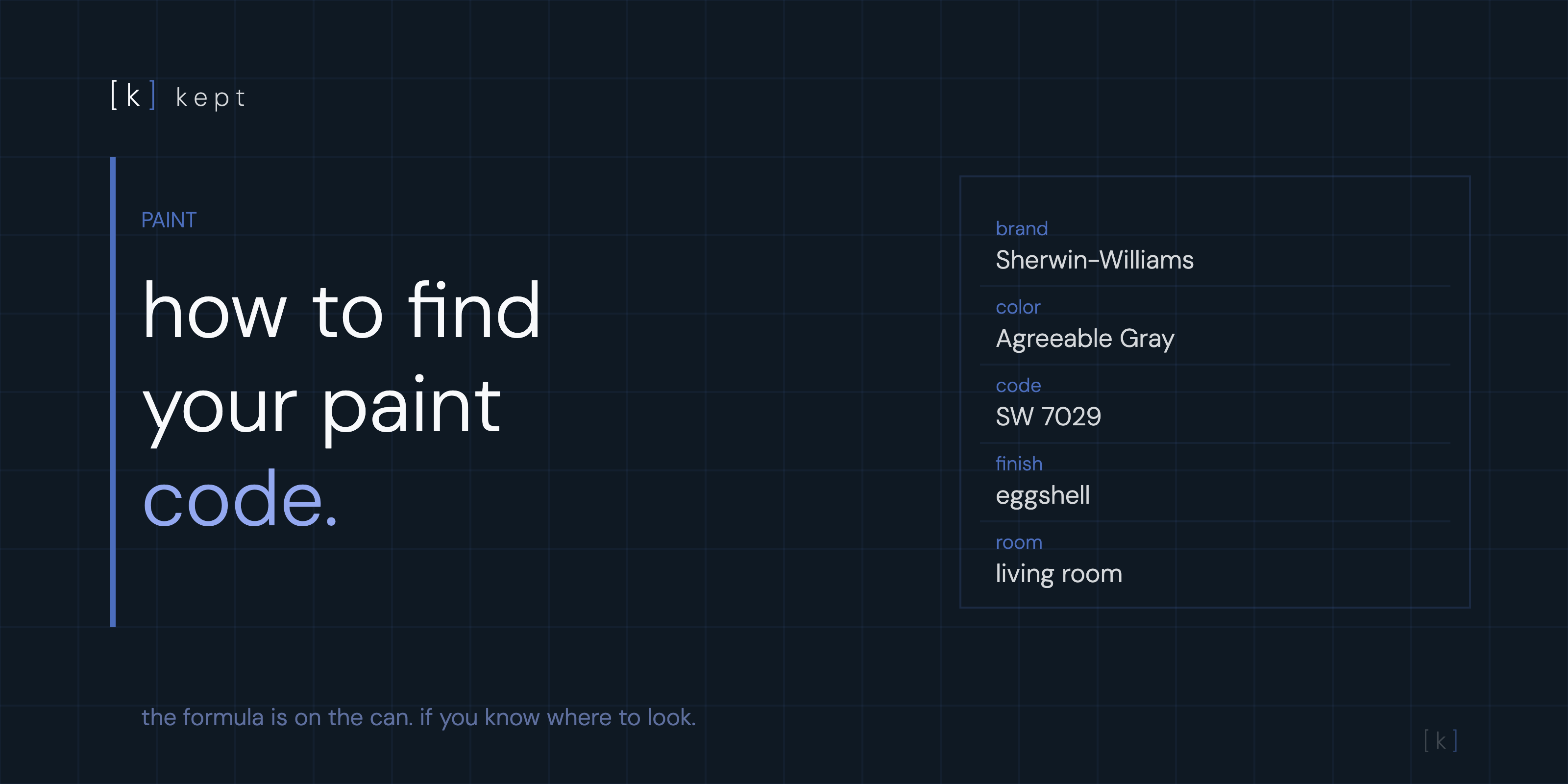
- Color name (e.g. Agreeable Gray)
- Paint code (e.g. SW 7029)
- Brand and finish (Sherwin-Williams, eggshell)
- Which room it's in
- Where you bought it
kept stores all of this for every room in your house. The next time you need to repaint, touch up a scuff, or tell a contractor what color was used, it's there in under 10 seconds.
kept saves paint codes by room so your next touch-up order starts with a search, not a scavenger hunt.
[ try kept free ]frequently asked questions
What is a paint code?
A paint code is the alphanumeric identifier that stores the exact formula for a specific color. For example, Sherwin-Williams Agreeable Gray is SW 7029. Any store that carries that brand can use the code to remix the exact same color.
Where is the paint code on a can?
On most paint cans, the code is on the label on the lid, printed either by the manufacturer or added by the store as a custom sticker when the color was mixed. Look for a combination of letters and numbers. On Sherwin-Williams it starts with SW, Benjamin Moore with BM or HC, Behr with a letter-number combo like N510-4.
Can I find my paint code without the can?
Sometimes. Check old email receipts from the paint store, photos you took of the can, or your contractor's records. If you can't find the code, the next best option is a physical paint chip taken to a store with a spectrophotometer for color matching.
Can you look up a paint color from a photo?
Roughly. Apps like Sherwin-Williams ColorSnap or Benjamin Moore Color Portfolio scan a photo of your wall and suggest the closest match in their catalog, but lighting and your phone's camera throw off the exact shade. Treat a photo match as a starting point, then verify it with a physical paint chip at the store before you commit to a full repaint.
Are paint codes universal between brands?
No. Paint codes are brand-specific formulas. A Sherwin-Williams SW code only works at Sherwin-Williams stores. A Benjamin Moore HC number only works at Benjamin Moore. You can ask any paint store to color-match a chip from another brand, but they'll remix it under their own formula system, not the original code.
What's the difference between a paint code and a color name?
The color name (like Agreeable Gray or White Dove) is the marketing label. The paint code is the formula identifier. You need the code, not just the name, to remix the exact color, because brands occasionally update formulas under the same name.