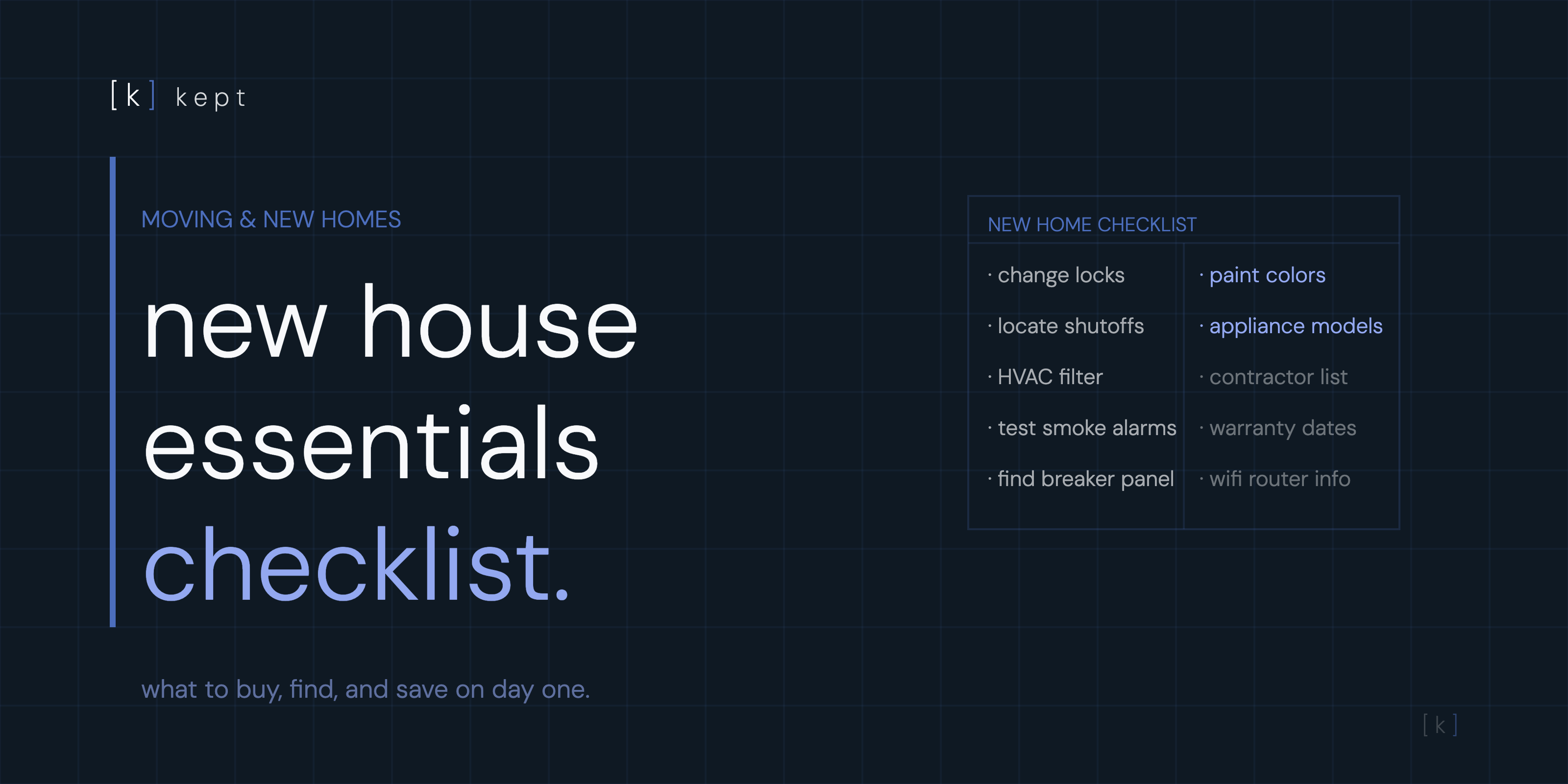
New House Essentials Checklist: Everything You Actually Need
Moving into a new house means two things: stuff to buy, and stuff to find out. Most checklists only cover the first one. This covers both.

Everyone tells you to buy a shower curtain and a toilet plunger. That's fine advice. But three months after you move in, when you're standing in Home Depot staring at a wall of furnace filters with no idea what size your furnace takes — that's the thing nobody warned you about. Still under contract? Read what to look for when buying a house before closing so you know what to ask the seller.
This checklist has two parts: what to buy, and what information to gather. The second part is the one that will actually save you time and money.
Part 1: Things to buy
Roughly in order of urgency. The first 24 hours are different from the first week.
Day one — before you sleep there
- ☐ New locks or rekeying — you don't know who has a key to the old locks
- ☐ Toilet paper — embarrassingly important
- ☐ Shower curtain and rings — if the bathroom has a tub
- ☐ Soap and hand towels
- ☐ Basic cleaning supplies — you'll want to clean before unpacking
- ☐ Paper towels and trash bags
- ☐ Shower curtain liner — separate from the curtain itself
- ☐ Toilet brush and plunger
- ☐ Dish soap and a sponge
kept is reader-supported. When you buy through links on this page we may earn a small commission, at no extra cost to you. It never changes what we recommend.
First week — safety and function
- ☐ Smoke detectors — test existing ones, replace batteries, add if missing
- ☐ Carbon monoxide detector — essential if you have gas appliances or an attached garage
- ☐ Fire extinguisher — one per floor, minimum one in the kitchen
- ☐ First aid kit
- ☐ Flashlight and extra batteries
- ☐ Basic toolkit — hammer, screwdrivers (flathead and Phillips), tape measure, level, pliers, utility knife
- ☐ Drill and drill bits — you'll hang something within a week
- ☐ Stud finder
- ☐ Step stool or ladder
- ☐ Surge protectors
- ☐ Extension cords
First month — household operations
- ☐ Furnace filters — once you know the size (see Part 2)
- ☐ Vacuum cleaner
- ☐ Mop and bucket
- ☐ Broom and dustpan
- ☐ Laundry detergent
- ☐ Light bulbs — get a variety pack, you'll use them
- ☐ Batteries — AA, AAA, 9V
- ☐ Drain covers — showers, tubs
- ☐ Door stoppers
- ☐ Command strips and picture hooks
- ☐ WD-40 and super glue — you'll thank yourself later
- ☐ Duct tape
- ☐ Weatherstripping — check doors and windows
Kitchen
- ☐ Can opener
- ☐ Cutting boards — separate ones for meat and produce
- ☐ Knife set
- ☐ Mixing bowls
- ☐ Measuring cups and spoons
- ☐ Pot and pan set
- ☐ Baking sheet
- ☐ Colander
- ☐ Dish rack or dishwasher-safe containers
- ☐ Oven mitts
- ☐ Refrigerator water filter — if your fridge has one, replace it on move-in
Outdoor (if applicable)
- ☐ Garden hose
- ☐ Hose nozzle
- ☐ Snow shovel — if relevant
- ☐ Ice melt / rock salt
- ☐ Lawn mower
- ☐ Rake
- ☐ Outdoor trash cans
- ☐ Doormat
Part 2: Information to gather
This is the part most new homeowners skip. It doesn't feel urgent. Then six months later you need it and it's nowhere.
The best time to gather this information is in the first week, when you're already poking around every corner of the house. It takes about an hour total. Do it once and you have it forever. A home inventory app like kept lets you scan barcodes and store filter sizes, paint codes, and warranty dates in one searchable place.
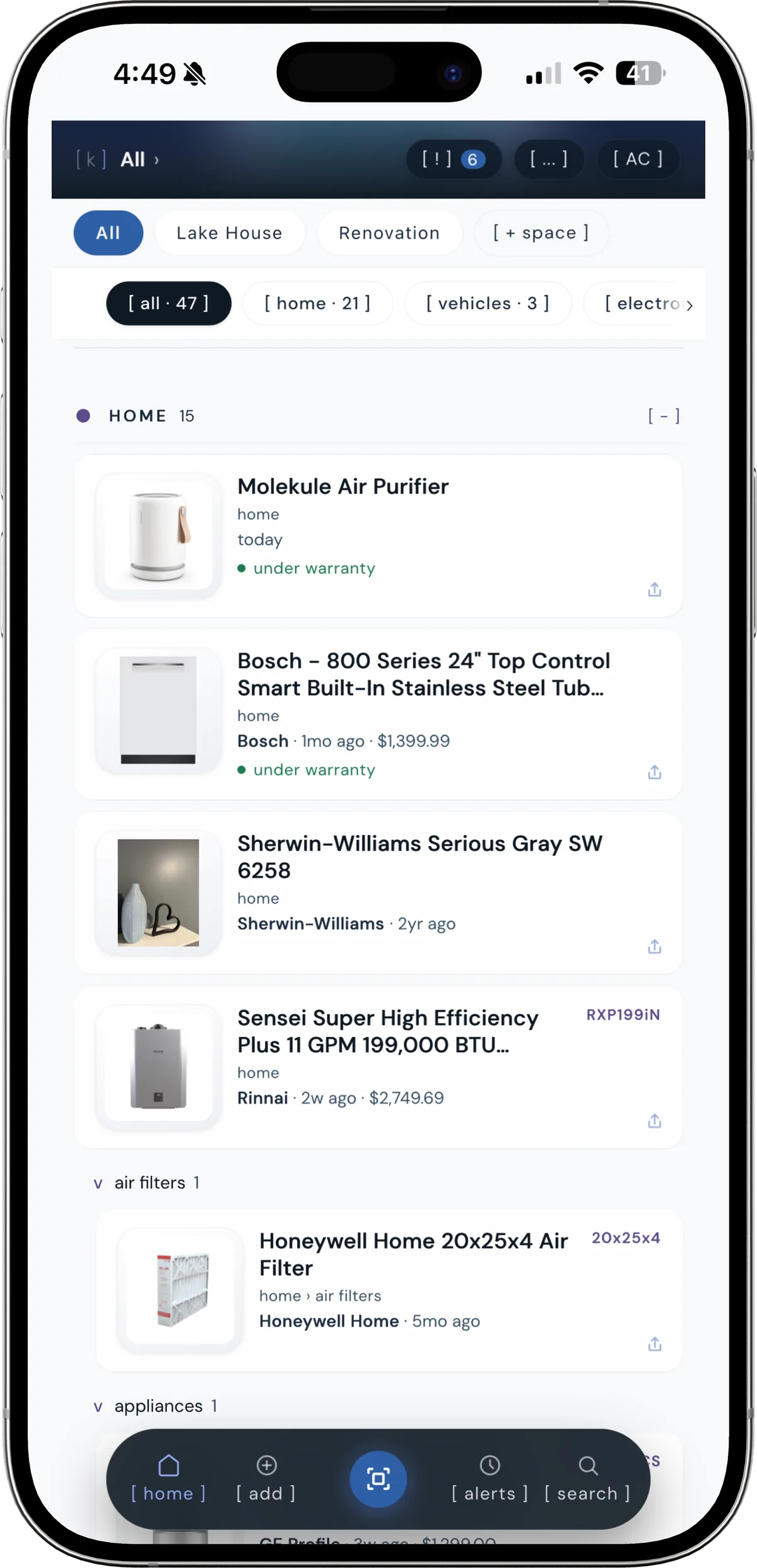
an hour of walking the house, turned into a searchable list you'll actually use again.
HVAC and home systems
- ☐ Furnace filter size — pull out the existing filter and read the size off the frame (e.g. 16x25x1). Full guide here.
- ☐ AC filter sizes — if you have central air, note the nominal size on the return filter. See our air conditioner filter sizes chart.
- ☐ Furnace model and serial number — on the data plate inside the furnace cabinet
- ☐ AC unit model number — on the exterior unit, usually on a label on the side
- ☐ Water heater model, serial number, and age — on the label on the tank
- ☐ Water heater type — gas or electric, tank or tankless
- ☐ Main water shut-off location — find it before you need it. Usually in the basement, utility room, or outside near the foundation.
- ☐ Electrical panel location and amp rating — usually in the basement, garage, or utility room. Note the total amps (100A, 200A).
- ☐ Breaker map — if the panel doesn't have one labeled, spend 20 minutes making one
- ☐ Gas shut-off location — if you have gas appliances
- ☐ Last HVAC service date — ask the previous owner or check any paperwork
Appliances
- ☐ Refrigerator model number — inside the fridge, on the walls or ceiling
- ☐ Dishwasher model number — inside the door frame
- ☐ Washer model number — inside the door frame or on the tub
- ☐ Dryer model number — inside the door frame or on the drum
- ☐ Oven/range model number — inside the door frame or bottom storage drawer
- ☐ Warranty status on all appliances — ask the previous owner for receipts or check manufacture dates on labels
- ☐ Refrigerator water filter type — if applicable, note the filter model number
For exactly where to find model numbers on each appliance, see this guide.
Paint and finishes
- ☐ Paint color for each room — ask the previous owner. If they don't know, check if there are leftover paint cans in the garage or basement with the color on the lid.
- ☐ Exterior paint color — brand, name, and color code if possible
- ☐ Trim color
- ☐ Deck or fence stain color and product — if applicable
If you can't find out, don't panic — there's a way to identify it. Here's how.
Contractors and service history
- ☐ HVAC technician the previous owner used — they'll already know your system
- ☐ Plumber they used
- ☐ Electrician
- ☐ Roofer — especially if the roof is newer
- ☐ Any recent repairs or renovations — permits, contractors, dates
- ☐ HOA contact — if applicable
- ☐ Pest control history
See how to organize contractor contacts so you never lose them.
Utilities and accounts
- ☐ Electric provider and account number
- ☐ Gas provider and account number
- ☐ Water provider and account number
- ☐ Internet provider setup
- ☐ Trash and recycling pickup days
- ☐ Mail forwarding from previous address
The single most important thing to do in the first week: Find the main water shut-off and make sure everyone in the household knows where it is and how to use it. A burst pipe gives you about 10 minutes before serious damage starts. You don't want to be searching for a valve.
Part 3: Things to set up
Safety and emergency prep
- ☐ Test every smoke and CO detector
- ☐ Create an emergency exit plan — especially important with kids
- ☐ Save local emergency numbers — non-emergency police line, nearest hospital, poison control
- ☐ Note nearest urgent care and ER
- ☐ Save your utility company emergency lines — for gas leaks and outages
Address updates
- ☐ USPS mail forwarding
- ☐ Driver's license and vehicle registration
- ☐ Voter registration
- ☐ Bank and credit card accounts
- ☐ Insurance policies (health, auto, life)
- ☐ Employer records
- ☐ Amazon, subscriptions, online shopping accounts
Maintenance schedule to set up immediately
- ☐ Furnace filter reminder — set a calendar reminder every 90 days
- ☐ HVAC annual service — schedule it now for next fall or spring
- ☐ Gutter cleaning — twice a year, spring and fall
- ☐ Smoke detector battery replacement — annually
- ☐ Water heater flush — annually if you have hard water
- ☐ Dryer vent cleaning — annually
The information problem
Here's the thing about moving into a new house: you get one window to gather the information that will take you hours to find later. The previous owner knows where everything is. The appliances are fresh in your mind. You're already opening every cabinet and crawling into every corner.
Most people close that window without taking notes. Then two years later they're squinting at a sticker in the back of a dark utility closet trying to read a furnace model number they should have saved on day three.
Save it now. All of it. Model numbers, filter sizes, paint colors, contractor names, shut-off locations. It takes one afternoon and it pays back every single time something goes wrong — which, in a house, it always eventually does. The complete home information checklist has every category worth documenting.
kept stores filter sizes, paint codes, and model numbers so you stop looking them up every time something breaks.
[ try kept free ]FAQ
What do I need to buy first when moving into a new house?
Prioritize in this order: change or rekey your locks (you don't know who has copies), stock the bathroom (toilet paper, shower curtain, soap), get your kitchen functional (dish soap, sponge, basic cookware), then handle safety (smoke detectors, fire extinguisher, CO detector). Everything else is second week stuff.
What information should I try to get from the previous owner?
The most valuable things they can tell you: paint colors for each room (brand and color name), which contractors they trusted (especially HVAC and plumber), recent repairs and when they happened, and whether any appliances are still under warranty. Most sellers are happy to share this — just ask.
I already moved in and didn't gather this info. Now what?
Start with what's still findable. Pull the furnace filter out right now — the size is printed on the frame. Open every appliance door and look for model number stickers. Check the garage and basement for leftover paint cans. Call your real estate agent — they sometimes have documentation from the seller's disclosures. It's slower than doing it on move-in day, but you can still get most of it.
Do I need a home warranty?
That's a personal finance question more than a home essentials question. If the major systems (HVAC, water heater, appliances) are older, a home warranty might make sense. If they're relatively new with manufacturer warranties still active, you might not need one. Either way, know your appliance warranty status before you decide.
What's the most overlooked thing on a new house checklist?
The information checklist. Everyone remembers to buy a plunger. Almost nobody spends the first week systematically gathering model numbers, paint colors, shut-off locations, and contractor contacts. That information is 10x easier to find on move-in week than any time after that.