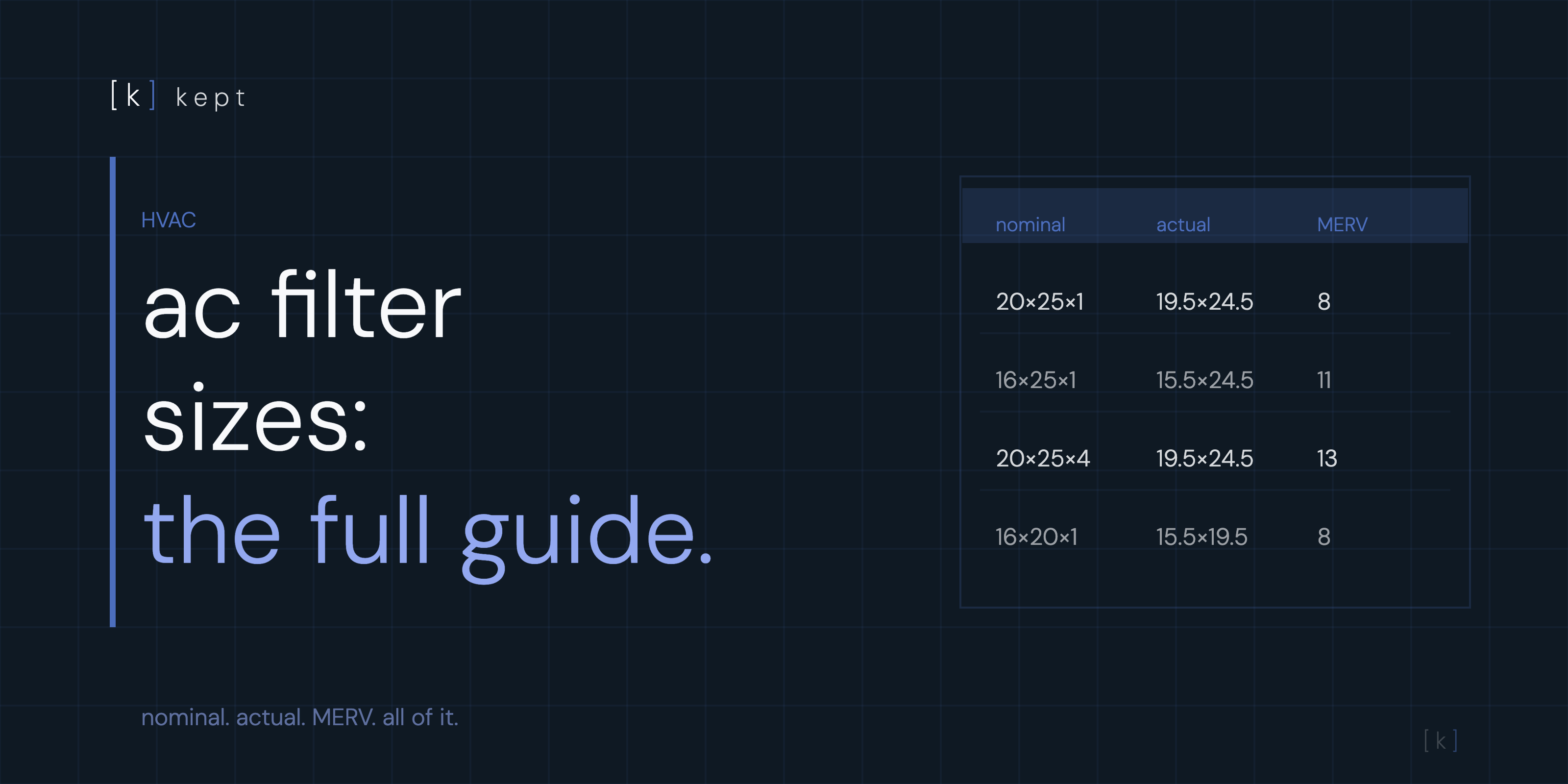
AC Filter Sizes Chart: Free Size Finder + Every Standard Size
Measure once, get the exact size to buy. Then the full chart, sizes by HVAC brand, and the MERV rating that actually suits your house.

find your filter size
Measure what you have, or start from your system brand. You'll get the nominal size to buy, the MERV rating that suits your house, and the date your next change is due.
table of contents
- Filter size finder — measure it, get your size
- Nominal vs. actual size — what the numbers mean
- How to find your filter size
- Complete list of common AC filter sizes
- AC filter sizes by HVAC brand
- Filter thickness — 1-inch vs 4-inch
- MERV ratings: which one to choose
- How often to change your AC filter
- Never buy the wrong filter twice
- FAQ
AC filter sizing is confusing because the number on the box isn't the actual size of the filter. It's also confusing because MERV ratings, filter thickness, and dozens of size combinations make the filter aisle at the hardware store feel like a decision tree with no right answer.
This guide covers all of it — what the sizes mean, which ones are most common, how to pick the right MERV rating, and how to make sure you never stand in that aisle guessing again.
Nominal vs. actual size — what the numbers mean
Every filter size is listed as a nominal size — a rounded number that doesn't reflect the filter's true physical dimensions. A filter labeled 20x25x1 is actually about 19.5 x 24.5 x 0.75 inches. The undersizing is intentional — it lets the filter slide in and out of the slot without snagging.
When shopping: always use the nominal size (what's on the box). Never try to cut a filter to fit — gaps around the edges defeat the entire purpose. If the size you need isn't on the shelf, try a filter supply site where custom sizes are often available.
How to find your filter size
Three methods, in order of reliability:
- Read the existing filter. Pull it out. The nominal size is printed on the cardboard frame. This takes 30 seconds and is 100% accurate.
- Measure the slot. If the filter is missing, use a tape measure: measure the length, width, and depth of the slot opening in inches. Round each dimension up to the nearest standard inch to get the nominal size.
- Check the manual or unit sticker. Your HVAC manual lists the recommended filter size. There's also usually a sticker inside the air handler access panel or on the furnace itself.
Complete list of common AC filter sizes
These are the most widely used residential HVAC filter sizes. The actual dimensions listed are approximate — slight variations exist between manufacturers.
| Nominal size | Actual size (approx) | Common application |
|---|---|---|
| 10 x 20 x 1 | 9.5 x 19.5 x 0.75 | Smaller systems, apartment HVAC |
| 14 x 20 x 1 | 13.5 x 19.5 x 0.75 | Smaller residential systems |
| 14 x 25 x 1 | 13.5 x 24.5 x 0.75 | Smaller residential systems |
| 16 x 20 x 1 | 15.5 x 19.5 x 0.75 | Common residential |
| 16 x 25 x 1 | 15.5 x 24.5 x 0.75 | Common residential |
| 16 x 25 x 4 | 15.5 x 24.5 x 3.75 | High-capacity media filter |
| 20 x 20 x 1 | 19.5 x 19.5 x 0.75 | Common residential |
| 20 x 25 x 1 | 19.5 x 24.5 x 0.75 | Most common residential size |
| 20 x 25 x 4 | 19.5 x 24.5 x 3.75 | High-capacity media filter |
| 20 x 30 x 1 | 19.5 x 29.5 x 0.75 | Larger residential systems |
| 25 x 25 x 1 | 24.5 x 24.5 x 0.75 | Square return vents |
| 16 x 20 x 4 | 15.5 x 19.5 x 3.75 | High-capacity media filter |
Shop: HVAC filters on Amazon — filter by your size and MERV rating to find the right one
AC filter sizes by HVAC brand
HVAC brands don't make filters — they make systems sized to take standard filters. So "Trane filter size" really means "what size filter does my Trane system take?" The answer is almost always one of the same dozen standard sizes above. These are the most common starting points by brand, but always verify by reading the existing filter or measuring the slot.
| HVAC brand | Most common filter sizes | Filter location |
|---|---|---|
| Trane | 16x25x1, 20x25x1, 16x25x4 (XC95m media cabinet) | Return grille or media cabinet at air handler |
| Carrier / Bryant | 16x25x1, 20x25x1, 16x20x1, 20x25x4 (Infinity media cabinet) | Return grille or air handler door |
| Lennox | 16x25x1, 20x25x1, 16x25x5 (Healthy Climate media) | Return grille or PureAir cabinet |
| Goodman / Amana | 16x25x1, 20x25x1, 14x25x1 | Return grille — Goodman systems rarely have media cabinets |
| Rheem / Ruud | 16x25x1, 20x25x1, 16x20x1 | Return grille or air handler |
| American Standard | 16x25x1, 20x25x1, 16x25x4 (AccuClean media cabinet) | Return grille or media cabinet |
| York / Coleman | 16x25x1, 20x25x1, 16x20x1 | Return grille |
None of these are guaranteed — a 4-ton Carrier system in a small house uses different filters than a 2-ton Carrier in a condo. Use brand as a starting point, then verify with the existing filter, the slot measurement, or the data plate inside the air handler door.
Filter thickness — 1-inch vs 4-inch
Most residential HVAC systems are designed for 1-inch filters. Some newer or upgraded systems have a dedicated media cabinet that accepts 4-inch or 5-inch filters. The thicker filters last longer (6–12 months vs. 1–3 months) and generally filter better because they have more media surface area.
Do not force a 4-inch filter into a slot designed for 1-inch. The increased restriction on airflow can cause the heat exchanger to overheat, increase energy bills, and shorten the life of your system. If you want to upgrade to a thicker filter, have an HVAC technician install the appropriate media cabinet first.
MERV ratings: which one to choose
MERV stands for Minimum Efficiency Reporting Value. It's a scale from 1 to 20 that measures how effectively a filter captures particles of different sizes. Higher = better filtration, but also more airflow resistance.
| MERV rating | What it catches | Best for |
|---|---|---|
| MERV 1–4 | Large dust, pollen, carpet fibers | Window AC units only |
| MERV 8 | Dust, pollen, mold spores, pet dander | Most homes — standard recommendation |
| MERV 11 | All of above + fine dust, smoke particles | Pets, mild allergies |
| MERV 13 | All of above + bacteria, virus carriers | Severe allergies, compatible newer systems only |
| MERV 16+ | Near-HEPA filtration | Commercial/hospital — not for residential use |
For most homes: MERV 8. If you have pets or allergy sufferers: MERV 11. Check your system manual before going to MERV 13 — older systems can't handle the airflow restriction and will work harder, run longer, and cost more to operate.
How often to change your AC filter
The standard rule: every 1–3 months for 1-inch filters, every 6–12 months for 4-inch media filters. But those are ranges — the right answer depends on your specific situation:
- Every month: You have multiple pets, someone with severe allergies, or run the system almost continuously
- Every 2 months: One pet, average use, average dust levels
- Every 3 months: No pets, no allergies, moderate use — the standard suburban house
- Every 6–12 months: 4-inch media filters, low-use vacation homes
A dirty filter doesn't just reduce air quality — it makes your system work harder. Energy bills go up, the system runs longer cycles, and components wear faster. Changing the filter on schedule is the single cheapest thing you can do for HVAC longevity.
Never buy the wrong filter twice
The filter size problem is a solved problem — if you write it down once. Every time someone buys the wrong filter, it's because they didn't record it the last time they changed it.
After your next filter change, add it to kept: size, MERV rating, brand preference, and the date you changed it. The next time you need one, you'll know exactly what to order before you leave the house — and you'll have a record of when it was last changed.
kept stores your filter dimensions by unit so reordering takes seconds, not a stepladder.
[ try kept free ]frequently asked questions
What size AC filter do I need?
Check your current filter — the nominal size is printed on the cardboard frame (e.g. 20x25x1). If you don't have the old filter, measure the slot opening in inches. The most common residential sizes are 16x20x1, 20x20x1, 16x25x1, and 20x25x1.
What is the difference between nominal and actual filter size?
Nominal size is the rounded number printed on the filter box (e.g. 20x25x1). Actual size is the true physical dimension, which is typically 0.5 inch smaller in each direction. Always buy by nominal size to match your slot.
How do I know if my AC filter is the right size?
The filter should slide into the slot without bending or forcing, and it shouldn't have gaps around the edges. The arrow on the filter frame should point toward the blower, not away from it.
What MERV rating should I use for my home?
MERV 8 is the standard recommendation for most homes. Use MERV 11 if you have pets or allergy sufferers. MERV 13 provides excellent filtration but can strain older HVAC systems — check your manual before going above MERV 11.
Can I use a thicker filter for better air quality?
Only if your system is designed for it. Standard systems use 1-inch filters. Never force a 4-inch filter into a 1-inch slot — it will restrict airflow and damage your system.